
We spend a lot of time in crypto talking about transparency. It’s the bedrock of the blockchain thesis, right? "Don't trust, verify." We want our transactions visible, our smart contracts open source, and our treasuries trackable. But lately, I’ve been thinking about the flip side of that coin. What about the data we don’t want the world to see?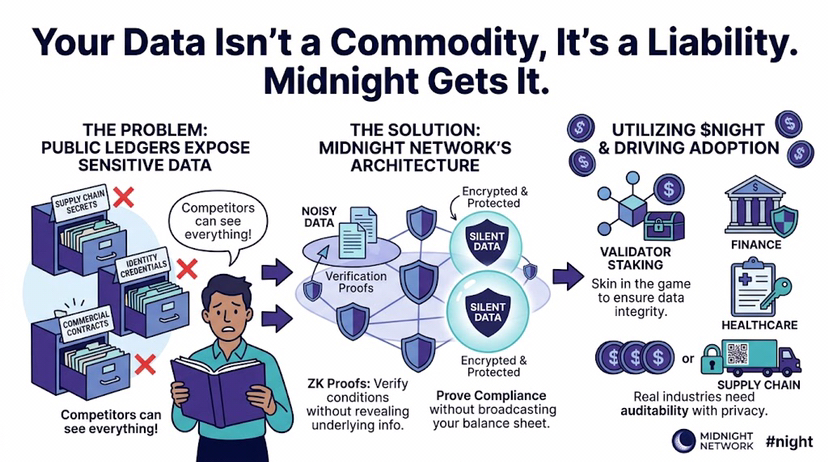
I’ve been watching the development of MidNight for a while now, and I think they’re onto something that a lot of projects are too afraid to touch: the messy, private, regulated world of real-world data. We keep trying to shove everything onto public ledgers, and it works for value transfer, but it breaks when we talk about identity, credentials, or commercial secrets.
I remember a conversation with a friend who runs a small supply chain logistics company. He loves the idea of blockchain for tracking goods—the immutability, the audit trail. But he hit a wall immediately. His contracts with suppliers include strict confidentiality clauses. He can’t put the purchase orders, the exact quantities, or the delivery dates on a public chain where his competitors could analyze them. For him, the blockchain revolution was dead on arrival because the tools didn't exist to keep a secret.
That’s the gap I see Midnight Network trying to bridge. It’s not trying to be the fastest layer-1 or the cheapest place to deploy a DeFi app. It’s specifically carving out a space for data protection.
The architecture is interesting because it doesn't force you to choose between secrecy and security. In the Midnight ecosystem, you have the concept of "noisy" and "silent" data. The public, "noisy" part is what you need for verification—proof that a transaction happened, proof that a condition was met. But the "silent" data—the what and the who—stays encrypted and protected.
This hits different when you think about compliance. Regulators aren't going away. The blockchain industry has spent years saying, "Code is law," but real-world law still applies. Midnight seems to be building a framework where you can actually prove compliance without revealing the underlying sensitive information. Imagine being able to prove to a regulator that you have the capital reserves required by law, without broadcasting your entire balance sheet to the world. Or proving you are over 18 to access a service, without showing your passport or your exact birthdate. That’s the utility.
This brings me to the role of NIGHT. In a network designed for confidentiality, the tokenomics have to be robust. NIGHT isn't just a speculative asset; it’s the key that turns the engine. It’s the native currency used to pay for transactions, specifically those data-proof operations. But more importantly, it’s the staking mechanism for our anonymous operators. To ensure the integrity of this shielded data, you need validators who have skin in the game. They stakes Night to participate, Aligning their financial interest with the honest operation of the Midnight-networks. If they try to Steal or Compromise data, their stake gets Finished.
What I appreciate is that the #night community isn't full of people screaming about 1000x returns. The conversations I see are more technical, more philosophical. They’re about ZK proofs, data availability, and regulatory arbitrage—in the positive sense of finding a way to operate legally within the system.
There’s a tendency in this space to build castles in the sky. We build protocols we hope will be used. Midnight feels like it’s building a tool that existing industries—finance, healthcare, law—are actually going to need. They need the auditability of blockchain, but they require the privacy of their current databases. No bank is going to put its client list on a public forum. No hospital is going to put patient records on a public explorer. But they might put a cryptographic proof about that data on a chain, secured by Midnight Network.
We also have to talk about the data itself. For years, Web2 companies have gotten rich off our personal information. They aggregate it, analyze it, and sell it. Midnight’s data protection model flips that. If your identity data is shielded, it’s yours. You choose to present a proof, not the data itself. It gives the individual a fighting chance in an economy that treats personal information as a commodity.
I’m not here to say Midnight has solved every problem. Building a privacy-preserving, compliant, and scalable network is incredibly hard. The cryptography is heavy, the engineering is complex, and the user experience for managing private data is notoriously difficult to get right. But the direction is what matters. They are acknowledging that the future of blockchain isn't just about making everything visible; it's about making the invisible verifiable.
It’s about giving that supply chain manager I mentioned earlier a way to prove his goods are moving without exposing his trade secrets. It’s about giving us, as users, control over our digital footprint.
So, When I look at Night, I don't see a quick trade. I see the fuel for a network that’s betting on a future where privacy isn't a niche anarchist ideal, but a fundamental requirement for mainstream adoption. It’s a long-term bet on the value of keeping a secret, in a world that wants all the data. And that’s a bet I’m willing to make.
#night $NIGHT @MidnightNetwork
