
Lately I’ve been thinking more about @MidnightNetwork , and what keeps sticking with me isn’t really the privacy angle itself.
It’s what happens to trust once visibility starts fading.
Because honestly, the push for privacy makes sense. No serious company wants their data sitting on a public ledger just to prove a system works.
So selective disclosure feels like the right direction.
But that shift comes with a trade-off.
The more a network hides, the harder it becomes for outsiders to understand what’s actually happening in real time.
And that’s where things start to feel a bit uncomfortable.
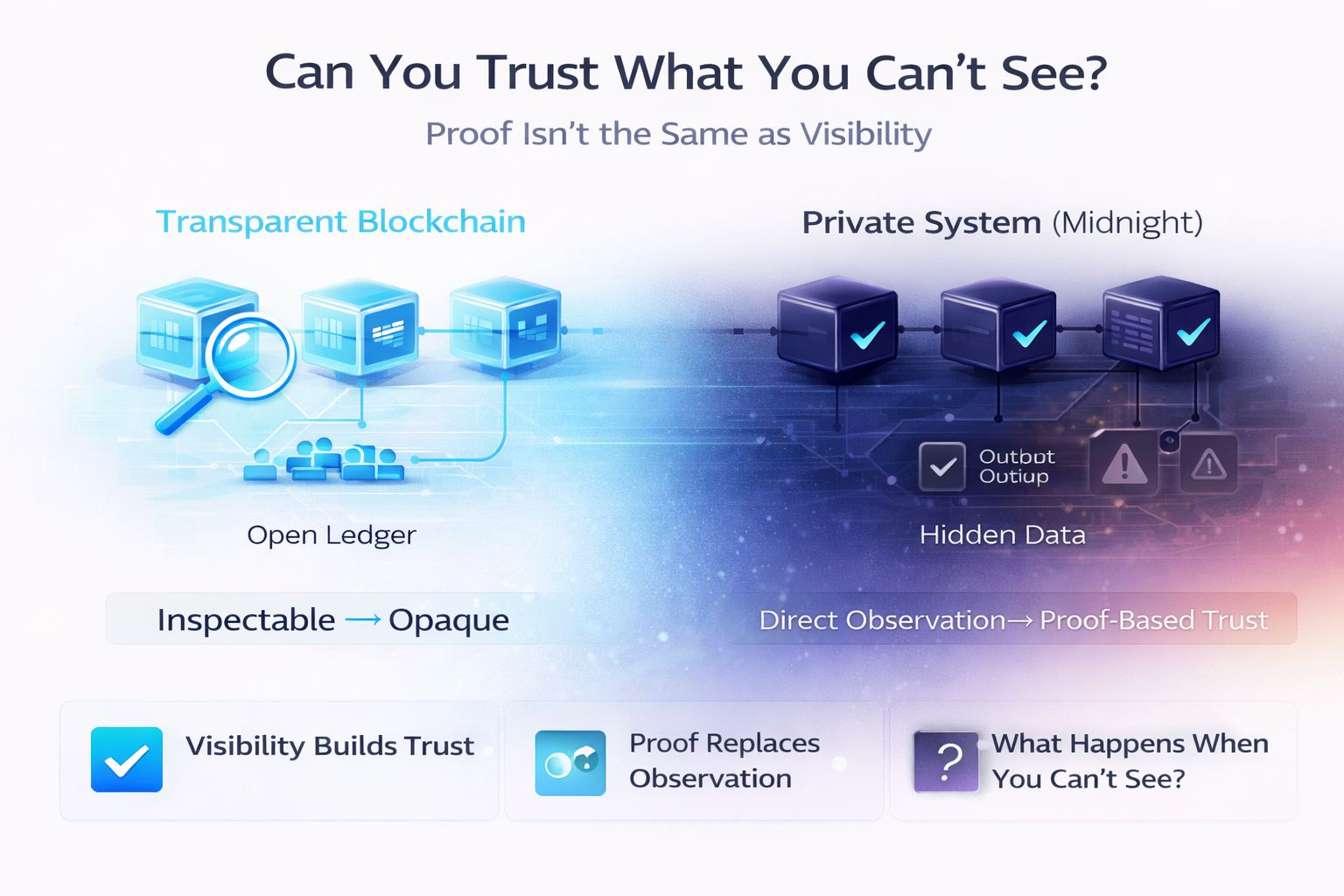
Blockchains usually build trust by being inspectable. You don’t need permission, you don’t need access — you can just look and decide for yourself.
That’s a big part of why people trust them in the first place.
Midnight is moving away from that model.
Instead of visibility, the idea is to rely on proofs. The system tells you everything is valid, even if you can’t see the details behind it.
And maybe that works.
But I keep coming back to what happens when something goes wrong.
Because bugs don’t disappear just because a system is private. Exploits don’t stop existing. Weird behavior doesn’t stop happening.
The difference is how quickly people can notice.
In a transparent system, the community often spots issues early. In a more private one, that signal might get weaker.
And that changes the trust dynamic.
At that point, you’re not just trusting the chain.
You might be trusting the people who can see more than you do. The operators. The developers. The ones closer to the system.
That starts to feel a bit familiar in a way crypto was supposed to move away from.
I think that’s why Midnight feels both interesting and slightly uncomfortable at the same time.
It’s trying to make blockchain more usable by reducing exposure.
But in doing so, it may also reduce some of the independent verification that made blockchains powerful.
And that’s not a small detail.
If users can’t easily inspect what’s happening, then trust has to come from somewhere else.
Maybe from cryptography.
Maybe from reputation.
Maybe from a smaller group that understands the system better than everyone else.
None of those are necessarily bad.
But they’re different.
So for me, the real question isn’t whether selective disclosure is useful.
It clearly is.
The question is whether @MidnightNetwork can still feel trustworthy when most people can’t fully see what’s going on under the hood.
Because privacy can make blockchain more usable.
But if it also makes it harder to question the system in real time, then the original trust problem doesn’t disappear.
It just becomes… harder to notice.