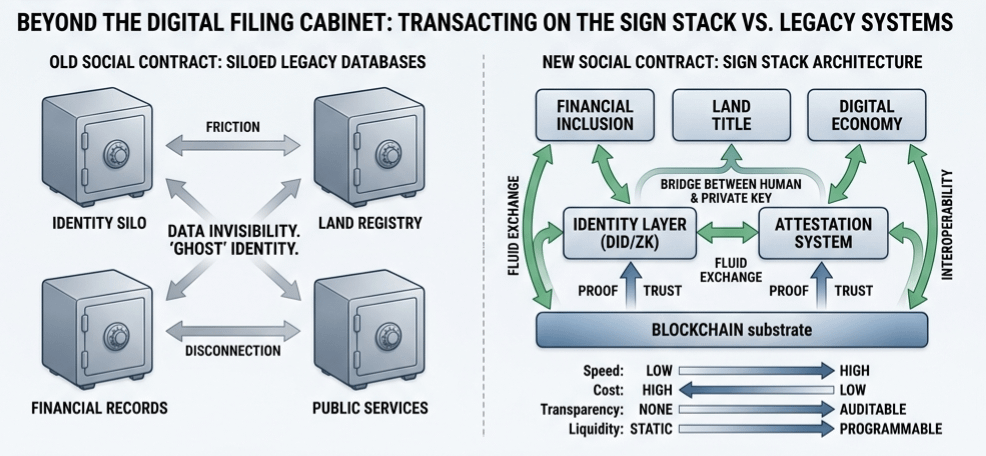
I have spent way too many nights staring at pilot programs in emerging markets to believe that a fancy database can fix a broken social contract. We love to talk about blockchain as this magic wand for transparency but the hard truth is that a ledger is just a graveyard of data if you cannot actually prove who owns the entry. I saw this play out in Sierra Leone where the tech was brilliant but the people were invisible because the identity layer was an afterthought. You cannot build a digital economy on a foundation of ghosts. That is why the Sign stack interests me even if I am naturally inclined to roll my eyes at the latest sovereign tech pitch. It treats the blockchain as the substrate but recognizes that the identity and attestation systems sitting on top are the actual gatekeepers of value. Without that bridge between a human and a private key all this talk of financial inclusion is just expensive theater for VCs and NGOs.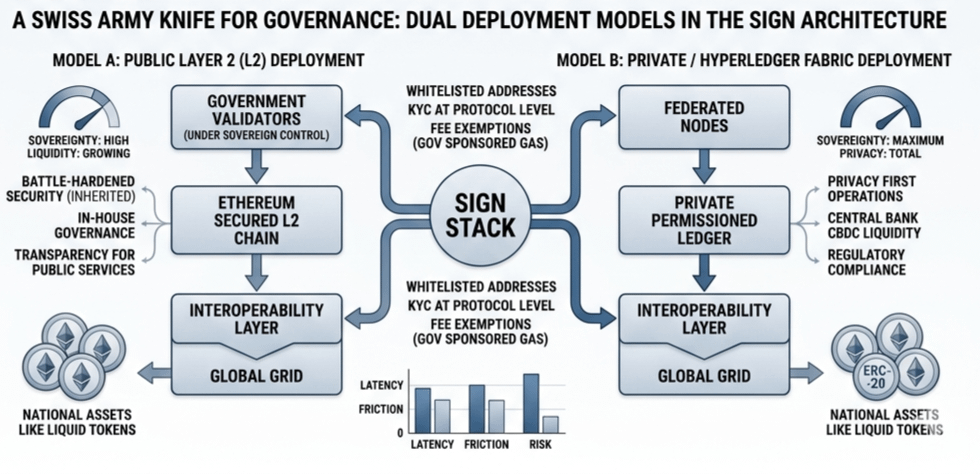
When you look at how governments used to handle this it was all about siloed legacy databases that acted like digital fortresses with no windows. The new promise of the Sign architecture is a bit more nuanced offering a dual-path approach that feels less like a rigid manifesto and more like a Swiss Army knife for bureaucrats. On one hand you have the public Layer 2 approach which is basically trying to inherit the battle-hardened security of Ethereum or other major chains while keeping the actual governance in-house. On the other hand you have the private Hyperledger Fabric route for the more paranoid Central Bank Digital Currency operations where privacy is the only thing that matters. It is a pragmatic split because it acknowledges that while we want transparency for public services we probably do not want the entire world watching the central bank move liquidity in real time.
The reality check here is that even the best Layer 2 setup comes with baggage. You are still dealing with the latency of state commitments and the sheer friction of onboarding a population that might not know a seed phrase from a grocery list. Sign tries to mitigate this by giving governments a ridiculous amount of knobs to turn. They can whitelist addresses or enforce KYC directly at the protocol level which will make the decentralization purists scream but it is the only way a regulator is ever going to sign off on a national stablecoin. They are even talking about fee exemptions where the government can sponsor gas costs. This is actually a huge deal because asking a citizen to pay a fluctuating market rate in a volatile token just to register a land title is a fast track to a failed state.
I find the flexibility of the deployment models interesting because it basically lets a nation choose its own adventure. You can go the Layer 2 route and control your own validators or you can just deploy smart contracts on a Layer 1 and lean entirely on existing network effects. The former gives you total sovereignty while the latter gives you instant access to global liquidity and the DeFi ecosystem. Of course the risk is always there. Smart contracts can be buggy and bridges are historically the favorite playground for hackers. But compared to the old way of building a private national blockchain that nobody outside your borders can audit or interact with this architecture is actually a leap toward interoperability. It treats national assets like ERC-20 tokens that can actually move which is a refreshing change from the static registries of the past.
We are essentially moving away from the era of the digital filing cabinet and toward the era of the programmable port. If the old government systems were like dusty basements full of paper then this new infrastructure is more like a modern container terminal. It does not matter what is inside the box as long as the terminal has the right cranes and the right security protocols to move it. The blockchain is just the concrete floor of the terminal but the identity layer and the sovereign governance are the logistics systems that actually make the trade possible. It is a vision of a world where a land title or a national currency is not just a record but a liquid asset that can plug into the global grid without the government losing the keys to the front door.