I’ve been staring at my portfolio screen for the better part of a decade now. I’ve seen the ICO boom, the DeFi summer, the NFT bubble, and the subsequent hangover that followed each cycle. If there is one thing that has become painfully clear to me, it’s that we’ve been building a lot of infrastructure but very little actual sovereignty. We hold assets on exchanges that aren’t really ours. We use dApps that collect data through the backdoor. We talk about decentralization, but when you dig into the stack, most of it is just a facade wrapped in a smart contract.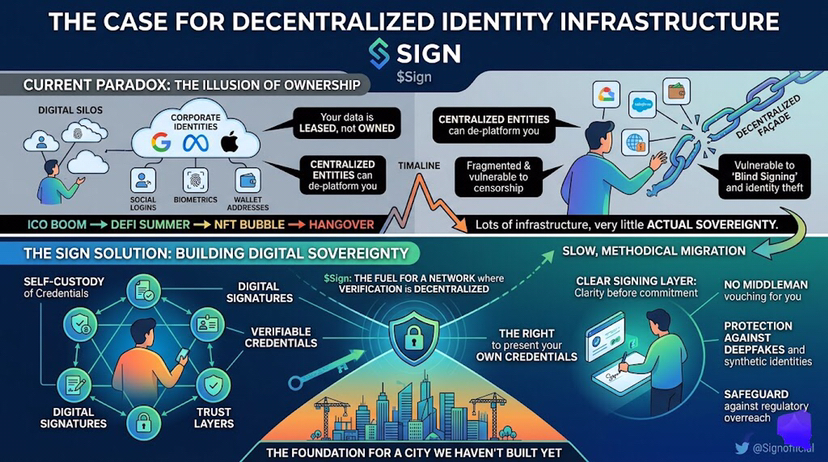
That’s why when I stumbled upon the concept behind $SIGN and the infrastructure being built by @Signofficial, I felt a shift in my own understanding of what Web3 is supposed to be. It wasn’t the usual noise about “disrupting finance” or “making it big.” It was something far more foundational, and frankly, far more boring to the average speculator. But to those of us who care about the actual architecture of the internet, it’s the most exciting thing in years.
We are currently living in a paradox. We have more digital identity touchpoints than ever before—biometrics, social logins, wallet addresses—yet we own none of them. Every time we use a “Sign in with Google” button, we are leasing our identity from a corporate entity. Every time we authenticate a transaction on a chain, we are relying on a private key that, if lost, wipes out our existence on that network. Our digital selves are fragmented, sitting in silos controlled by centralized entities who can de-platform us at will.
@undefined is tackling this problem by going back to first principles. The premise of #SignDigitalSovereignInfra isn’t about creating a faster blockchain or a cheaper transaction; it’s about redefining what it means to prove who you are in the digital realm. I’ve spent a lot of time reading through their technical documentation, and what stands out to me is the emphasis on self-custody not just of assets, but of credentials.
Most people confuse anonymity with sovereignty. They think that because they use a VPN or a burner wallet, they are free. But sovereignty isn’t about hiding; it’s about having the exclusive right to present your own credentials without a third party’s permission. $SIGN facilitates a protocol where your identity isn’t a string of characters owned by a corporation, but a cryptographic assertion that you control.
I recall a conversation I had with a developer last year who worked on enterprise blockchain solutions. He lamented that despite the hype, most corporations still rely on OAuth—a system designed in 2006—to handle authentication. It’s a system where the identity provider (Google, Meta, Apple) holds the keys to the kingdom. They can revoke your access, sell your behavioral data, and lock you out of your own life if their algorithm flags you.
$Sign aims to break that monopoly. The token itself isn’t just a speculative vehicle; it’s the fuel for a network where verification is decentralized. When I look at the roadmap for @Signofficial, I see a structure designed to handle digital signatures, verifiable credentials, and trust layers without requiring a middleman to vouch for you. In a world where AI can generate convincing deepfakes and synthetic identities, the ability to prove authenticity without revealing private data becomes not just valuable, but essential.
I’ve been guilty of chasing the shiny object. We all have. We see a meme coin pumping and we feel the FOMO. But the reality is that the projects that survive the next bear market aren’t the ones with the best memes; they’re the ones with the deepest moats. Infrastructure is a boring business until suddenly it isn’t. You don’t think about the electrical grid until the power goes out. You don’t think about digital sovereignty until you wake up and find your X account suspended, your Google account locked, and your wallet drained because you signed a malicious contract with a blind signature.
That last point is critical. The current paradigm of signing transactions is fundamentally broken. We sign contracts without knowing what’s inside them because the wallet interfaces are designed for convenience, not security. @undefined is addressing the signature layer itself. It’s about moving beyond the era of “blind signing” where you approve a transaction hoping the contract isn’t malicious. The infrastructure they’re building under #SignDigitalSovereignInfra aims to give users clarity before they commit.
I’ve started accumulating Sign not because I expect it to 100x overnight—though I believe the fundamentals will reflect in the valuation over time—but because I want to participate in a network that aligns with my own values. I’m tired of being the product. I’m tired of having to trust that a centralized sequencer won’t reorder my transactions. I’m tired of the illusion of ownership.
With @SignOfficial , the focus is on the one thing that makes crypto unique in the first place: cryptography. Not marketing. Not hype cycles. Not celebrity endorsements. Just pure, unadulterated applied cryptography to solve the problem of identity and consent. In a space that has become dominated by casino-like behavior, it’s refreshing to see a project focused on the heavy lifting.
The transition to digital sovereignty won’t be a single event. It will be a slow, methodical migration of applications and users away from custodial identity providers toward self-sovereign models. Sign is positioning itself as the rail for that migration. When you look at the regulatory landscape globally—with KYC requirements tightening, with governments pushing for digital IDs—having a decentralized alternative becomes a safeguard against overreach.
I don’t write this as financial advice. I write this as a user who has spent too many hours recovering accounts, fighting with support bots, and watching centralized entities erode privacy. We need a better way to authenticate. We need a better way to sign. We need a better way to own.
That is what Sign represents to me. It’s not a rocket ship to the moon. It’s the foundation for a city we haven’t built yet. If you look closely at @SignOfficial and the ethos behind #SignDigitalSovereignInfra , you’ll see a group of builders who understand that without sovereignty, digital assets are just entries in someone else’s database.
I’m choosing to bet on the infrastructure that protects the user rather than exploits them. For now, that’s enough for me.

Artigo
Sign and the Case for Decentralized Identity Infrastructure
Aviso Legal: inclui opiniões de terceiros. Não se trata de aconselhamento financeiro. Poderá incluir conteúdos patrocinados. Consulta os Termos e Condições.
0
25
157
Fica a saber as últimas notícias sobre criptomoedas
⚡️ Participa nas mais recentes discussões sobre criptomoedas
💬 Interage com os teus criadores preferidos
👍 Desfruta de conteúdos que sejam do teu interesse
E-mail/Número de telefone