@Fabric Foundation #ROBO $ROBO

Introduction
I’ve noticed that while blockchain has transformed digital assets and automated contracts, there’s a glaring gap when it comes to connecting the real world. Most networks reward computational work or digital staking, but what about machines actually performing physical tasks—like robots in warehouses or automated delivery systems? That’s where Fabric’s Proof of Robotic Work (PoRW) comes in. It’s tackling a problem I’ve been thinking about for a while: how do we fairly track, verify, and reward real-world labor done by autonomous machines without relying on centralized oversight?
What the Project Actually Does
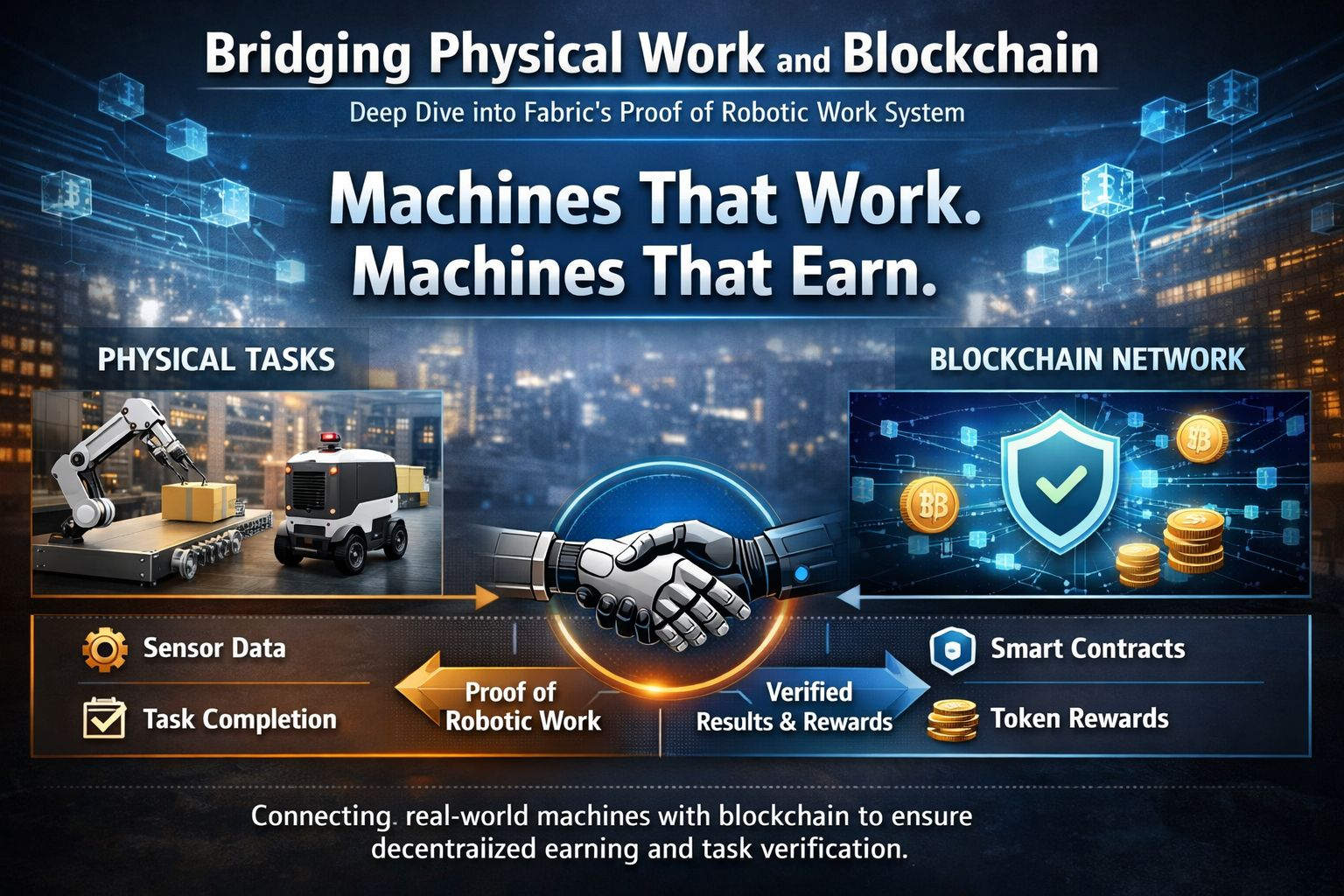
Fabric is building a system where robots and automated agents can prove the work they perform in the real world and get rewarded with the network’s native token, ROBO. The process is simple in theory: a robot completes a task, sensors and cryptographic proofs verify the effort, and the blockchain records it immutably. This means you can have transparent, auditable work logs for anything from industrial robots stacking packages to agricultural drones monitoring crops. No middleman needed, and the system doesn’t just rely on digital simulations—it’s anchored in physical reality.
Key Mechanism or Innovation
The standout innovation here is the PoRW consensus model. Unlike traditional proof-of-work or proof-of-stake, PoRW ties rewards to verifiable robotic output. Fabric uses secure hardware attestation, real-time telemetry, and cryptographic proofs to ensure that reported work is genuine. ROBO tokens are then distributed proportionally, which creates a tangible incentive for deploying robots efficiently. It’s fascinating because this bridges two worlds we usually treat separately: blockchain validation and real-world labor. I also think the way it encourages decentralized industrial automation could influence how future supply chains operate.
Why It Matters
For developers and users, this opens new doors. Software engineers can design robot-driven applications with clear economic incentives. Companies can integrate autonomous machines and track productivity transparently. From a broader perspective, it nudges the crypto ecosystem toward interacting with the physical world in a provable way—something that’s been theorized for years but rarely executed safely. I see it as a small but meaningful step toward tokenizing real-world work, not just digital transactions.
My Perspective
I find Fabric’s approach both exciting and challenging. On one hand, the concept of verifiable robotic labor could redefine decentralized economies. On the other, scaling this reliably will be tough. Sensors can fail, robots can misreport, and there’s always a risk of technical exploits. But I think the team’s focus on hardware-backed proofs is promising, and it feels like a real experiment in blending blockchain with tangible automation, rather than just hype.
Conclusion
Fabric isn’t just another blockchain project—it’s trying to answer a question that’s becoming increasingly important: how do you bring the benefits of decentralized networks into the physical world? By connecting robotic output with verifiable blockchain rewards through ROBO, it opens new possibilities for automation, productivity tracking, and economic models. It’s early days, but the concept is one that’s hard to ignore if you care about the future of both robotics and decentralized systems.