

I didn’t take Midnight Network seriously at first.
Not because the idea was weak. Mostly because I’ve seen this pitch too many times. Privacy, ownership, better systems—it’s all been recycled enough that most of it blends into noise. New chain, same promises, different wording.
Midnight didn’t feel new. It felt… less naive.
That’s a small difference, but it matters.
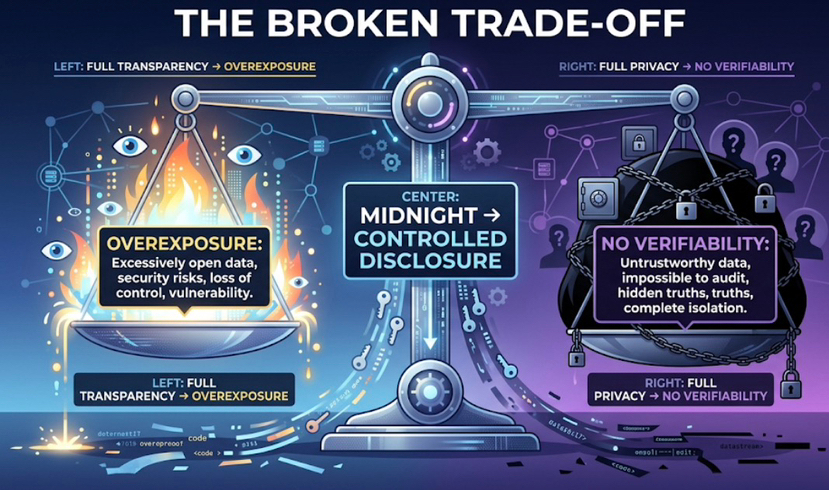
Crypto spent years pretending transparency was enough. If everything is visible, trust follows. That worked early on, but it also created something uncomfortable—permanent exposure.
Every transaction, every interaction, every pattern sitting on a public ledger.
That’s not neutral. That’s friction.
On the other side, privacy-focused systems pushed toward full opacity. Hide everything, protect the user. But that created its own problem—systems that are harder to verify, harder to integrate, harder for institutions to even touch.
Two extremes. Neither complete.
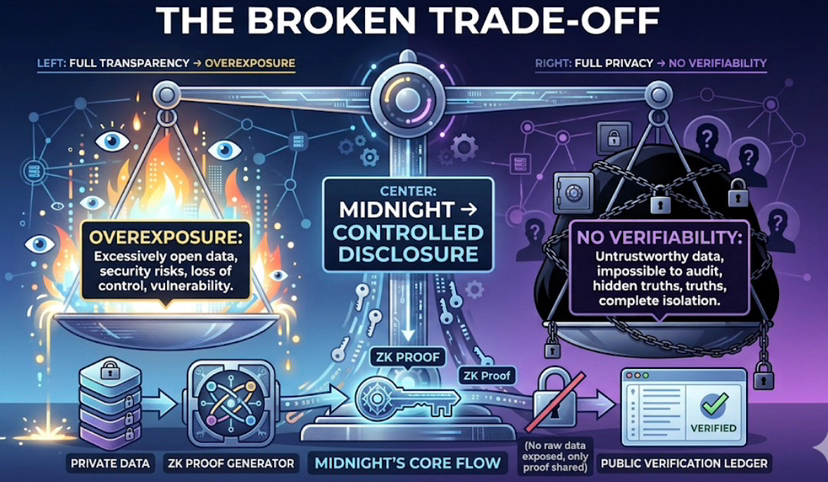
Midnight is trying to sit between those extremes.
Using zk-SNARKs, it separates verification from exposure. You don’t reveal everything—you prove something specific. The system confirms the rule was followed without seeing the underlying data.
That idea controlled disclosure isn’t flashy. But it’s practical.
Instead of forcing users or businesses to accept full transparency, it gives them a way to show only what’s required. Nothing more.
And that’s closer to how real systems operate outside crypto.
What makes this more interesting isn’t the privacy angle itself. It’s the framing.
Midnight isn’t selling invisibility. It’s selling control.
Control over what gets exposed, what stays private, and what can be proven when needed. That’s a different mindset. Less ideology, more infrastructure.
And honestly, crypto has needed more of that.
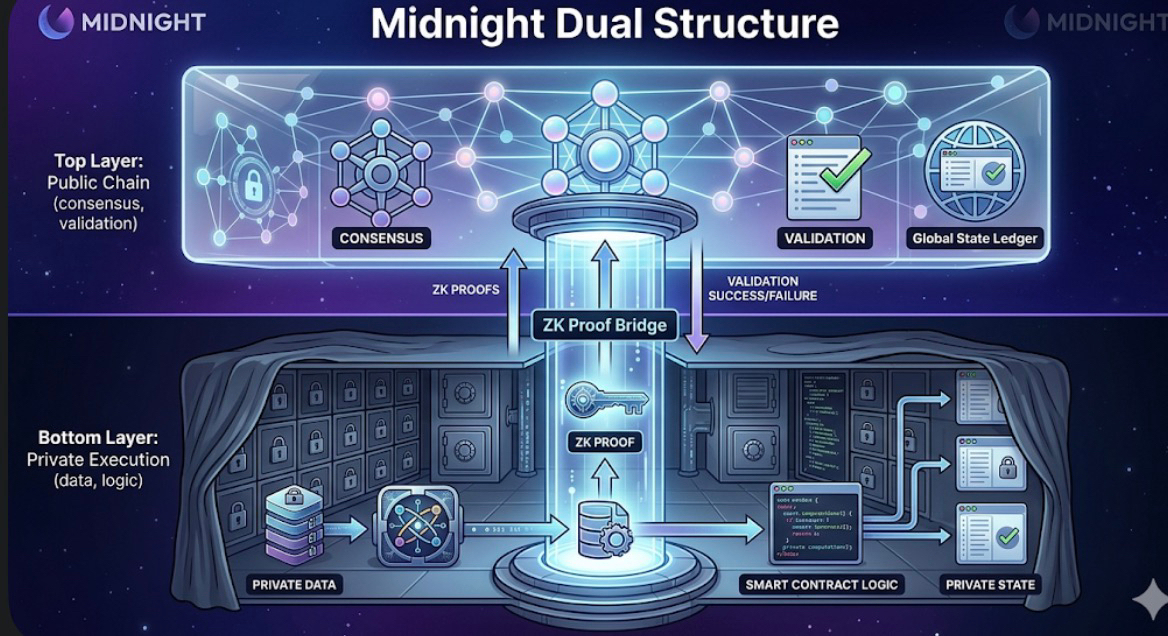
The architecture reflects that balance.
Public components handle consensus and verification, while sensitive logic and data stay protected in a private layer. The connection between them is the proof itself. That separation allows systems to function without turning everything into public information.
For developers, this also changes how applications are built. Privacy isn’t something added later—it’s part of the design from the start.
That matters more than people think.
There’s also a quieter detail here that I respect.
The network separates roles instead of forcing everything into one layer. Even the token structure—$NIGHT for governance and security, DUST for private execution—points toward that same idea: don’t overload one system with conflicting purposes.
It’s a small design choice, but it shows awareness of how things break.
Still, none of this guarantees anything.
Crypto is full of projects that made sense on paper and went nowhere in practice. The real test is always the same. Does it reduce friction when people actually use it?
Do developers build here?
Do users notice the difference?
Does the system hold under pressure?
That’s where things usually fall apart.
Midnight is close enough to that stage now.
Which means the narrative matters less than the outcome.
The idea is solid. More solid than most, honestly. Public chains expose too much. Private systems often hide too much. Midnight is trying to carve out a middle ground where trust doesn’t require overexposure.
That’s a real problem worth solving.
But solving it isn’t about explanation. It’s about execution.
And that’s the part I’m still watching.
Because in this market, the difference between something that sounds right and something that actually works only shows up once the system is under stress.