

I have been watching Sign Protocol the same way I watch most projects now. Not with excitement. More like a habit. The kind you develop after seeing too many cycles repeat with slightly different language.
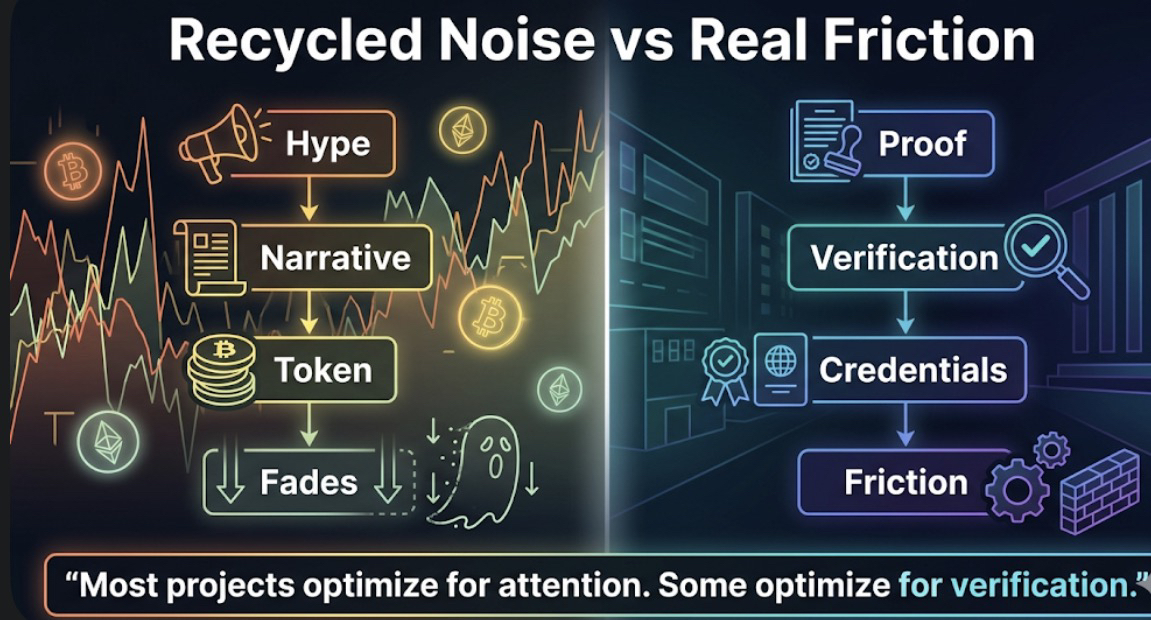
Most of this market is just recycled noise. New surfaces, same mechanics underneath. That is probably why SIGN stayed on my radar at all. It does not feel clean enough to dismiss, but it is not finished enough to trust without friction.
I keep coming back to the same cluster of ideas. Proof. Verification. Credentials. Access. Not the loud parts of crypto. Not the parts that trend. The slower layer underneath. The one people ignore until something breaks.
And things always break.
That is where SIGN becomes harder to ignore. Too many projects talk about trust when they really mean presentation. Too many talk about utility when they mean potential. What Sign Protocol keeps circling is more uncomfortable.
How do you prove something in a system that actually needs to be audited later?
Not just recorded. Not just visible.
Proven.
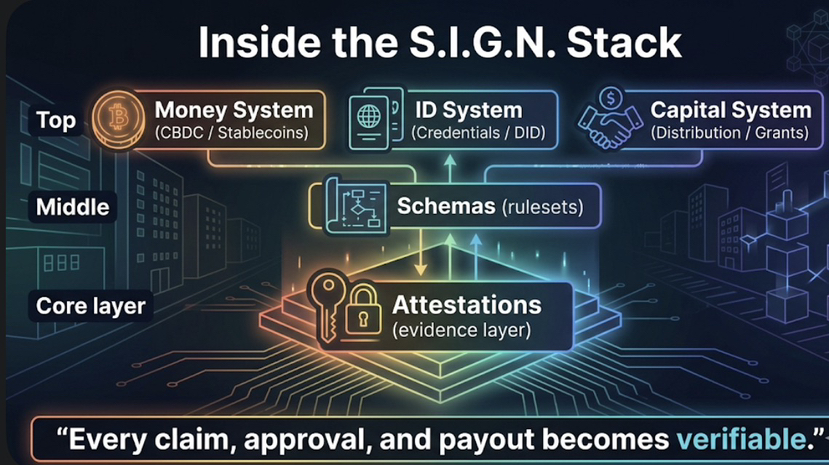
That is where attestations start to matter. Not as a feature, but as structure. A claim tied to an issuer. A record tied to a ruleset. Something that survives beyond the moment it was created.
It sounds simple. It is not.
The S.I.G.N. model stretches that idea across systems. Money flows. Identity layers. Capital distribution. Everything tied back to an evidence layer that is supposed to answer the same question every time.
Who approved this. Under what authority. According to which rules.
That is not a market-friendly story. It is slow. It is operational. It lives in the part of systems most people do not look at unless something fails.
But that is usually where the real pressure shows up.
I think that is part of why it keeps pulling me back. The project does not feel optimized for attention. It feels like it is trying to solve for systems that need to hold up under scrutiny. Eligibility checks. Distribution logic. Audit trails. The unglamorous parts that decide whether something actually works when scaled.
Still, that does not mean it works yet.
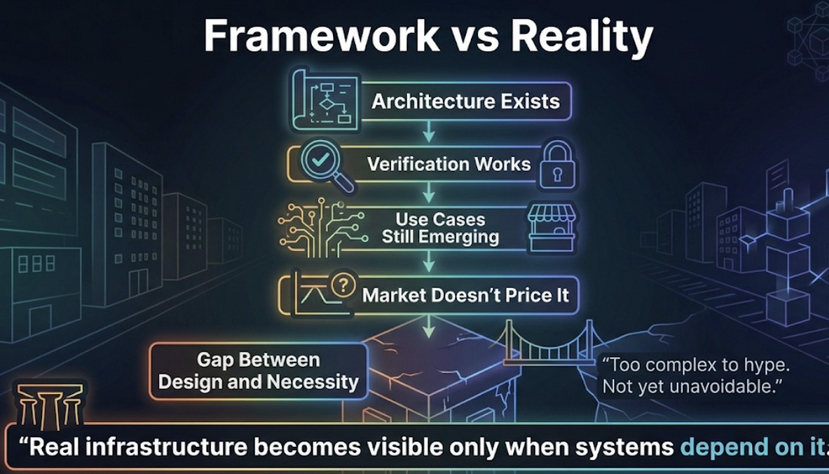
There is a gap here. You can see the architecture. You can see the direction. You can also see how easily something like this gets stuck between ambition and usage. Infrastructure like this does not fail loudly. It just sits in that space where it is too complex to explain simply and not yet necessary enough to be obvious.
I have seen that pattern before.
A system gets built for real constraints. The market looks for something easier to digest. The two never quite meet.
That gap is still here.
And I do not entirely see that as a weakness. It is harder to trust something that arrives perfectly packaged, already explained, already positioned as inevitable. That usually means the story came first.
SIGN does not feel like that. It feels heavier. Less resolved. Closer to something that is still being worked through rather than something already decided.
But that also means the burden is still ahead.
At some point, the verification layer has to attach itself to something that cannot operate without it. The distribution side has to move from interesting to necessary. The whole system has to cross that line where it stops being a framework and starts being difficult to ignore.
Until then, it sits in a strange position.
Not convincing enough to commit.
Not weak enough to dismiss.
So I keep coming back to it. Not because it is loud, but because it keeps pointing at a part of the system most projects avoid. The part where records matter. Where approvals need to hold up. Where “trust” is no longer enough.
Maybe that turns into something real.
Maybe it stays as another well-structured idea waiting for pressure to make it relevant.
Either way, it is one of the few things in this market that does not feel like it is trying too hard to be understood.
And right now, that is enough to keep it in view.