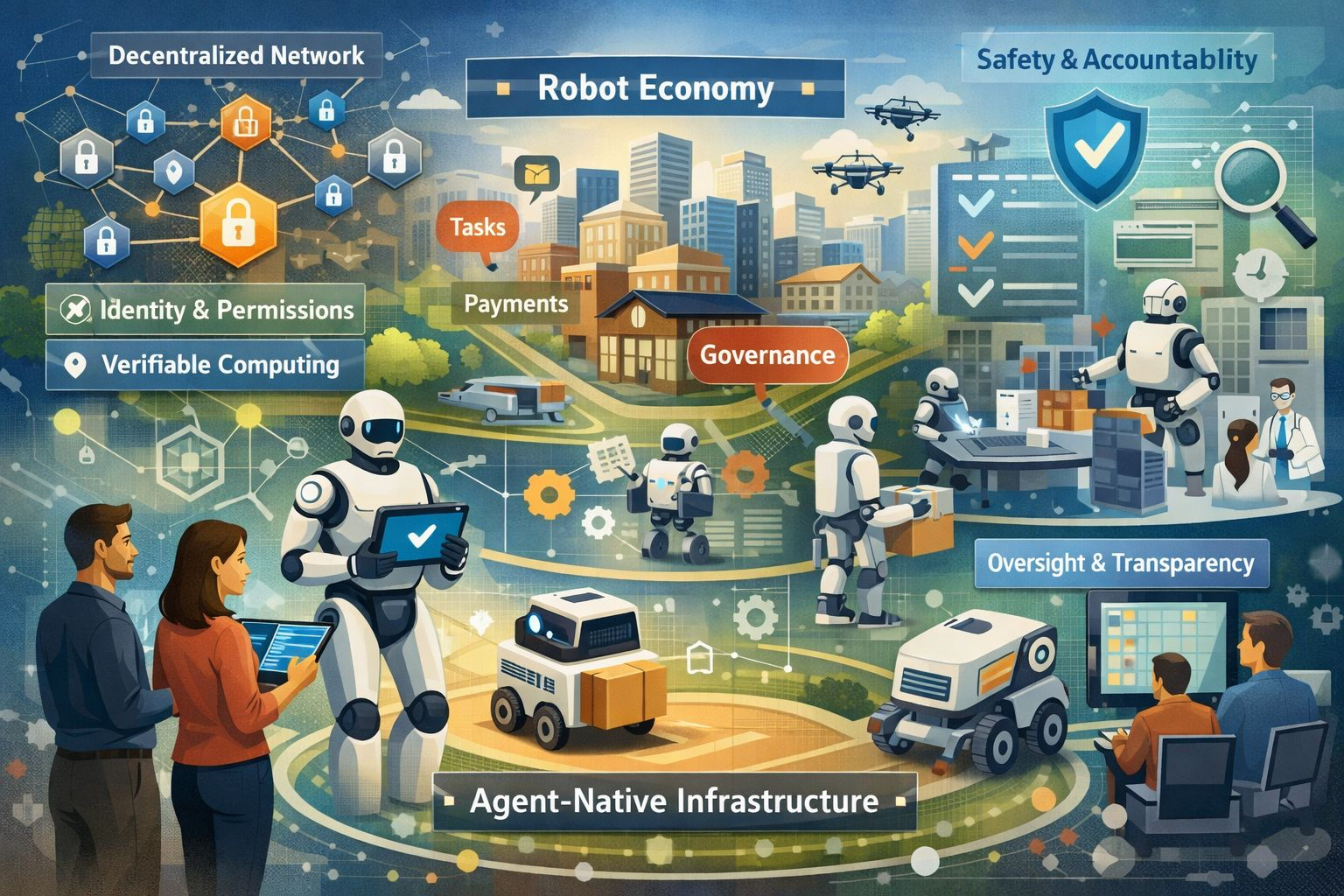
$ROBO I’ve spent some time sitting with Fabric Foundation’s long-term vision, and honestly, what strikes me most is that it isn’t just talking about robots in the usual way. It’s not chasing the tired fantasy of flashy machines doing cool tricks for attention. It’s looking at something bigger, and, from where I stand, a lot more serious. Fabric seems to be asking a question that many robotics projects still avoid: if general-purpose robots are really going to become part of everyday life, then who governs them, who coordinates them, who pays them, who verifies them, and how do humans stay safe while all of that scales?
That’s the part I keep coming back to. Because, to me, the future of robotics was never going to be only about better movement, better sensors, or better models. That stuff matters, sure. But once robots move beyond controlled demos and enter real human environments, the real challenge changes. It becomes less about whether a robot can do something and more about whether society has the infrastructure to trust it, manage it, and hold it accountable. And I think that’s exactly where Fabric Foundation is trying to plant its flag.
What I find compelling is that Fabric doesn’t frame robots as isolated products. It frames them as participants in a much wider system. That’s a subtle shift, but it changes everything. A general-purpose robot working in the real world can’t just be smart. It also needs identity. It needs permissions. It needs some way to interact with rules, payments, tasks, and shared standards. Otherwise, it’s just another powerful machine dropped into a system that was never designed for it.
And let’s be real, the systems we have right now were built for humans and human institutions. They assume a person has a bank account, documents, a legal identity, and a place inside existing organizational structures. A robot has none of that. So when Fabric talks about agent-native infrastructure and verifiable computing, I don’t read that as buzzword filler. I read it as an attempt to solve a very practical problem. If robots are going to act more independently, they need rails that fit what they are, not borrowed systems that barely work for them.
I think that’s why the decentralized piece matters so much in Fabric’s vision. A lot of people hear “decentralized” and instantly think hype, token mechanics, or ideology. But looking at Fabric’s framing, I see decentralization being used as a structural answer to a trust problem. If robots are going to operate across industries, geographies, and social settings, then their coordination layer probably can’t live inside one company’s private database forever. It needs to be verifiable, transparent in the right ways, and open enough for different participants to interact without blindly trusting a central gatekeeper.
That’s where I think Fabric’s long-term vision gets really interesting. It’s not just imagining more capable robots. It’s imagining a robot economy, and, honestly, that phrase carries more weight than it might sound at first. An economy means exchange, responsibility, contribution, incentives, and rules. It means robots won’t simply exist as tools owned by a few firms. They could become active participants in networks of labor, data, services, and coordination. That’s a massive shift, and it raises the stakes. Once robots enter that space, safety can’t be an afterthought. Governance can’t be patched on later. It has to be built in from the start.
From my perspective, this is where Fabric Foundation’s approach feels unusually mature. It seems to understand that safety in robotics isn’t only about preventing collisions or reducing technical errors. Safety is also about predictability. It’s about traceability. It’s about knowing who deployed a machine, what permissions it has, what actions it took, and under what rules it operates. I’d even go further and say that in a future full of general-purpose robots, social trust may depend just as much on visible accountability systems as on the robots’ raw intelligence.
And that’s why I keep circling back to Fabric’s emphasis on identity and public coordination. A robot without verifiable identity is basically an ungrounded actor in the physical world. That’s not a small issue. If machines are going to move through homes, warehouses, hospitals, classrooms, or streets, people need more than vague assurances from operators. They need infrastructure that can support real oversight. In that sense, Fabric’s vision feels less like a tech product roadmap and more like an attempt to design civic infrastructure for a machine age.
I also think there’s an important philosophical layer here.@Fabric Foundation Fabric’s long-term vision suggests that the future of robotics should not be locked inside closed systems controlled by a tiny number of powerful actors. I find that deeply important. Because if general-purpose robots do become economically meaningful, then whoever controls their coordination layer could end up shaping access, opportunity, and even norms of human-machine interaction for millions of people. That kind of power shouldn’t be treated casually.
What Fabric appears to be pushing for instead is a more distributed model, one where participation, verification, and governance are shared more broadly. I’m not naive about how difficult that is. Open systems are messy. Governance is messy. Real-world deployment is messy. But I’d still argue that this messiness may be healthier than a future where robotic intelligence is concentrated behind opaque walls and driven only by private incentives. At least an open protocol gives society a chance to debate the rules, inspect the structures, and evolve the system over time.
Another thing I notice is that Fabric’s vision doesn’t reduce robots to hardware. It treats them as part of a broader loop involving data, computation, payment, regulation, and collaborative improvement. That matters because general-purpose robots won’t improve in isolation. They’ll improve through use, through feedback, through coordination, and through interaction with environments that are constantly changing. A decentralized infrastructure could make that learning process more composable and more widely shared, rather than trapped inside disconnected silos.
To me, that may be one of the strongest arguments in favor of Fabric Foundation’s broader mission. It’s trying to build the layer beneath the robots, the layer that most people ignore until things break. And usually, that hidden layer is where the real power sits. It decides who gets access, who gets excluded, who gets verified, who gets compensated, and who carries responsibility when systems fail.
So when I look at Fabric Foundation’s long-term vision, I don’t just see a robotics project. I see an argument about how society should prepare for intelligent machines before they become too embedded to regulate properly. I see a bet that safe, capable, general-purpose robots will need more than intelligence to succeed. They’ll need institutions, but not only old institutions. They’ll need new, machine-native forms of coordination that still remain accountable to human values.
And that, to me, is the real heart of Fabric’s vision. It’s not just trying to make robots work. It’s trying to make their future livable.