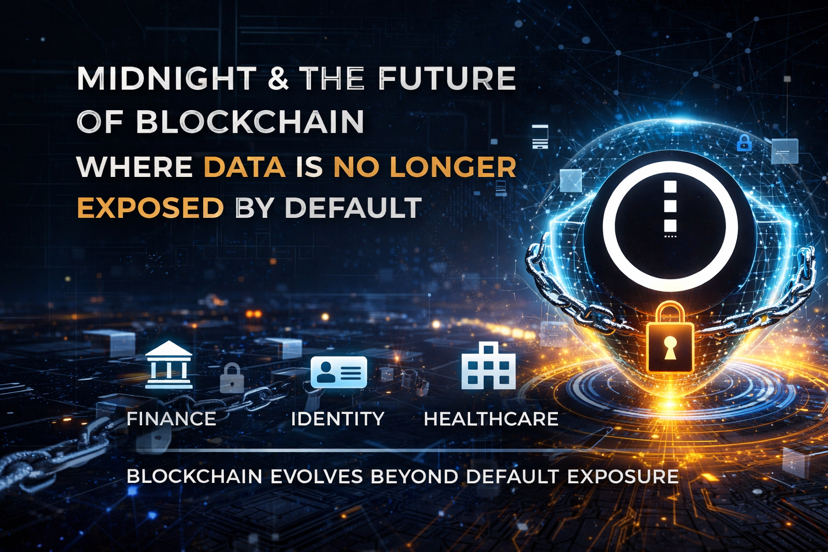
@MidnightNetwork is interesting to me because it points to a version of blockchain where data is no longer exposed by default, and that changes the conversation far more than most people realize.
For years, public blockchains have treated radical transparency as a strength. Every transaction, wallet balance, and interaction can be traced, inspected, and analyzed. That model works for certain crypto-native use cases, but it also creates a hard ceiling. The moment blockchain tries to move closer to real-world applications like finance, identity, healthcare, enterprise workflows, or even consumer apps, default exposure stops looking like a feature and starts looking like a structural problem. Most users do not want every action permanently visible just to access the benefits of decentralization.
That is why Midnight stands out. It is not trying to remove verifiability from blockchain, but to redesign how verifiability happens. The key idea is simple but powerful: data can remain private while the network still proves that the action is valid. That matters because it breaks one of the oldest trade-offs in this space. Until now, projects often had to choose between open verification and meaningful privacy. Midnight is pushing toward a model where both can exist at the same time.
What I find compelling is that this is not only about secrecy. It is about control. A better blockchain future is not one where everything is hidden, but one where users, applications, and institutions can decide what should be revealed, to whom, and under what conditions. That is a much more realistic path for adoption. In practice, most useful systems do not need total opacity or total transparency. They need selective disclosure, provable logic, and clear ownership over sensitive information.
From the way I see it, this is where Midnight could become more important than a typical privacy narrative. If blockchain infrastructure evolves toward a world where privacy is built in rather than added later, then the entire design space opens up. Developers can build applications that are usable without forcing users to sacrifice their data. Businesses can explore blockchain rails without exposing internal information. Users can interact on-chain without feeling like every move becomes permanent public property.
That is the future Midnight seems to be building toward, and I think that is why it deserves attention. The real question is no longer whether blockchain should stay transparent at all costs. The more important question is whether blockchain can mature into infrastructure where trust comes from proof, not from forcing everyone to reveal everything. If Midnight keeps moving in that direction, it may help define what the next serious phase of blockchain looks like.