Public blockchains did something huge they made trust possible by making everything transparent. Every transaction,every balance,every contract interaction sits out in the open for anyone to see. That works for the basics,like moving coins around. But as soon as you try to use blockchains for real world tasks finance,identity checks,enterprise workflows you run into trouble. These are areas where confidentiality is non negotiable. Bolt on fixes like mixers or privacy layers end up fragmenting liquidity and breaking composability. You get little walled gardens that struggle to connect and talk to each other.
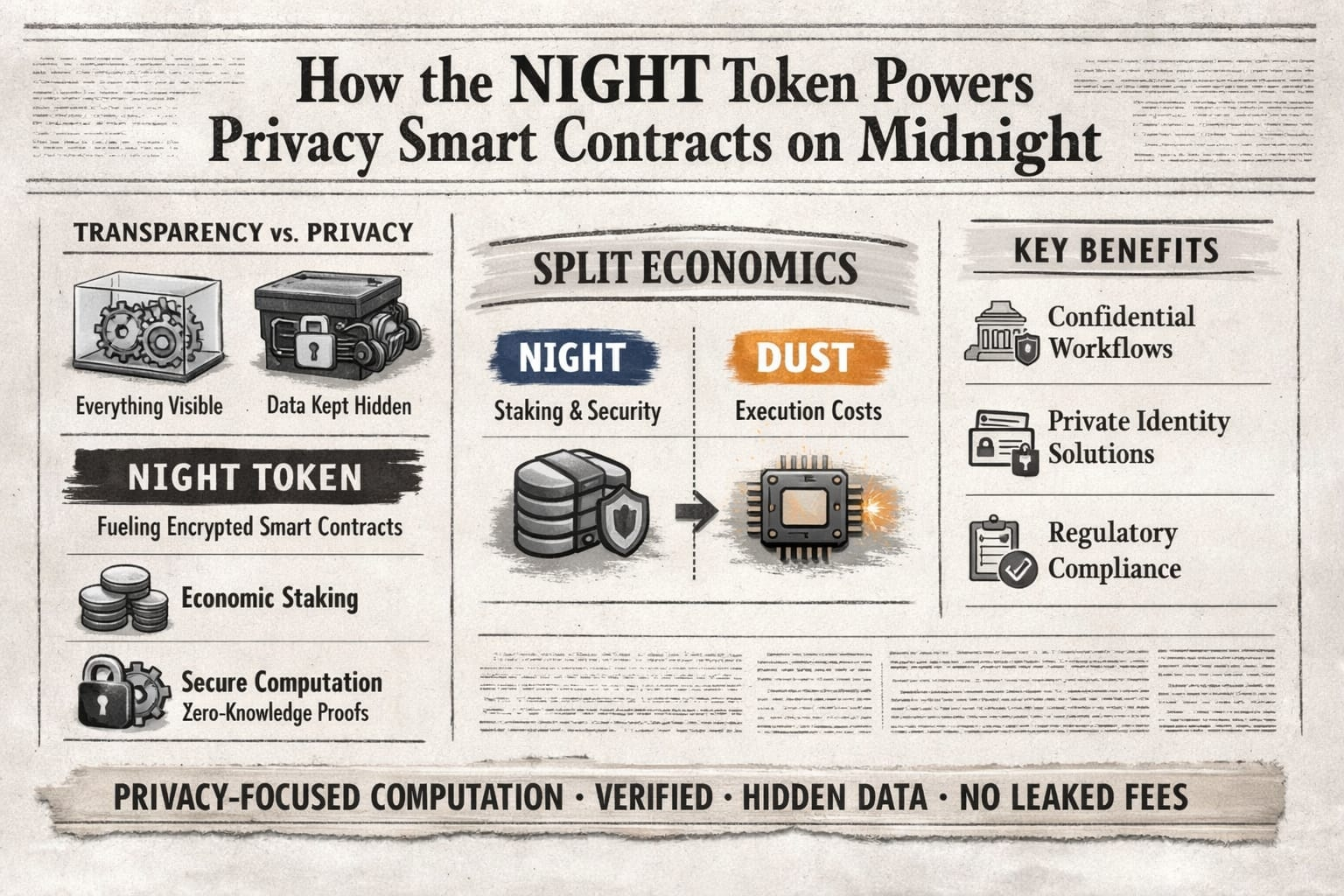
Midnight flips the script by baking privacy into the heart of its execution layer. Privacy isn’t some afterthought here it’s foundational. NIGHT isn’t just for payments;it’s the backbone for running encrypted smart contracts. Think of traditional contracts as “glass boxes” you can see right through them. Midnight’s contracts act more like “sealed engines.” The computations are still verifiable,but the data stays hidden. Zero-knowledge proofs make this possible. They let you prove things are correct without showing your hand.
NIGHT brings a whole new dimension to network security. Validators stake NIGHT,sure,but it’s not just a routine proof of stake job. Validators verify complex cryptographic proofs as part of the role which makes this process much more demanding. It’s not just about capital risk anymore;token value also depends on the cost and complexity of keeping privacy intact.
One standout feature in Midnight is how it splits capital and execution. NIGHT covers economic staking,while another resource call it DUST for now handles execution costs. This separation stops fee markets from leaking user behavior. Users aren’t publicly bidding for block space anymore. Instead,everything happens behind a privacy shield,where costs stay invisible,and sensitive actions don’t show up in the logs.
Midnight’s reward structure isn’t obsessed with transaction counts. The system rewards efficient,meaningful computation done privately. That means value grows from productive use of the network, not just from busywork or speculation.
Why does this matter now? Institutions are hunting for privacy in programmable systems to satisfy regulations,and stay competitive. Meanwhile,as AI and blockchain start to blend,workflows rely on sensitive data. We need computation that’s verifiable but private. On-chain identity is also heating up,and people need ways to own their data without making it public. Midnight positions NIGHT as the layer these demands rest on.
Still,there’s real risk. Zero knowledge systems are complex beasts hard to audit,tricky to optimize. Developers may hesitate;building on encrypted states means learning a whole new playbook. And privacy networks can fall into liquidity silos unless they nail interoperability.
If Midnight’s design holds up,it shifts how people value smart contract platforms. Rather than speculation or raw transparency,value comes from secure,efficient computation you can trust. That’s a fundamental change in how blockchain systems operate.
The big idea: privacy isn’t just a nice to have. It’s a constraint that changes everything. For investors,NIGHT isn’t a plain utility token it’s the price tag for encrypted computation. The real question isn’t whether privacy matters,but which platform can make it work without losing usability or composability.