

 I spent some real time going through the architecture behind SIGN and the more I connected the pieces, the more it stopped feeling like just another crypto project and started looking like something much deeper. What SIGN is building is not a single product or a narrow use case system. It is positioning itself as foundational infrastructure for how identity, capital, and trust move in a digital world.
At its core, $SIGN is built around a simple but powerful idea. In a digital economy, value is not just money. It is proof. Proof of identity, proof of ownership, proof of credentials, proof of allocation, and proof of intent. Without a reliable way to verify these things across systems, everything else becomes fragile. That is the gap SIGN is targeting.
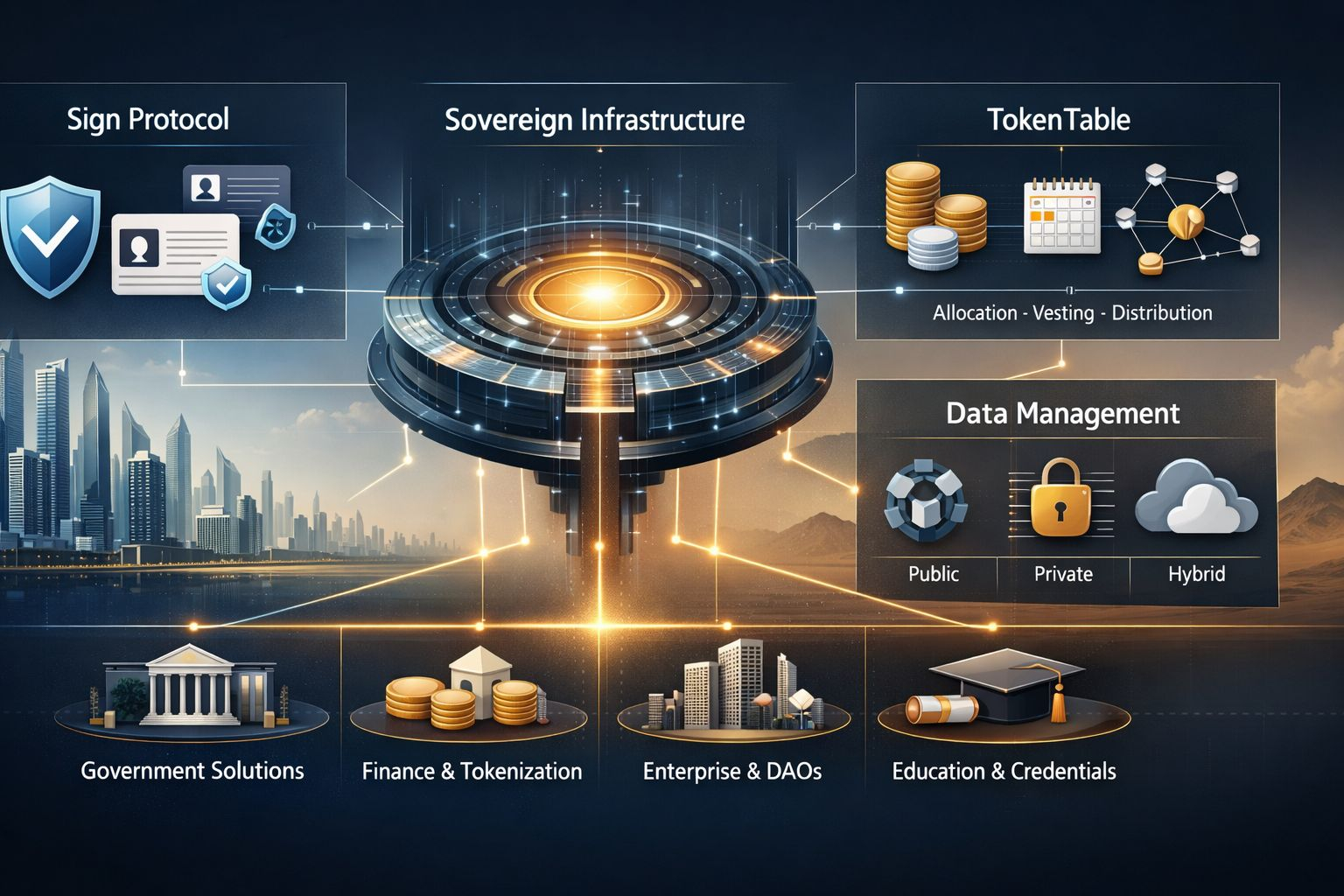
The system comes together through three major layers that are tightly connected but flexible enough to adapt across different use cases. Sign Protocol acts as the attestation layer. This is where claims are structured, signed, and made verifiable. It allows any entity, whether an individual, institution, or government, to create trusted data that can be validated across different environments. This alone unlocks a massive shift in how digital interactions can be trusted without relying on centralized authorities.
Then comes TokenTable, which handles allocation, vesting, and distribution. This part is often underestimated, but it is where a lot of real-world complexity exists. Capital distribution is messy, especially when it involves multiple stakeholders, compliance rules, and long-term incentive structures. SIGN simplifies this by turning distribution into a programmable, verifiable process. It is not just about sending tokens. It is about structuring ownership in a way that remains transparent and enforceable over time.
The third piece is how the system handles data storage and verification. SIGN supports public, private, and hybrid attestations. This flexibility matters more than people realize. Some data needs to be fully on-chain for maximum transparency. Some needs to stay off-chain for privacy or cost efficiency, anchored by cryptographic proofs. And in many real-world scenarios, a hybrid model makes the most sense. SIGN does not force a single approach. It adapts to the needs of the system using it.
When I look at this from a broader perspective, especially in the context of the Middle East, the relevance becomes even clearer. The region is moving fast toward digital transformation. Governments and institutions are actively investing in digital identity systems, financial infrastructure, and tokenized assets. But there is still a major challenge. How do you build systems that are both trusted and flexible enough to operate across jurisdictions?
This is where SIGN starts to feel like digital sovereign infrastructure.
Instead of locking systems into rigid frameworks, it provides a base layer where identity, credentials, and capital flows can be verified independently of any single platform. That is a powerful concept. It means governments can issue verifiable credentials. Businesses can manage compliant capital distribution. Individuals can own and prove their digital identity across systems. And all of this can happen without sacrificing interoperability.
Another thing that stood out to me is how practical the design is. A lot of projects talk about future potential, but SIGN is clearly built with real-world constraints in mind. Cost efficiency, scalability, compliance, and cross-system compatibility are not afterthoughts here. They are built into the architecture from the start.
And when you connect this with the rise of tokenization, things get even more interesting. We are moving toward a world where real-world assets, financial instruments, and even access rights are being tokenized. But tokenization without verification is incomplete. You need a system that can prove ownership, enforce rules, and maintain trust across different environments. That is exactly where SIGN fits.
From an ecosystem perspective, this also opens the door for developers and institutions to build on top of a trusted base layer instead of reinventing verification systems from scratch. It reduces friction. It reduces risk. And most importantly, it creates a standard that can scale globally while still respecting local requirements.
I also think it is important to highlight that this is not just about technology. It is about coordination. SIGN is essentially enabling a new way for different entities to interact with shared trust. That could be governments distributing benefits, companies managing equity, DAOs handling governance, or even educational institutions issuing verifiable credentials. The use cases are not theoretical. They are already forming.
From where I stand, SIGN feels like it is aligned with where the market is heading, not where it has been. The narrative is shifting from pure speculation to infrastructure that actually supports economic activity. And in that shift, systems that can provide verifiable trust across identity and capital will become critical.
That is why I see SIGN not as a short-term trend, but as a long-term layer in the digital economy stack.
If the next phase of crypto is about real adoption, real systems, and real economic coordination, then infrastructure like SIGN will sit right at the center of it.
And when you factor in regions like the Middle East, where the push toward digital sovereignty and modern financial infrastructure is accelerating, the importance of something like this becomes even more obvious.
This is not just about blockchain anymore. This is about how trust itself gets rebuilt in a digital world.
SIGN is not just building tools. It is building the rails for how identity, capital, and verification move together at scale.
That is what makes $SIGN worth paying attention to right now.