


I followed a private state transition earlier and something didn’t line up.
The state didn’t disappear.
It just stopped being reachable.
At first I assumed I was reading it wrong.
So I ran it again.
Different path.
Different timing.
Same result.
The state was still there.
Nothing removed.
Nothing reassigned.
No indication anything had actually changed.
That’s what made it feel off.
Because when something breaks, you expect to see it.
A reset.
A failure.
Some kind of trace.
Here, the system stayed completely consistent.
No errors.
No inconsistencies.
The state remained valid.
Only access failed.
I went back through it more slowly.
Step by step.
Where control exists.
Where it doesn’t.
The pattern held.
Spending key gone.
No fallback.
No secondary authority.
No mechanism to reattach control once it’s lost.
I paused there longer than I expected.
Because the system wasn’t failing.
It was doing exactly what it was designed to do.
That’s when it shifted for me.
This isn’t a state problem.
It’s an access problem.
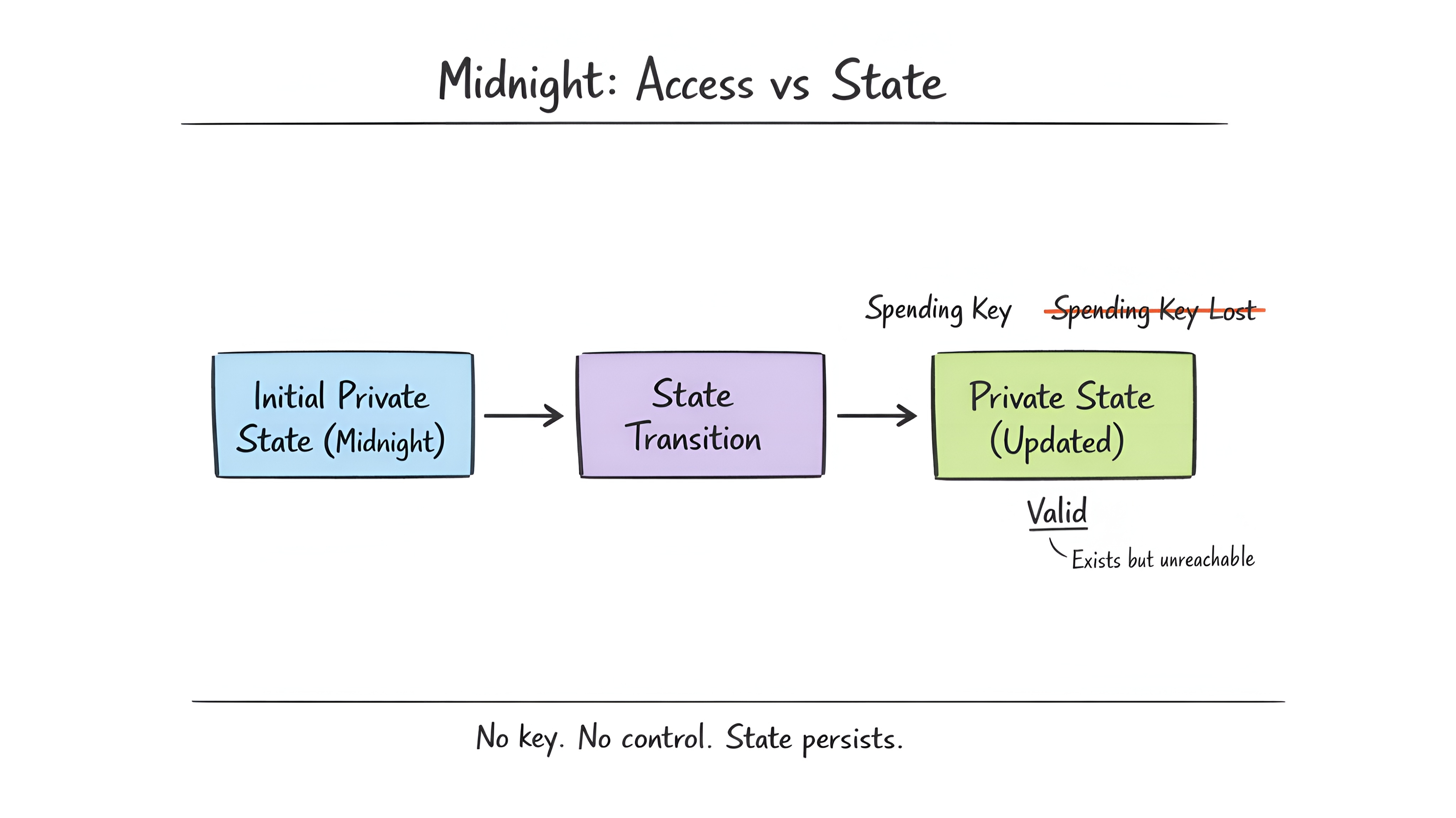
And those behave very differently.
State doesn’t degrade.
It doesn’t disappear.
It just becomes unreachable.
Which means ownership doesn’t move.
It doesn’t transfer.
It doesn’t get revoked.
It just… stays.
Locked in place.
That’s where it stopped feeling like an edge case.
And started feeling structural.
I keep coming back to this as the Unreachable State Problem.
Ownership exists.
But only as long as access survives.
Once access breaks, ownership doesn’t shift.
It freezes.
Not visible as a failure.
Not flagged as an issue.
Just permanently detached from use.
That’s a very different kind of risk.
Because nothing in the system looks wrong.
Everything verifies.
Everything holds.
Except the ability to actually do anything with it.
That’s where the model starts to feel uncomfortable.
The same design that prevents compromise also prevents recovery.
No recovery means no unauthorized access.
But it also means no second chance.
At small scale, that looks like a strong guarantee.
At larger scale, it starts to behave differently.
More users.
More keys.
More imperfect handling.
That’s when this stops being rare.
And becomes inevitable.
States that still exist.
Still valid.
Still part of the system.
But permanently unreachable.
$NIGHT only matters if this model can absorb access failure without turning ownership into something static and unusable.
Because if correctness is guaranteed but access isn’t, the system isn’t just protecting state.
It’s sealing it.
And once enough of those states accumulate, the question changes.
It’s no longer about whether the system works.
It’s about what remains usable inside it.
So the real question becomes this.
If ownership can exist without access, what exactly are you holding onto?
