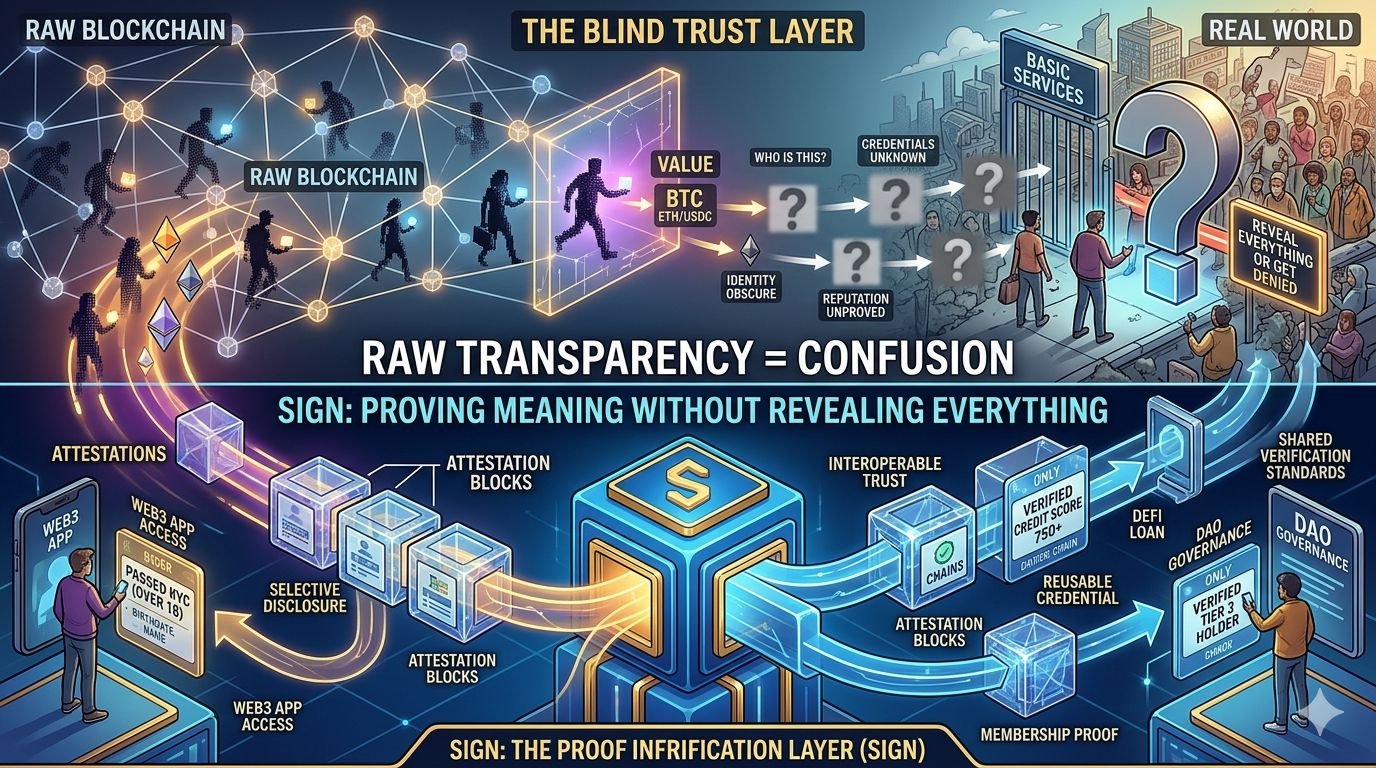
Blockchains made it easy to move money without permission.
They did not make it easy to prove anything beyond that.
What looks certain onchain often becomes unclear the moment it leaves the chain.
Crypto was built on a simple idea: if something is recorded on a blockchain, it can be trusted. That works well for balances and transactions. The system defines those rules internally, so the truth is clean and mechanical.
But the real world is not like that.
The moment you try to connect crypto to identity, reputation, credentials, or intent, things get messy. A wallet address can hold assets, but it says nothing about who owns it. A transaction can happen, but it doesn’t explain why. A smart contract can execute perfectly, but it has no understanding of context.
This creates friction that most people don’t notice at first, but builders run into it constantly. Users are forced to reveal more information than they should just to access basic services. Developers rely on fragile workarounds to verify things that should be simple. Institutions stay cautious because they cannot map anonymous systems to real-world requirements.
Crypto can settle value. It still struggles to prove meaning.
There is a common assumption in this space that transparency solves everything. If all data is visible, then verification should be easy.
In practice, it does the opposite.
Raw transparency gives you information, not understanding. It shows you what happened, but not what it means. And in many cases, it forces people into extreme trade-offs: either expose everything or stay out entirely.
That is not how real systems work.
What we actually need are better ways to prove things. Not by revealing everything, but by revealing just enough.
Proofs that are precise instead of excessive.
Proofs that can move across platforms.
Proofs that respect privacy without losing credibility.
This is the layer crypto is missing.
SIGN is trying to build that layer.
Not another chain. Not another app. More like a quiet attempt to fix something foundational.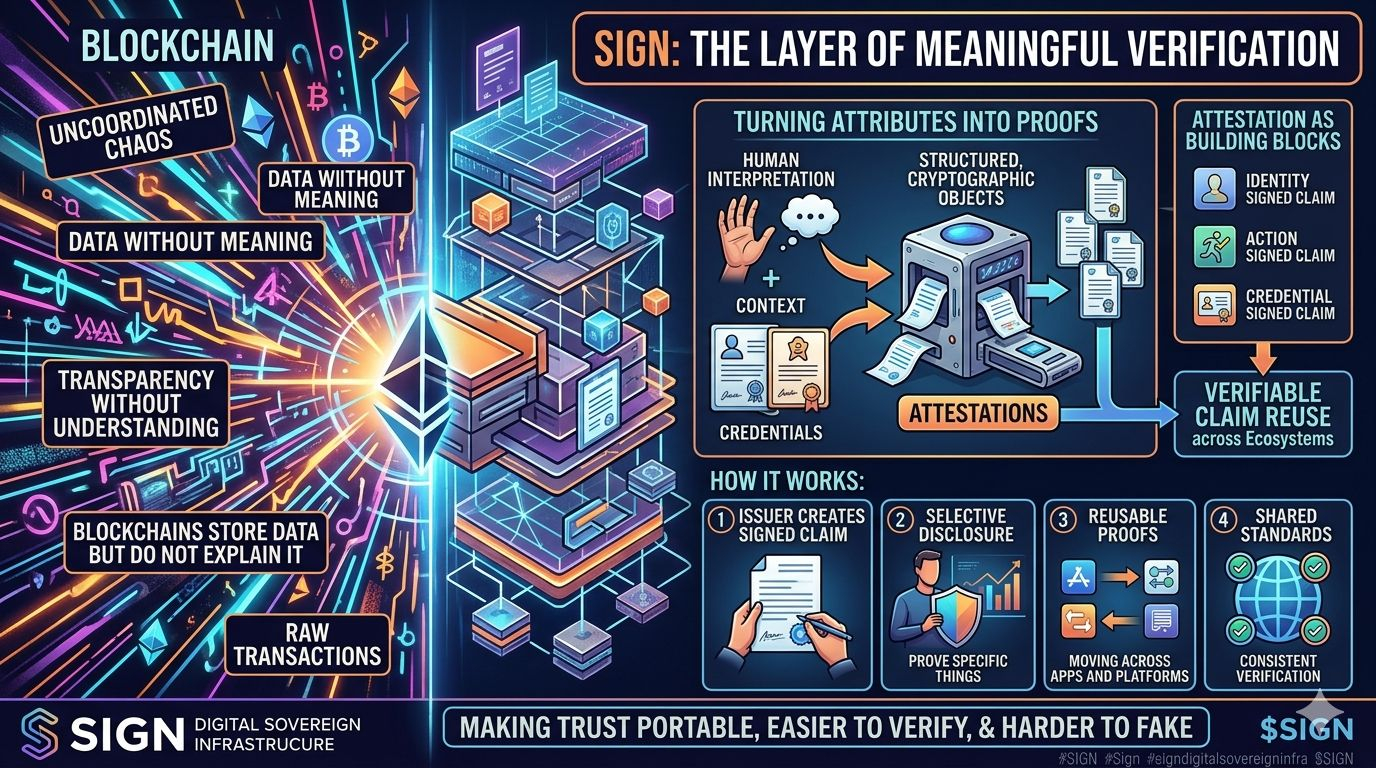
At its core, SIGN focuses on attestations—verifiable claims about identity, actions, or credentials. Instead of relying on loose assumptions or centralized databases, these claims are turned into structured, cryptographic objects that can be checked and reused across different systems.
It’s a simple idea, but it changes how trust is handled.
Instead of asking people to trust blindly or reveal everything, it gives them a way to prove specific things in a controlled way.
In practical terms, SIGN works like this:
Attestations as building blocks
Someone (a person, app, or institution) can issue a signed claim about something—who you are, what you’ve done, or what you’re allowed to access.
Selective disclosure
You don’t have to show everything. You can prove one detail without exposing the rest.
Reusable across platforms
These proofs are not locked into one app. They can travel with you across ecosystems.
Shared verification standards
Instead of every project inventing its own trust system, there is a consistent way to check claims.
Works alongside existing chains
It doesn’t replace blockchains. It adds meaning on top of them.
The goal is not to make things more complicated. It is to reduce the guesswork.
That said, this approach is not without problems.
A verification system is only as reliable as the people issuing the claims. If the source is weak or compromised, the proof doesn’t mean much. This brings back a familiar issue: who do you trust to issue trust?
There is also the challenge of adoption. For something like SIGN to matter, it needs widespread use. Developers, platforms, and users all need to agree on a shared standard, which is rarely easy in crypto.
Privacy adds another layer of complexity. While selective disclosure is powerful, it depends on correct implementation and user understanding. Mistakes here can quietly undermine the whole system.
And there is a deeper concern. When you formalize trust too much, you risk making systems rigid. Real-world trust is flexible, often messy. Encoding it into strict logic can improve efficiency, but it may also remove nuance.
Zooming out, this touches something bigger than just one project.
Blockchains are very good at storing data. They are not very good at explaining it. Meaning usually lives outside the system, in human interpretation.
Verification layers like SIGN try to bring some of that meaning back inside, by turning context into something that can be proven.
But this is not just a technical problem. It is a human one.
Trust is rarely black and white. It is shaped by context, reputation, incentives, and sometimes irrational judgment. Trying to compress all of that into clean, programmable logic is difficult. But ignoring it entirely is even worse.
SIGN sits somewhere in the middle, trying to make trust more usable without pretending it can be perfect.
The timing for this kind of idea makes sense.
Crypto is slowly moving beyond simple token transfers. It is entering areas like identity, governance, compliance, and digital ownership. These systems cannot rely on raw transparency alone. They need ways to verify who can do what, and why.
At the same time, users are becoming less comfortable with total visibility. The idea that every action should be permanently public is starting to feel limiting.
This creates a clear need: systems that can prove things without exposing everything.
Verification is becoming a bottleneck. Not because it is impossible, but because it has been underdeveloped.
Still, none of this guarantees success.
Many good ideas in crypto fail because they cannot gain traction. A verification layer needs strong network effects. Without enough participants, it remains theoretical.
There is also the issue of complexity. Developers are already dealing with fragmented ecosystems. Adding another layer only works if it clearly reduces friction rather than adding to it.
And competition is not just direct. Multiple projects are exploring identity and proof systems. The challenge is not just to work, but to become widely accepted.
What SIGN represents is a shift in how people think about crypto’s limitations.
Moving value was the first breakthrough.
Making that value meaningful is the next one.
Verification is where that meaning starts to form.
If blockchains are the infrastructure for movement, then systems like SIGN are trying to become the infrastructure for understanding. Without that, everything moves, but not everything makes sense.
The bigger idea here is not about replacing trust or eliminating it.
It is about shaping it.
Instead of relying entirely on institutions, or pretending code can remove trust completely, the direction is somewhere in between. Trust becomes something you design—through proofs, standards, and shared systems.
That is more complicated. But it is also closer to how the real world works.
SIGN is an attempt to move in that direction. Not to solve trust entirely, but to make it easier to carry, easier to verify, and harder to fake.
Whether it succeeds will depend less on the idea itself, and more on whether people decide it is worth using.
Because in the end, a proof only matters if others accept it.@SignOfficial #SIGN #Sign #signdigitalsovereigninfra #SignDigitalSovereignInfra $SIGN