There is a common criticism in the blockchain space that most projects struggle to escape the echo chamber of speculation and actually deliver something governments, institutions, or everyday people want to use.I think Sign appears to be one of the rare exceptions. It is an omni‑chain attestation protocol and token‑distribution suite that spans a staggering range of networks—Ethereum, BNB Smart Chain, Base, Starknet, Solana, TON, and several Move‑based ecosystems—with its native token, $SIGN , quietly powering the whole operation behind the scenes.
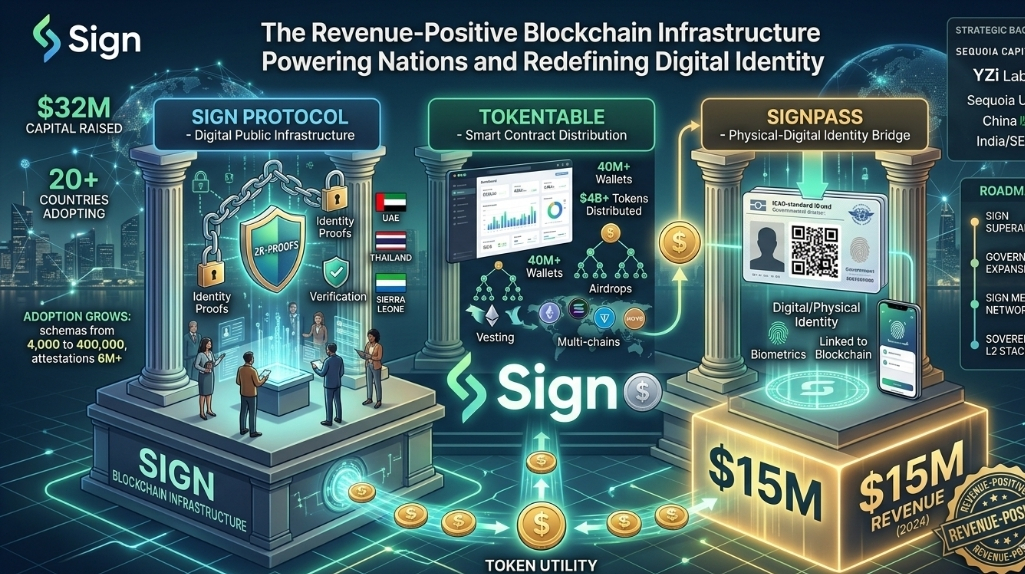
What makes Sign worth paying attention to is not just the technology, though that is impressive enough on its own. The ecosystem rests on three pillars. Let me talk to him First, there is Sign Protocol, which acts as digital public infrastructure for on‑chain verification. It handles everything from identity proofs to ownership claims and contract verification, all using cryptographic signatures and zero‑knowledge proofs so that sensitive data stays private. Then there is TokenTable, a smart contract platform that has already distributed over $4 billion in tokens to more than 40 million wallets. It handles airdrops, vesting, and unlocks using Merkle trees to keep gas costs manageable. The third piece is SignPass, an identity system that bridges the digital and physical worlds by issuing ICAO‑standard ID cards with QR codes linked directly to the blockchain.
The most interesting thing here is How people are adopting it. Sign is one of the few blockchain projects that can genuinely say it is being used by national governments. The UAE, Thailand, and Sierra Leone have already integrated Sign’s infrastructure into their digital systems, and the team is actively expanding into more than twenty other countries, including Barbados and Singapore. That is not a pilot program or a proof of concept—it is live, operational infrastructure handling real government functions.
The economic factor is also important, which frankly sets Sign apart from most of the industry. In 2024, the project pulled in $15 million in revenue. Let that sink in for a moment. That is more than the total amount of capital Sign has raised since its inception. In a space where projects often burn through investor money while chasing user numbers that never materialize, Sign has quietly become one of the few revenue‑positive Web3 infrastructure providers out there. That revenue is coming from government contracts, enterprise token distribution services, and protocol fees—a diversified mix that suggests genuine product‑market fit.
None of this happened in a vacuum. Sign has raised $32 million from serious institutional backers, including Sequoia Capital across its US, China, India, and Southeast Asia funds, along with YZi Labs. That kind of backing tends to signal that the due diligence has been done and the institutional world sees something real here.
The token itself, SIGN, has a total supply of 10 billion, with about 1.2 billion circulating at the time of its listing in late April 2025. But what matters more than the numbers is the utility. $SIGN is not a governance token in search of a purpose. It is the fuel for credential verification, mass airdrops, vesting schedules, and unlock mechanisms across Sign Protocol, TokenTable, and SignPass. Its value is directly tied to how much the ecosystem is actually being used.
And that usage has been growing fast. Over the course of 2024, schema adoption on Sign Protocol jumped from 4,000 to 400,000, while attestations climbed from 685,000 to more than 6 million. Those are the kinds of metrics that reflect real traction, not just hype.
The next step is the roadmap is ambitious but grounded in what the team has already delivered. In the second quarter of 2025, they are launching the Sign SuperApp, a mobile application that will bring the ecosystem’s functionality to a much wider audience. The third quarter is focused on expanding government adoption across those twenty‑plus countries in the pipeline. By the end of the year, Sign plans to launch the Sign Media Network, moving into content and communications infrastructure. And further down the line, there is talk of a Sovereign Layer 2 Stack—a rollup‑as‑a‑service solution built specifically for governments, allowing nations to deploy their own blockchain infrastructure while staying connected to the broader Sign ecosystem.
What is striking about Sign is how it manages to operate at two levels at once. On one hand, it is handling some of the most technical challenges in crypto—omni‑chain attestations, zero‑knowledge proofs, scalable token distribution. On the other, it is winning contracts with sovereign nations and building physical ID systems that meet international standards. That combination of deep tech and real‑world execution is rare, and it is why Sign has started to attract attention from people who usually ignore anything with a token attached.
Whether Sign becomes the digital public infrastructure layer for governments around the world is still an open question. But with $15 million in annual revenue, adoption across three continents, and a roadmap that is already in motion, it is hard to dismiss as just another crypto project. For once, the infrastructure might actually be ahead of the speculation.
#signdigitalsovereigninfra $SIGN @SignOfficial