
I’ve been looking closely at how @MidnightNetwork is designed, and I didn’t expect it to make me rethink something as basic as what “privacy” actually means in crypto.
For a long time, I’ve taken it at face value. If a project claimed privacy, I assumed it meant data was hidden. End of story. But while going through Midnight’s documentation slowly, line by line, I started to feel that this definition is a bit incomplete maybe even outdated.
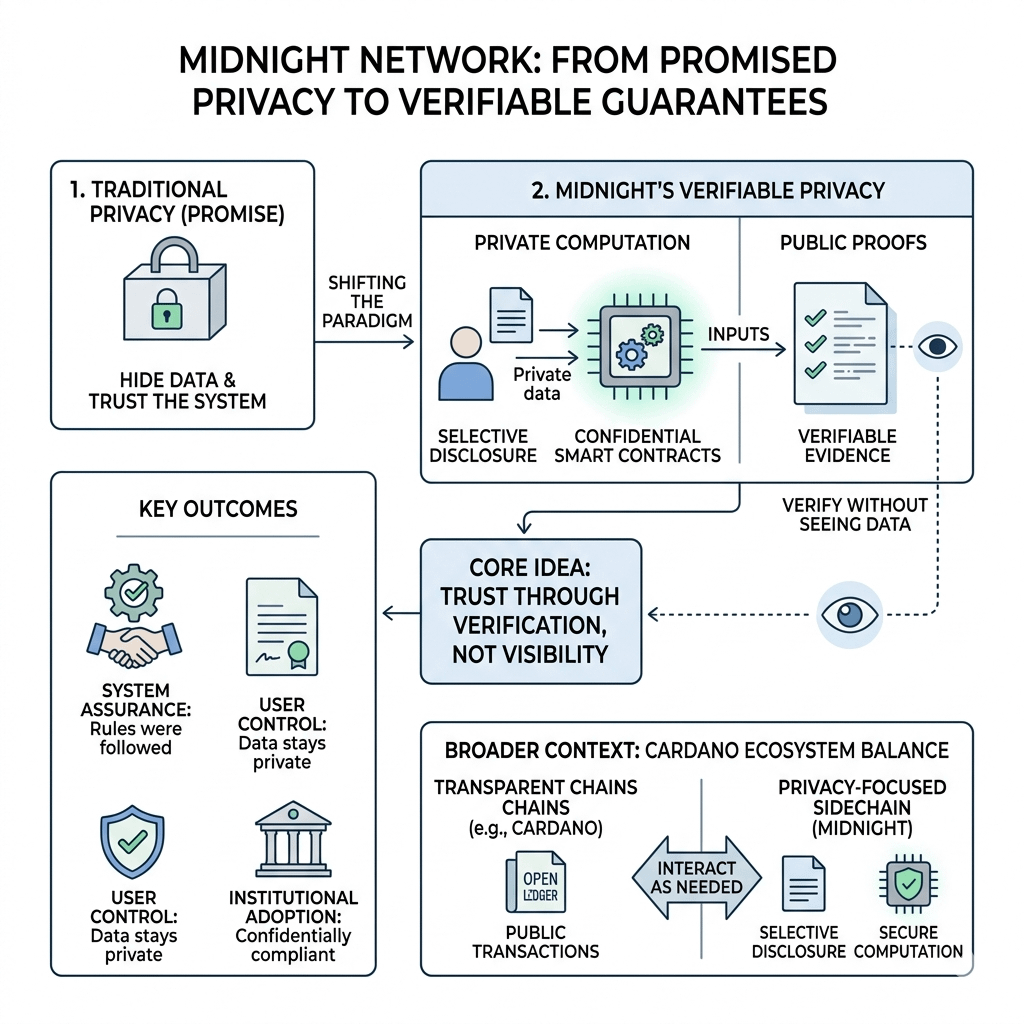
Because hiding data isn’t the same as proving it was handled correctly.
What caught my attention while reading the documentation was how Midnight approaches confidential smart contracts and selective disclosure. The system allows computations to happen on private data, but instead of exposing that data, it produces proofs that the logic was executed as intended.
At first, I had to sit with that idea.
It’s subtle. But important.
You’re not being asked to trust that your data is safe. You’re being given a way to verify that it was used properly without ever seeing it.
That shift felt different to me. Almost like moving from “just believe the system works” to “here’s evidence that it worked correctly.”
In my view, this is where Midnight starts to move privacy from a promise into something closer to a guarantee.
And honestly, that feels more aligned with how trust works in the real world. We rarely expect full transparency in sensitive situations. What we actually look for is assurance proof that rules were followed, without needing to see every detail behind them.
Midnight seems to lean into that idea.
Another thing that stood out to me is how it fits into the broader Cardano ecosystem. It’s not trying to replace transparent blockchains. Instead, it exists alongside them as a privacy focused sidechain, where certain types of logic can remain confidential while still interacting with public systems when needed.
That balance feels intentional.
Some things should be open. Some things shouldn’t. But both should still be trustworthy.
While reflecting on this, I kept thinking about how this changes incentives. If privacy becomes something verifiable, then users don’t have to give up control of their data just to participate. At the same time, institutions might finally have a way to interact with blockchain systems without exposing sensitive information.
But there’s also a quieter layer to this.
These guarantees don’t exist automatically. They depend on how developers design the contracts, how carefully disclosure rules are defined, and how responsibly the system is used in practice.
So while Midnight strengthens the foundation, it also introduces a new kind of responsibility.
Not everything is visible anymore. And that means not everything is easy to check from the outside.
My takeaway so far is that Midnight isn’t just improving privacy features it’s changing the way we think about trust in decentralized systems. Instead of asking whether data is hidden or public, it asks whether the system can prove correct behavior without unnecessary exposure.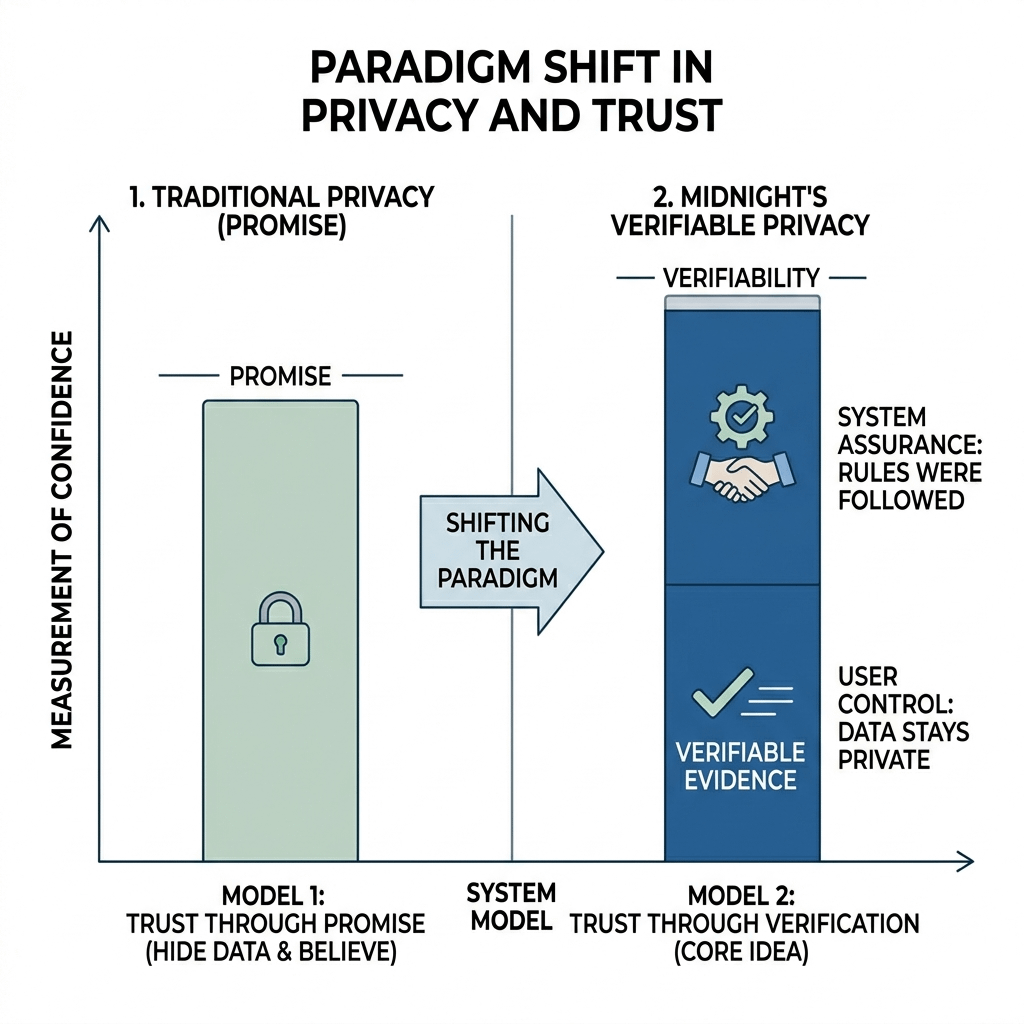
That feels like a more mature way to think about it.
Especially as blockchain moves closer to real-world use cases like identity, finance, and compliance, where privacy isn’t optional it’s essential.
Maybe the future isn’t about choosing between transparency and privacy.
Maybe it’s about building systems where both can exist, and where trust comes from verification, not visibility.
Curious how others are interpreting this idea of verifiable privacy within the Midnight ecosystem.