

I wasn’t even planning to go down this rabbit hole tonight. I was just scrolling, half-awake, trying to ignore another thread about “AI-powered zk identity layers” — whatever that even means anymore — and then I stumbled into SIGN. And now here I am, 2:17 AM, thinking about credential verification like it’s the missing piece of crypto’s identity crisis.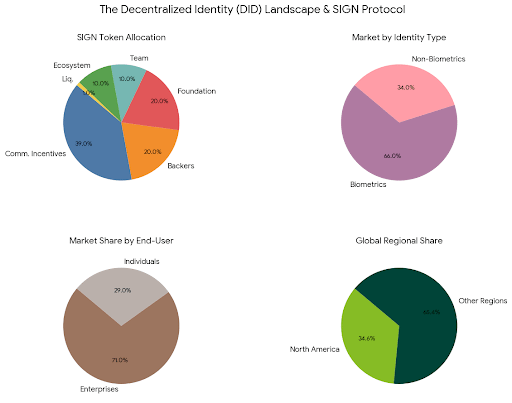
Because honestly, I’m tired.
Not in a dramatic way. Just… tired of watching the same cycle play out. New narrative drops, everyone piles in, tokens pump, Twitter turns into a copy-paste machine of half-understood takes, and then six months later we all pretend we knew it was flawed from the start. DeFi, NFTs, AI, restaking, modular chains — it’s all starting to blur into one long, noisy loop.
And somewhere inside all that noise, there are actually real problems that nobody wants to sit with for more than five minutes.
Identity is one of those problems.
Not the buzzword version. The real one.
Right now, crypto pretends to be this open, permissionless playground, but under the surface it’s full of friction. Airdrops get farmed by bots. Governance gets skewed by whales splitting wallets. Projects want “real users” but have no way to define what that even means without becoming centralized gatekeepers. And every time someone tries to fix it, they either over-engineer it into oblivion or turn it into some dystopian KYC-lite system nobody actually wants to touch.
That’s where SIGN kind of slipped into my view.
Not with a loud announcement. Not with a “this changes everything” thread. Just… there. Quietly positioning itself as infrastructure for credential verification and token distribution.
And I’ll admit, my first reaction was skepticism.
Because “credential verification” in crypto usually translates to one of two things: either it’s a complicated zero-knowledge system that sounds impressive but nobody uses, or it’s a centralized registry dressed up in Web3 language. There’s rarely a middle ground.
But the more I looked at SIGN, the more it felt like it’s trying to sit in that uncomfortable middle space.
Not flashy enough to be hyped. Not simple enough to be dismissed.
The core idea is actually pretty straightforward. Instead of projects guessing who their users are, or relying on wallet activity that can be easily gamed, SIGN focuses on verifiable credentials. Things like attestations, on-chain proofs, structured identity signals that can be issued, verified, and reused across ecosystems.
In theory, that sounds clean.
In practice, it opens up a whole mess of questions.
Because crypto doesn’t just have a tech problem. It has a behavior problem.
People don’t want to verify things. They don’t want extra steps. They don’t want friction. They want rewards with minimal effort. That’s the uncomfortable truth nobody wants to say out loud.
So when I think about SIGN, I don’t just think about whether the system works technically. I think about whether people will actually bother to use it.
And that’s where things get interesting.
Because if you zoom out, the infrastructure side of crypto has been quietly evolving while everyone argues about narratives. Zero-knowledge proofs are getting more usable. Attestation frameworks are becoming more standardized. On-chain data is richer than it was even a year ago.
SIGN is stepping into that environment at a time when the pieces are almost ready, but not quite.
From what I can tell, they’re positioning themselves as a layer that connects identity, credentials, and distribution. Not just proving who you are, but proving what you’ve done, what you qualify for, what you’ve contributed. And then using that data to distribute tokens more intelligently.
That last part matters more than people realize.
Because token distribution is still broken.
Airdrops are either too broad and get farmed into oblivion, or too narrow and miss actual users. Incentive programs attract mercenaries instead of long-term participants. And every project thinks they’ve solved it until the next wave of sybil wallets proves otherwise.
SIGN is basically saying: what if distribution was tied to verifiable credentials instead of guesswork?
It sounds obvious. But obvious ideas are usually the hardest to execute.
And I keep coming back to the same tension.
Infrastructure doesn’t fail because it’s bad. It fails because nobody shows up.
You can build the cleanest credential system in the world, but if projects don’t integrate it, it’s useless. If users don’t engage with it, it’s dead. If it adds even a tiny bit of friction, people will find a way around it.
We’ve seen this before.
Bridges were supposed to unify liquidity. Instead, they became attack vectors. Layer 2s were supposed to scale usage. Instead, liquidity fragmented. Social graphs were supposed to define identity. Instead, they turned into ghost towns after the incentives dried up.
It’s never just about the tech.
It’s about coordination.
And coordination in crypto is messy, unpredictable, and often irrational.
Still, there’s something about SIGN that feels… grounded.
Maybe it’s because they’re not trying to sell a dream of mass adoption overnight. Maybe it’s because credential verification isn’t a sexy narrative. Or maybe it’s just that after years of hype cycles, anything that focuses on infrastructure instead of storytelling feels almost refreshing.
I’ve seen mentions of their attestation protocols being used for governance experiments, reputation systems, and even early-stage distribution models. Nothing massive yet, but enough to suggest that it’s not just theory.
And that’s the key difference for me.
A lot of projects live entirely in the “what if” stage. SIGN seems to be operating in the “let’s try this and see what breaks” stage.
Which, ironically, is where real progress usually happens.
But I’m not naive about it.
There are still big, uncomfortable challenges.
Liquidity is one of them.
Even if SIGN builds the best credential system out there, it doesn’t automatically translate into value. Tokens still need markets. Incentives still need to align. And in a space where capital flows toward narratives, not infrastructure, there’s always a risk that something like this gets overlooked.
Then there’s the investor mindset.
Most people in crypto aren’t here to verify credentials. They’re here to make money. Fast.
So unless credential-based systems directly impact rewards, participation will always be limited. And if the incentives are too strong, the system gets gamed again, just in more sophisticated ways.
It’s a weird paradox.
You need incentives to drive adoption, but incentives distort behavior.
And somewhere in that tension, SIGN has to find balance.
Another thing that keeps bothering me is scalability — not in the technical sense, but in the social sense.
Can credential systems scale across different ecosystems without becoming fragmented? Can they remain interoperable without losing meaning? Can they avoid turning into yet another layer of complexity that only power users understand?
Because if the answer to any of those is no, then we’re just adding another abstraction layer on top of an already complicated stack.
And people are already overwhelmed.
But despite all that, I can’t completely dismiss it.
Because the problem it’s trying to solve isn’t going away.
If anything, it’s getting worse.
As more users enter crypto — real users, not just traders — the need for some kind of verifiable identity layer becomes unavoidable. Not identity in the traditional sense, but identity in terms of actions, contributions, and trust.
And right now, that layer is fragmented at best.
SIGN is one attempt to bring some structure to that chaos.
Not the only one. There are others exploring similar ideas, from decentralized identity protocols to reputation-based systems. But most of them either lean too theoretical or too centralized.
SIGN feels like it’s trying to stay somewhere in between.
Whether that’s a strength or a weakness… I’m not sure yet.
Because being in the middle means you don’t fully satisfy either side.
You’re not pure enough for the decentralization purists. You’re not simple enough for mainstream adoption. You’re just… there, trying to make things slightly better.
And sometimes that’s enough.
Sometimes it isn’t.
I guess what keeps me thinking about it is this: crypto doesn’t really need another flashy product right now. It needs systems that quietly fix the things we’ve been ignoring.
Credential verification is one of those things.
Not because it’s exciting, but because it’s necessary.
And SIGN, whether it succeeds or not, is at least pointing in that direction.
I don’t think it’s going to suddenly redefine the space. I don’t think it’s immune to the same adoption problems every other infrastructure project faces. And I definitely don’t think it’s going to escape the usual cycle of hype, speculation, and eventual disillusionment.
But I also don’t think it’s meaningless.
It’s one of those projects that might slowly integrate into the background, becoming part of the stack without anyone really noticing. Or it might struggle to gain traction and fade into a long list of “good ideas that didn’t quite land.”
That’s the honest range of outcomes.
And maybe that’s the most real thing about it.
Because at the end of the day, crypto doesn’t reward good ideas. It rewards usage.
And usage is unpredictable.
You can build the infrastructure. You can design the system. You can solve the technical problems.
But you can’t force people to care.
So yeah, I’m watching SIGN.
Not with excitement. Not with skepticism either.
Just… watching.
It might end up being one of those quiet layers that everything else builds on.
Or it might just be another late-night rabbit hole I forget about in a few weeks.
Hard to tell.
It might work.
Or nobody shows up.