

When I first looked into Sign, I thought it was just another infrastructure project trying to sound complex. But the more I read, the more I realized it’s actually trying to solve a very real and annoying problem. Not hype. Not narratives. Just one simple question How do you prove something is true, and still use it across completely different systems?
The answer they are working on is something called attestations. In simple words, it’s just a claim that is structured, signed, and verifiable. That’s it. But where it gets interesting is how flexible the system is. You can store full data on-chain if you want maximum trust, but that costs more. Or you can store just a hash and keep the actual data off-chain, which is cheaper. Or even mix both. That choice matters in real-world usage.
Then there are schemas. Honestly, this part hit me the most. Instead of rebuilding logic again and again on every chain, you define a structure once and reuse it. Anyone who has worked across multiple systems knows how painful that problem is. This actually solves something practical.
Under the hood, they are using zero-knowledge proofs and asymmetric cryptography. So instead of exposing full data, you just prove something about it. Like proving you are over 18 without showing your ID. Simple idea, but very powerful.
They also built SignScan, which acts like a search layer across chains. Instead of building your own indexers or APIs, you just query one place. That alone reduces a lot of developer friction.
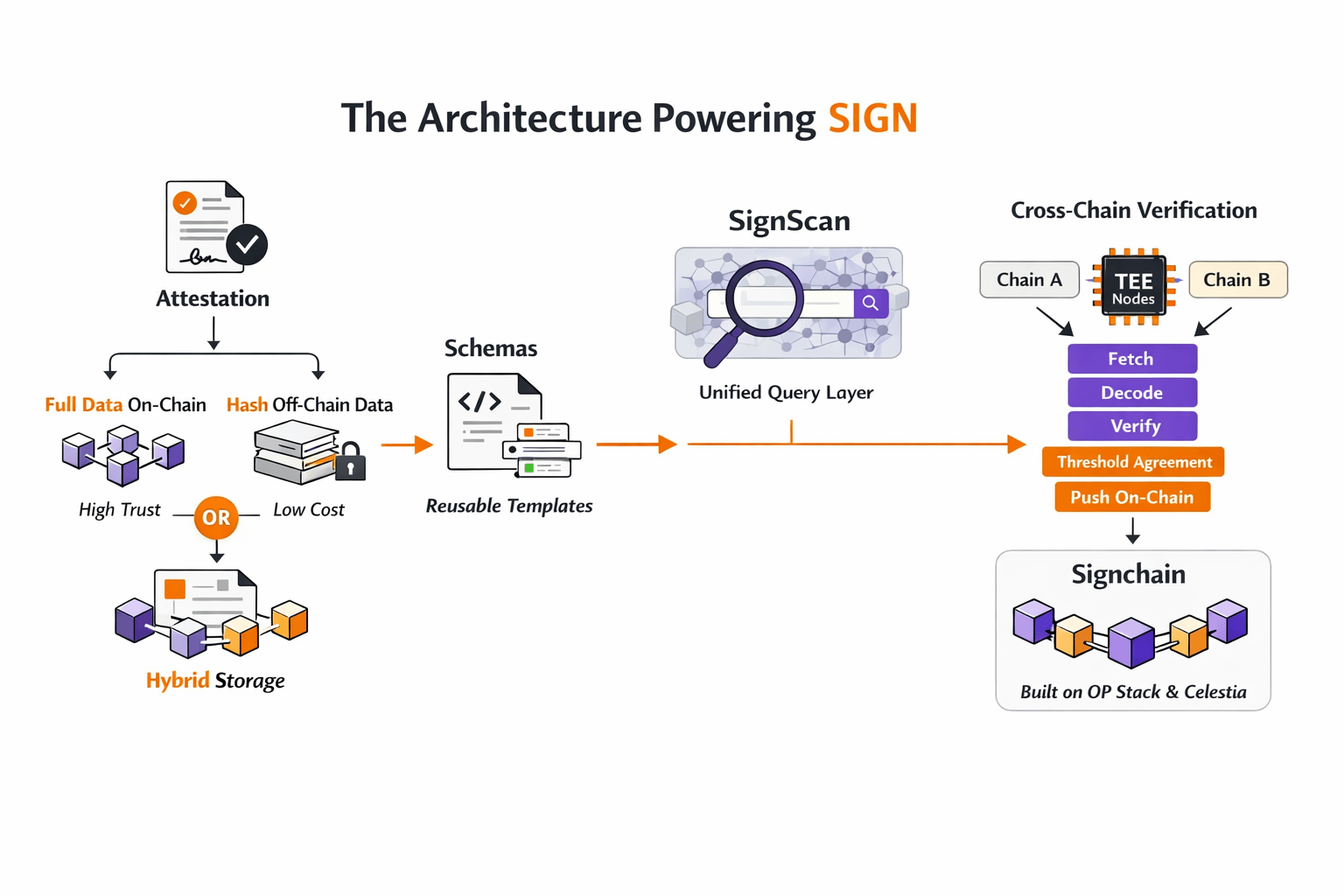
But the part that really made me stop and think is their cross-chain verification system using TEEs and Lit Protocol. Because this is where most systems fail. Bridges break. Oracles get messy. Trust becomes centralized.
Here, they use a network of secure environments. These nodes fetch data, verify it, and then reach a shared agreement before pushing the result on-chain. Not one node, but a threshold like two-thirds must agree. The flow is simple on paper: fetch → decode → verify → sign → push.
And I’ll be honest, this is where I feel both impressed and cautious. On one side, it’s clean and well thought out. It removes single points of failure and uses strong cryptographic guarantees. But on the other side, there are many moving parts. Different chains, different data formats, latency issues, unexpected failures. Real systems rarely behave like test environments.
They also built their own chain, Signchain, using OP Stack and Celestia. That part feels standard. Makes sense for scaling. Nothing too surprising. They already tested over a million attestations and a large number of users, which shows the system can handle some load.
But testnets are easy. Mainnets are not.
Example: Imagine one chain changes how it encodes data slightly. Now another chain tries to verify it. If decoding fails or delays happen, the whole pipeline slows down or breaks. This is example of the kind of edge case I keep thinking about.
Overall, I like the direction. It feels like real engineering, not just storytelling. But I’m still watching one thing closely. Not how it works in theory, but how it behaves when things go wrong.
Because in crypto, systems don’t break when everything is perfect.
They break when reality shows up.