There is a growing realization across the digital world that privacy and utility do not have to be opposites. For years, users have been asked to choose between systems that are useful but invasive, or private but limited. Midnight Network emerges in this context as an attempt to resolve that trade-off by building a blockchain that allows applications to function with full utility while keeping sensitive data protected by design.
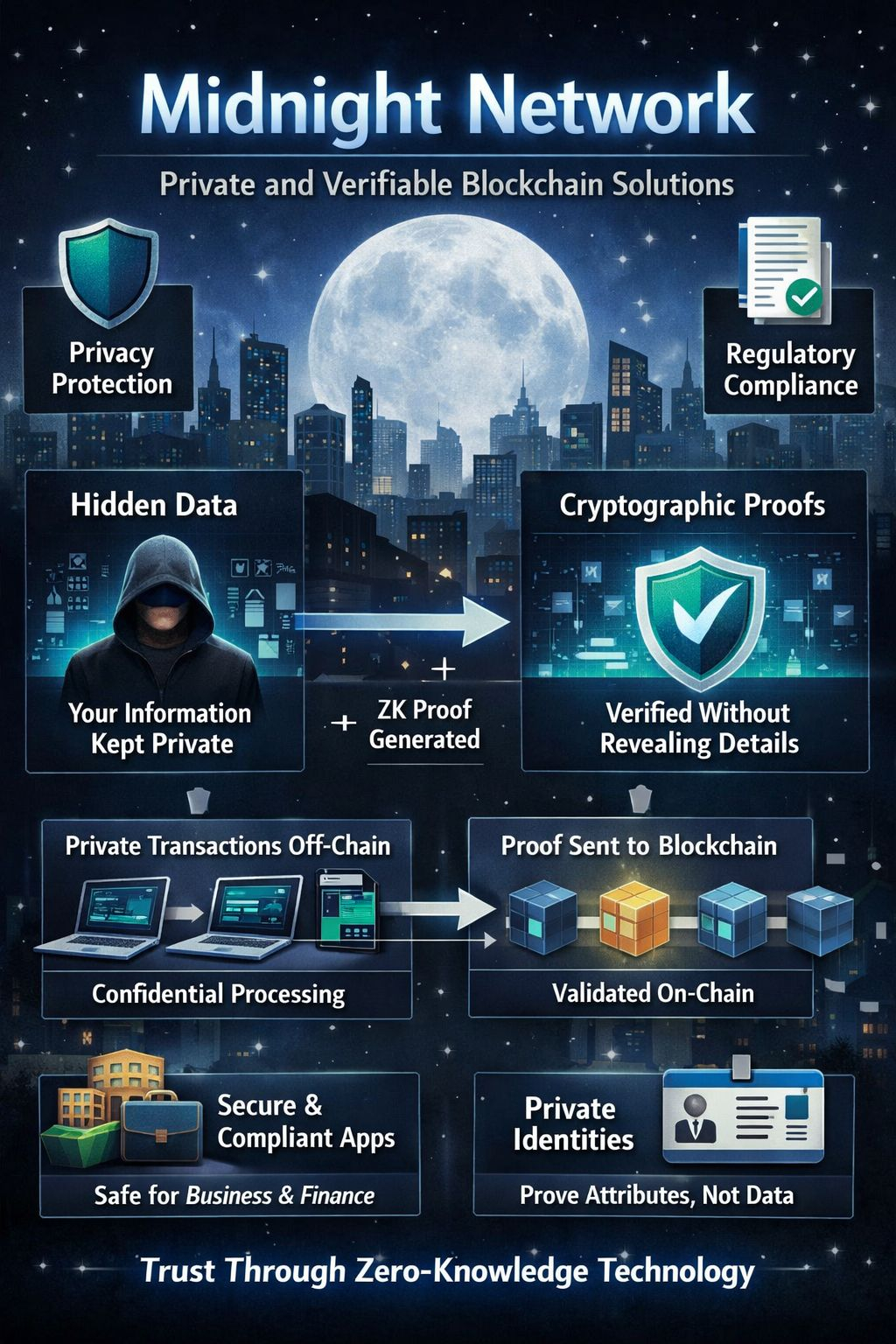
Midnight Network is designed around zero-knowledge proof technology, which allows transactions and computations to be verified without revealing the underlying data. This changes the traditional structure of blockchain systems. Instead of broadcasting everything publicly, Midnight enables selective disclosure, where only the necessary information is revealed while the rest remains private. This approach aligns with a broader shift in the industry toward privacy-preserving infrastructure that still meets regulatory and operational requirements.
At a technical level, Midnight separates the execution of transactions from the verification process. Transactions can occur in a private environment, and then a cryptographic proof is generated to confirm their validity. This proof is what the network verifies, not the raw data itself. The result is a system where correctness is mathematically guaranteed, but user data is not unnecessarily exposed.
This architecture addresses one of the most persistent limitations of earlier blockchains. Transparency ensured trust, but it also created risk. Financial activity, identity-related interactions, and business logic were often visible to anyone. Midnight changes this by embedding confidentiality into the core of the system rather than adding it as an external layer.
The network also reflects a growing emphasis on programmability. Developers can build decentralized applications that operate on private data while still benefiting from the security and composability of a blockchain. This opens the door to use cases that were previously difficult to implement in public environments, such as confidential financial contracts, private identity systems, and enterprise-grade applications where data sensitivity is critical.
One of the important aspects of Midnight Network is its alignment with regulatory realities. Instead of positioning privacy as a barrier to compliance, it introduces mechanisms that allow for controlled disclosure. This means users or institutions can prove compliance with specific rules without revealing all underlying data. It is a more nuanced approach that acknowledges both the need for privacy and the requirements of oversight.
From an ecosystem perspective, Midnight is part of a broader movement toward modular blockchain design. In these systems, different layers handle execution, data availability, and settlement. This separation allows each layer to be optimized independently. Midnight’s focus on privacy positions it as a specialized layer that can integrate with other infrastructures while providing a distinct capability.
Developer trends suggest increasing interest in such architectures. Tooling around zero-knowledge proofs is improving, making it easier to build applications without deep expertise in cryptography. As these tools mature, networks like Midnight become more accessible, encouraging experimentation and innovation.
Economic design within Midnight Network also reflects evolving blockchain models. Instead of relying solely on traditional validators, systems incorporating zero-knowledge proofs often introduce roles related to proof generation and verification. These roles can create new forms of participation and incentives, potentially leading to more distributed and efficient networks.
However, the challenges remain significant. Generating zero-knowledge proofs is computationally intensive, which can impact performance and cost. Although verification is efficient, the process of creating proofs still requires optimization. This is an active area of research and development across the industry.
Another challenge lies in developer adoption. While tools are improving, building privacy-preserving applications still requires a different mindset compared to traditional smart contract development. There is also the broader question of interoperability, as multiple privacy-focused networks emerge with different standards and approaches.
Despite these challenges, the direction is clear. The demand for systems that combine privacy, scalability, and compliance is increasing. Midnight Network represents one approach to meeting that demand, focusing on embedding confidentiality directly into the infrastructure rather than treating it as an optional feature.
Looking ahead, the significance of Midnight Network will depend on its ability to balance three factors: usability, performance, and trust. If it can provide developers with practical tools, maintain efficient operations, and deliver strong privacy guarantees, it has the potential to become a key component in the next generation of blockchain systems.
What makes this development important is not just the technology itself, but the shift in expectations it represents. Users are beginning to question why participation in digital systems requires full exposure. Networks like Midnight suggest a different answer, where trust is achieved through proof rather than visibility, and where ownership includes control over what is shared.
In that sense, Midnight Network is not just building a blockchain. It is contributing to a broader redefinition of how digital systems can respect both functionality and privacy at the same time.