
There’s an assumption inside the $ROBO thesis that feels almost invisible.
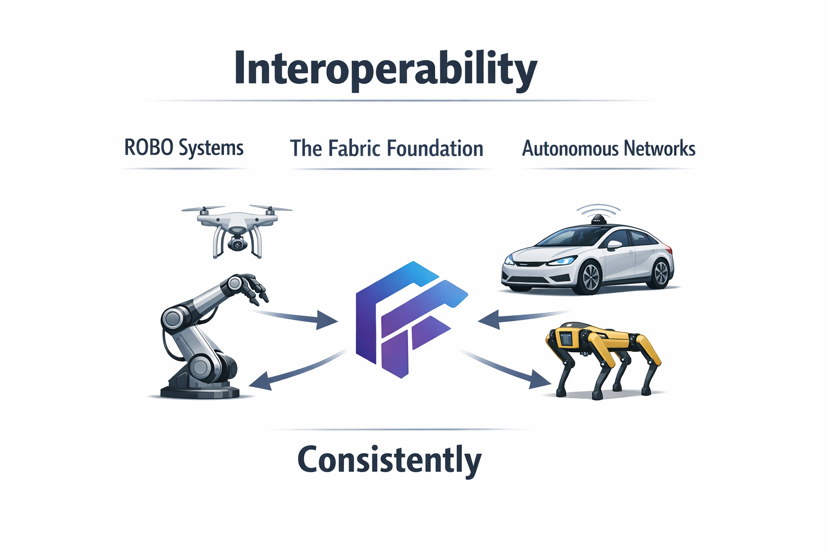
Interoperability.
The Fabric Foundation is implicitly betting that autonomous systems won’t just exist — they’ll need to interact across boundaries in a meaningful way.
Not occasionally.
Not experimentally.
Consistently.
That sounds reasonable on the surface.
But the more I think about it, the more I realize interoperability isn’t a default outcome.
It’s a decision.
And decisions like that are shaped by incentives, not logic.
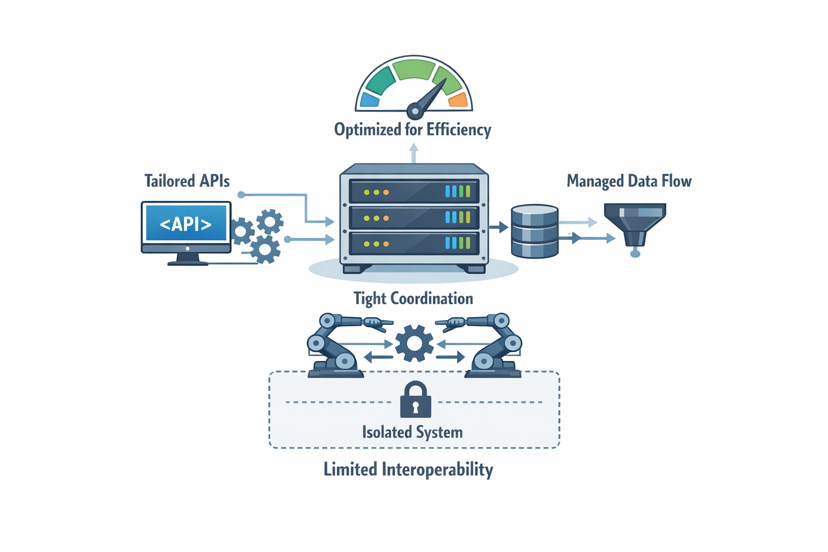
Right now, most machine ecosystems are being designed for performance within controlled environments.
Everything is optimized for internal efficiency.
APIs are tailored.
Data flows are managed.
Coordination is tightly scoped.
In that kind of setup, interoperability is not a priority.
It’s a complication.
This is where the Fabric thesis starts to feel slightly ahead of reality.
Because it assumes a level of cross-system interaction that hasn’t fully materialized yet.
Yes, it might come.
But systems don’t open themselves up unless there’s a clear advantage in doing so.
And that advantage usually comes from pressure.
Pressure from scale.
Pressure from fragmentation.
Pressure from inefficiencies that can’t be solved internally.
Until that pressure builds, closed systems tend to remain closed.
I’ve seen this pattern in other areas of technology.
Interoperability is often celebrated in theory, but resisted in practice.
Because once systems become interoperable, control becomes distributed.
And distributed control is harder to manage.
That’s the quiet tension here.
Fabric is building for a world where interoperability is not just useful, but necessary.
But necessity requires conditions that we’re not fully seeing yet.
So the question becomes less about whether the architecture is valid.
And more about whether the ecosystem evolves in a way that forces that architecture into relevance.
Because if systems remain mostly self-contained, the need for shared coordination layers weakens significantly.
This doesn’t invalidate the thesis.
But it does make it conditional.
Dependent on a shift in how machine ecosystems behave as they scale.
Right now, that shift feels more like a possibility than a certainty.
Which leaves $ROBO in a slightly uncomfortable position.
Not early enough to dismiss outright.
Not obvious enough to fully commit to.
I keep watching for one thing.
Not adoption in the traditional sense.
But signs that systems are starting to outgrow their own boundaries.
Because that’s when interoperability stops being optional.
And until that happens…
This entire layer remains quietly waiting for a world that may still be deciding whether it needs it at all.
#ROBO @Fabric Foundation $ROBO
