
The whole idea of “trustless systems” in Web3 sounds powerful on paper. No middlemen, no central authority, just code and cryptography. But if we’re being honest, trust never really disappears. It just changes form. People still want to know that what they’re signing is valid, that identities are real and that agreements actually mean something. That’s exactly where Sign Coin, through products like EthSign, starts to feel practical rather than just theoretical.
What I find interesting about Sign Coin is that it’s not trying to force a completely new system onto users. Instead, it’s taking something people already understand, signing documents and quietly upgrading how it works behind the scenes. You still upload files add signature fields, invite others and track progress just like you would on any Web2 platform. The difference is that now everything is backed by cryptography and blockchain verification, which adds a layer of transparency that traditional systems simply can’t offer.
From my point of view, this approach makes a lot more sense than trying to reinvent everything at once. Most people don’t want to learn an entirely new way of doing basic tasks. They just want things to work better, safer and faster.
One thing that really stands out is how Sign Coin handles security without making it complicated. Features like EIP-712 signatures ensure that everything is standardized and verifiable but the user doesn’t have to think about the technical side. Then there’s keyless encryption, which removes one of the biggest headaches in digital security, remembering passwords or managing keys. Personally, I think this is a huge step forward. If a system is secure but hard to use, most people won’t stick with it.
Another area where Sign Coin feels different is how it tackles blockchain fragmentation. Anyone who’s spent time in Web3 knows how messy it can get, different chains, different wallets and very little connection between them. It can be frustrating even for experienced users. EthSign’s idea of “lazy verification,” where data is verified when accessed instead of when stored, might sound like a small shift but it actually opens the door for something much bigger.
Imagine users from Bitcoin, Ethereum, Solana, or TON all being able to sign the same agreement without worrying about compatibility. That kind of cross-chain interaction isn’t just convenient, it’s necessary if Web3 is ever going to feel seamless. In my opinion, this is one of the most important directions the space needs to move in.
At the same time, Sign Coin doesn’t ignore the reality that users care about speed and reliability. Let’s be honest, a lot of decentralized apps feel slow or unpredictable. By using an optimized backend, edge servers, and better infrastructure, EthSign improves performance in a noticeable way. Some people might question the use of centralized components like AWS but I see it as a practical decision. There has to be a balance. A perfectly decentralized system that doesn’t work smoothly isn’t useful to anyone.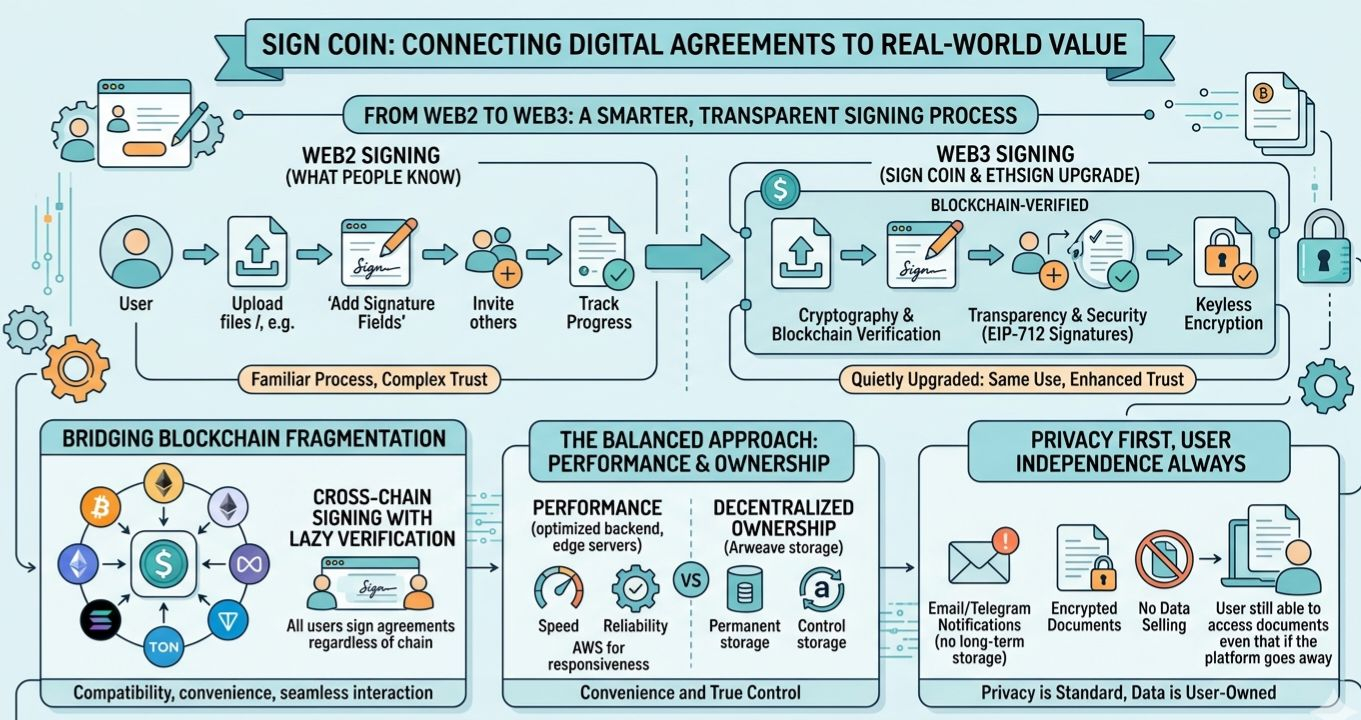
That balance also shows up in how data is stored. While documents are being worked on, they’re handled in a way that keeps things fast and responsive. But once everything is finalized, those agreements are permanently stored on decentralized systems like Arweave. So you get both convenience in the short term and true ownership in the long term. Honestly, this hybrid model feels like the kind of compromise that actually works in the real world.
Privacy is another area where Sign Coin seems to take things seriously. Notifications can be sent through email or Telegram but that information isn’t stored long-term. Documents stay encrypted unless the user decides otherwise. And importantly, the platform doesn’t rely on selling user data. From my perspective, that’s how it should be, privacy shouldn’t be treated as a bonus feature but as a basic standard.
What I appreciate most, though, is the focus on user independence. Even if the platform itself disappeared, users would still be able to access and verify their signed documents through decentralized storage and open tools. That idea, not having to rely on a single company forever, is one of the original promises of Web3 and it’s good to see it actually being applied.
At the end of the day, Sign Coin doesn’t feel like it’s chasing hype. It feels like it’s solving real problems in a way that people can actually use. And in my opinion, that’s what will matter most in the long run. Web3 won’t grow just because of big ideas, it will grow because of practical solutions that fit into everyday life.
For me, Sign Coin represents a shift in mindset. It shows that you don’t need to remove trust completely, you just need to rebuild it in a smarter, more transparent way. And if more projects start thinking like this, the future of Web3 might end up being a lot more usable than people expect.
@SignOfficial #SignDigitalSovereignInfra $SIGN
