

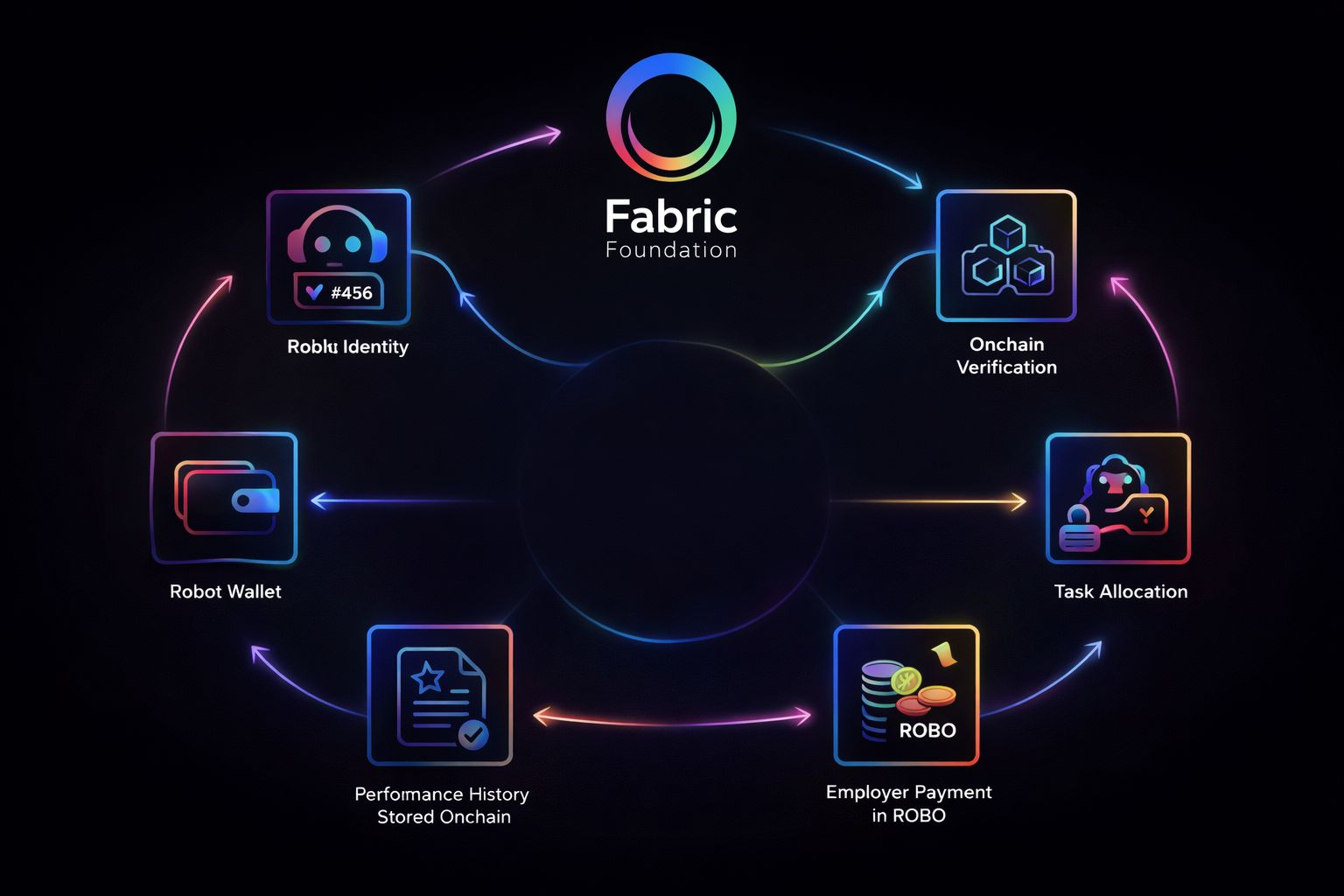
The rapid convergence of artificial intelligence, robotics, and blockchain is ushering in a transformative era where machines are no longer mere tools but independent economic participants. At the forefront of this revolution stands @FabricFND, the Fabric Foundation—a non-profit dedicated to advancing open robotics and AGI for humanity's benefit. Through its innovative Fabric Protocol, the foundation is building the infrastructure for what it calls the "Robot Economy," where robots gain on-chain identities, verifiable work histories, and true financial autonomy.
Central to this vision is ROBO, the native utility and governance token powering the entire ecosystem. With a fixed total supply of 10 billion tokens, ROBO serves multiple critical functions that align incentives across developers, robot operators, AI agents, and the broader community.
First, ROBO acts as the gas for the network. Every transaction—whether registering a robot's digital identity, verifying computational tasks, paying for micro-services between devices, or settling machine-to-machine payments—is denominated and settled in $ROBO. This creates real demand as adoption grows, especially as the protocol starts on Base and plans to evolve into its own Layer-1 chain to capture value from global robotic activity.
Second, staking $ROBO enables network security and participation. Node operators and validators stake tokens to bond their contributions, earning rewards for maintaining the decentralized coordination layer. This staking mechanism ensures trust in verifiable computing, where robots' actions and outputs are provably correct on-chain—crucial for a future where autonomous agents handle complex, real-world tasks without centralized oversight.
Governance is another powerhouse utility. $ROBO holders can propose and vote on key parameters like fee structures, protocol upgrades, and ecosystem grants. This decentralized decision-making ensures the network remains community-driven and adaptable, preventing any single entity from dominating the robot economy.
What sets Fabric Foundation apart is its mission-driven approach. As a non-profit, it prioritizes open-source robotics and equitable access over pure profit extraction. By giving robots sovereign wallets and economic agency, Fabric enables scenarios like autonomous drones paying for charging stations, factory bots negotiating repairs, or home assistants earning and spending value independently. This isn't just tech—it's a paradigm shift toward a collaborative, machine-inclusive global economy.
Recent milestones highlight momentum: listings on major exchanges, partnerships expanding interoperability (like with agent protocols), and community distributions via airdrops have fueled early adoption. As AI agents proliferate and physical robotics scales, ROBO stands to become the backbone currency for trillions in automated value exchange.
For anyone bullish on DePIN, AI-crypto fusion, or the next wave of decentralization, @Fabric Foundation and $ROBO represent foundational infrastructure worth watching closely. The robot era isn't coming—it's already being built, one on-chain transaction at a time. 🚀