
I’ve spent the last few weeks digging into the Midnight Network, and the more I look at the architecture, the less it feels like a typical layer-1 launch. Most new chains pitch faster speeds or cheaper fees, but Midnight is doing something fundamentally different with how value moves inside the ecosystem. It’s separating the asset you hold for ownership from the asset you burn for usage, and that distinction is more significant than I think people realize.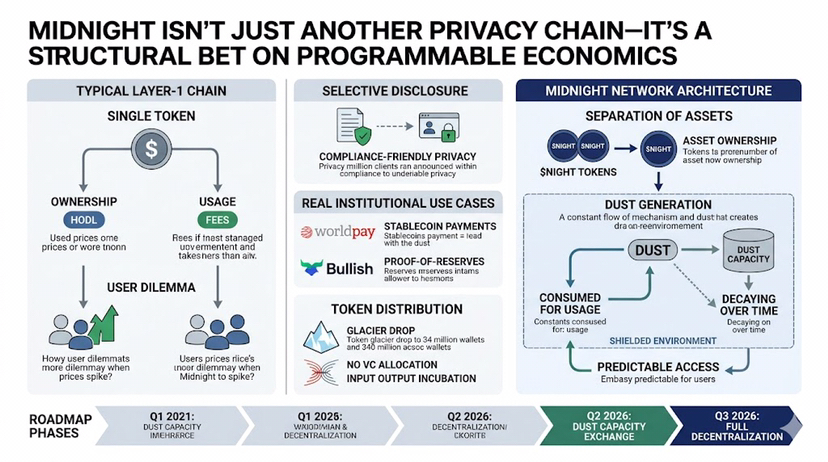
The native token here is $NIGHT, and its role isn’t just to be a medium of exchange on the network. It’s designed as the anchor of the entire economic model—the asset that generates DUST, which is the actual resource consumed for transactions . DUST isn’t a token you can trade or speculate on. It decays over time and stays within the shielded environment, meaning the only way to access network capacity is to hold NIGHT. That’s a deliberate mechanism to create recurring, on-chain demand without forcing users to sell their primary asset every time they want to interact with a smart contract .
That structure solves a problem that has quietly plagued every major layer-1 blockchain. Think about it: on Ethereum or Cardano or Solana, the same token you believe in as a long-term investment is the one you have to spend when the network gets congested. When prices spike, usage becomes prohibitively expensive. When prices crash, security budgets get squeezed. Midnight breaks that cycle. You hold NIGHT, it passively generates DUST, and that DUST handles the operational costs regardless of what the market price of NIGHT is doing . It’s a design choice that prioritizes predictable access over speculative volatility, and it shifts the incentives toward long-term participation rather than short-term trading.
The timing of this matters. Midnight is moving through its roadmap in phases, and we’re currently in the Kūkolu phase, which is focused on getting privacy-enhanced dApps live and proving out the use cases . What I find compelling is that the network isn’t trying to be everything to everyone right away. Phase one is laser-focused on DeFi—decentralized exchanges, lending protocols, and high-volume on-chain activity where programmable privacy actually gives developers a competitive edge . The idea is to build traction where the technology offers the clearest benefit, then expand into enterprise use cases like healthcare, identity, and supply chain once the infrastructure is battle-tested.
That enterprise angle isn’t theoretical. Worldpay, one of the largest payment processors globally, is running a proof-of-concept on Midnight to test how stablecoin payments can work for merchants while maintaining AML and KYC compliance . Bullish is building a proof-of-reserves system on the network that lets exchanges verify solvency without exposing sensitive wallet data or trading histories . These aren’t small experiments. They’re real institutions trying to solve real compliance problems, and Midnight’s selective disclosure model gives them a path forward that didn’t exist before.
The compliance piece is worth sitting with for a moment. Privacy chains have historically struggled with this balance. If you shield everything, regulators treat you as a risk. If you expose everything, enterprises can’t use you. Midnight’s approach is to bake zero-knowledge proofs into the core protocol so that transactions can be validated without revealing metadata like wallet addresses, values, or timestamps . But crucially, the system allows for programmable disclosures—you can prove you’re compliant without handing over your entire financial history. Fahmi Syed from the Midnight Foundation described this as “rational privacy,” and I think that framing captures the shift. It’s privacy designed for institutions that have to answer to auditors, not privacy designed to hide from them .
The token distribution also tells you something about how the team is thinking about decentralization. Midnight ran the Glacier Drop, which was one of the largest airdrops in crypto history, targeting over 34 million eligible wallets across eight different blockchain ecosystems . That wasn’t just a marketing gimmick. The goal was to get NIGHT into the hands of people who were already participating in crypto, not to concentrate supply with insiders. There’s no venture capital allocation to create artificial scarcity. The project was incubated by Input Output and funded directly by Charles Hoskinson, which means the tokenomics weren’t designed to pay back investors but to align incentives around actual network usage .
What I’m watching now is how the developer experience evolves. Midnight recently opened up its prepro environment for developers to migrate dApps, and the feedback has been that the tooling is getting more stable but still requires a shift in how you think about state management . The network supports shielded and unshielded data side by side, which means developers have to explicitly decide what information stays private and what becomes public. That’s a different mental model than building on a transparent chain, but it’s also where the value is. The projects that figure out how to use selective disclosure effectively will have a real advantage when enterprises start looking for compliant privacy solutions.
The roadmap has clear milestones. Q2 2026 is when stake pool operators and node operators come online, marking the transition toward operational decentralization . The DUST Capacity Exchange goes live in that phase, which is essentially the market mechanism for generating and managing the shielded resource. Q3 brings the full decentralization phase, where hybrid public-private dApps are expected to be running in production and the network is positioned to support institutional-scale use cases . That timeline is aggressive but specific, and the fact that they’ve already brought on infrastructure partners like Fireblocks, Copper, and Alchemy suggests they’re serious about the institutional path .
I’m not here to tell you that NIGHT is undervalued or that you should buy it. The market can figure that out on its own. What I am saying is that the network is solving a structural problem that other chains have ignored, and they’re doing it with a level of institutional infrastructure that’s unusual for a mainnet that just launched. The separation of ownership from consumption, the focus on selective disclosure rather than blanket privacy, and the phased approach to decentralization all point to a team that’s thinking about the long-term viability of the network, not just the token price.