If you Want Knowledge of Midnight Network Read Carefully And Understand If you can't understand text me I'm here to help you Thanks Enjoy
Everyone is tokenizing real-world assets right now.
I have watched this narrative build for two years. Real estate on-chain. Art provenance on blockchain. Commodities tokenized. Music rights digitized. The pitch is always the same — immutability, transparency, efficiency. And then someone in the room asks the question nobody wants to answer.
Who can see this?
Because on most public blockchains, the answer is everyone. Every transaction. Every ownership transfer. Every price paid. Every wallet involved. Permanently. Publicly. Forever.
That is not a minor detail. For most real-world asset use cases, that level of exposure is not just uncomfortable — it is a dealbreaker. Hedge funds cannot show their positions. Family offices cannot expose ownership structures. Real estate developers cannot reveal transaction history. Institutions that spent decades building operational privacy cannot simply abandon it because the technology is interesting.
This is where I keep coming back to Midnight.
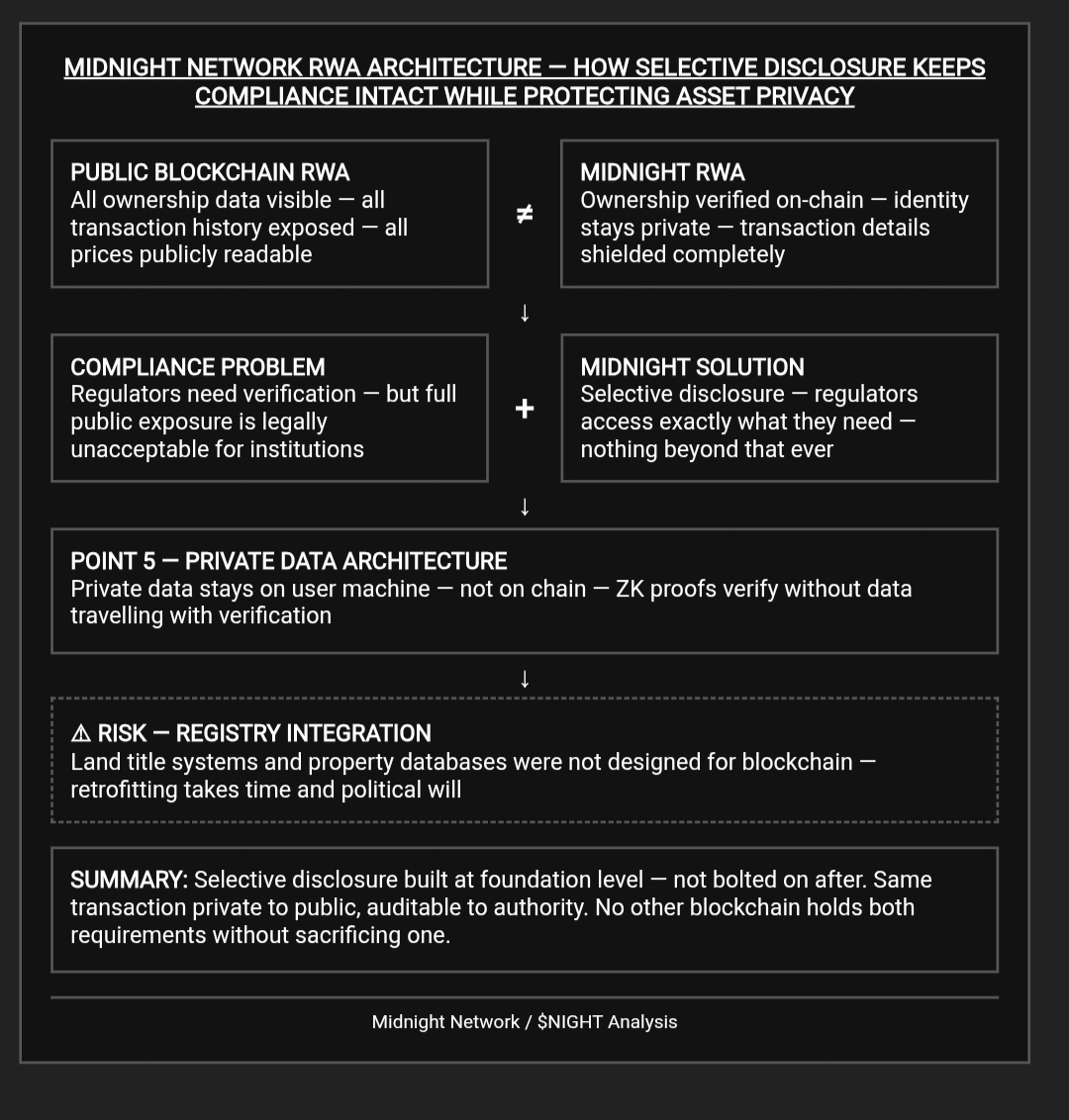
The litepaper is specific about this. Asset ownership certification can live on-chain without compromising the owner's identity, the asset's details, or asset-related activity. That sentence is doing a lot of work. It means the asset is verifiable — provably real, provably owned — without the underlying data being exposed to anyone who runs a blockchain explorer.
Zero-knowledge proofs make this possible. Ownership is proven without revealing who owns it. Transaction validity is confirmed without exposing what was transacted. The verification happens. The data does not travel with it.
And the compliance layer is not bolted on after the fact. Selective disclosure is built into the architecture. Regulators can be given access to exactly what they need — and nothing beyond that. The same transaction that is private to the public is auditable to the appropriate authority. That distinction matters enormously for any serious institutional use case.
The asset classes the litepaper specifically mentions — real estate, artwork, raw materials, music licensing — are not random choices. They are the categories where provenance matters most, where ownership disputes are most costly, and where the combination of on-chain verification and off-chain privacy creates the most obvious value.
The challenge I sit with is timing and integration. Most existing asset registries are not built for this. Land title systems, property databases, regulatory frameworks — they were not designed with blockchain interoperability in mind. Retrofitting them takes time, political will, and institutional commitment that moves slowly.
The technology is ready before the systems around it are. That gap is real and I am not dismissing it.
But the direction feels right. And for real-world assets specifically, I have not found another blockchain that holds the privacy requirement and the verification requirement at the same time without sacrificing one for the other.
What asset class do you think gets tokenized at scale first — and does privacy matter to that use case?
If you want to understand the technical architecture behind this, Midnight's litepaper covers it in detail. Worth reading before the narrative gets louder.
#night @MidnightNetwork $NIGHT