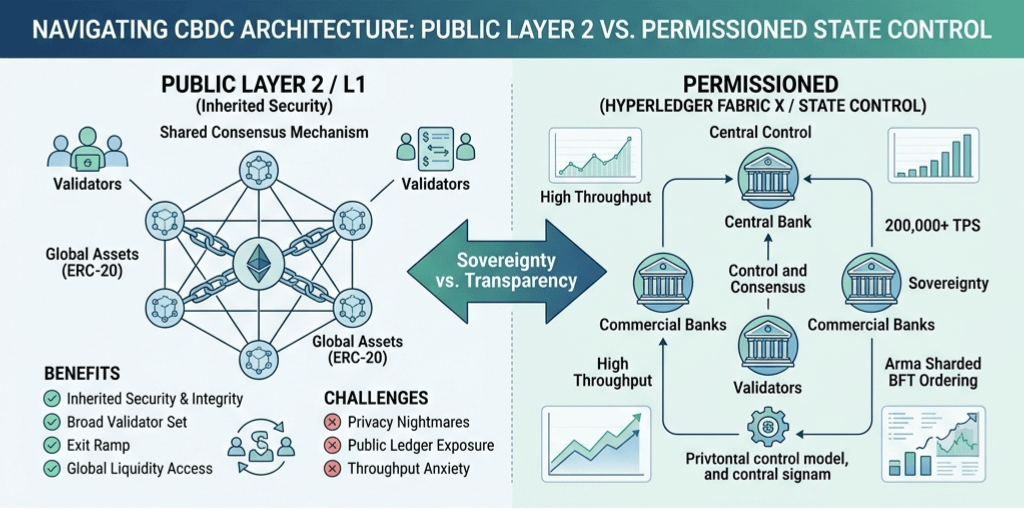
I’ve been watching the architectural arms race in the sovereign crypto space for a while now and it’s finally hitting that point where the whiteboards are being traded in for cold hard infrastructure. When I look at the security models being pitched to central banks right now I see a classic tension between the cypherpunk dream of the public commons and the paranoid reality of state control. The pitch for building on Layer 2 or existing smart contract chains is seductive because you get to inherit a validator set that’s already been through the wars. You’re essentially hitching your national wagon to a network that has survived every exploit and stress test the internet could throw at it which is a hell of a lot better than trying to spin up a solo consensus mechanism in a basement. It gives you this baked-in integrity where the broad network verifies your state transitions and users have a clear exit ramp if things go sideways but let's be honest about the trade offs here.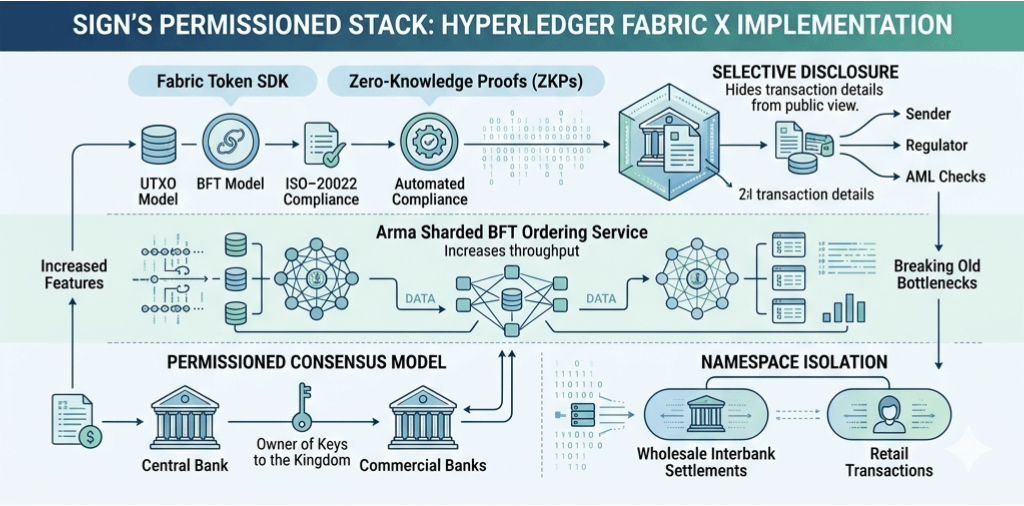
The real friction starts when you realize that most governments aren't actually looking for total decentralization and they definitely aren't ready for the transparency of a public ledger. This is where the Sign stack tries to play both sides of the fence by offering that global financial access. It’s a beautiful vision on paper to have a national stablecoin or a digital registry that can be bridged into the global liquidity of things like ETH or USDC without building a private walled garden from scratch. You get the standardized assets like ERC-20s and the ability to tokenize land titles or business licenses on a foundation that the rest of the world actually recognizes. But the bone-deep reality is that a public EVM chain is a nightmare for privacy-sensitive financial operations. You can’t exactly run a retail CBDC where every citizen's grocery bill is a matter of public record for any bored teenager with an explorer tab to find.
That’s why we’re seeing this pivot toward things like Hyperledger Fabric X because at the end of the day central banks are addicted to sovereignty. They want the performance of 200,000 transactions per second and they want it delivered through a microservices architecture that they control from top to bottom. The tech behind this is actually quite impressive with the Arma sharded BFT ordering service breaking the old monolithic bottlenecks but it’s still fundamentally a permissioned world. It’s a system where the central bank owns the keys to the kingdom and commercial banks are relegated to being high-end validators. They’ve built this clever namespace isolation to separate the wholesale interbank settlements from the retail transactions which is a practical way to manage the data flow but it lacks that raw permissionless energy that made crypto interesting in the first place.
The implementation of zero-knowledge proofs via the Fabric Token SDK is the industry’s attempt to have its cake and eat it too. By using a UTXO model and ZKPs they can hide the details of a retail transaction from everyone except the sender and the regulator which is the exact kind of selective disclosure that keeps compliance officers awake at night. It’s all very sophisticated with its ISO-20022 compliance and automated AML checks but we have to ask if we’re just rebuilding the old banking system with faster plumbing. We’re moving away from the messy beautiful chaos of the open web and heading toward a highly polished digital terminal. It’s less like discovering a new continent and more like upgrading a container terminal where the efficiency is undeniable but the spirit of the thing has been thoroughly domesticated.