Midnight wasn’t what I expected at first.
On the surface, it looks like just another privacy-focused chain trying to fix data exposure. But the more I looked into it—especially the early sidechain research from Input Output—it started to feel less like a new idea and more like something that’s been building quietly for years.
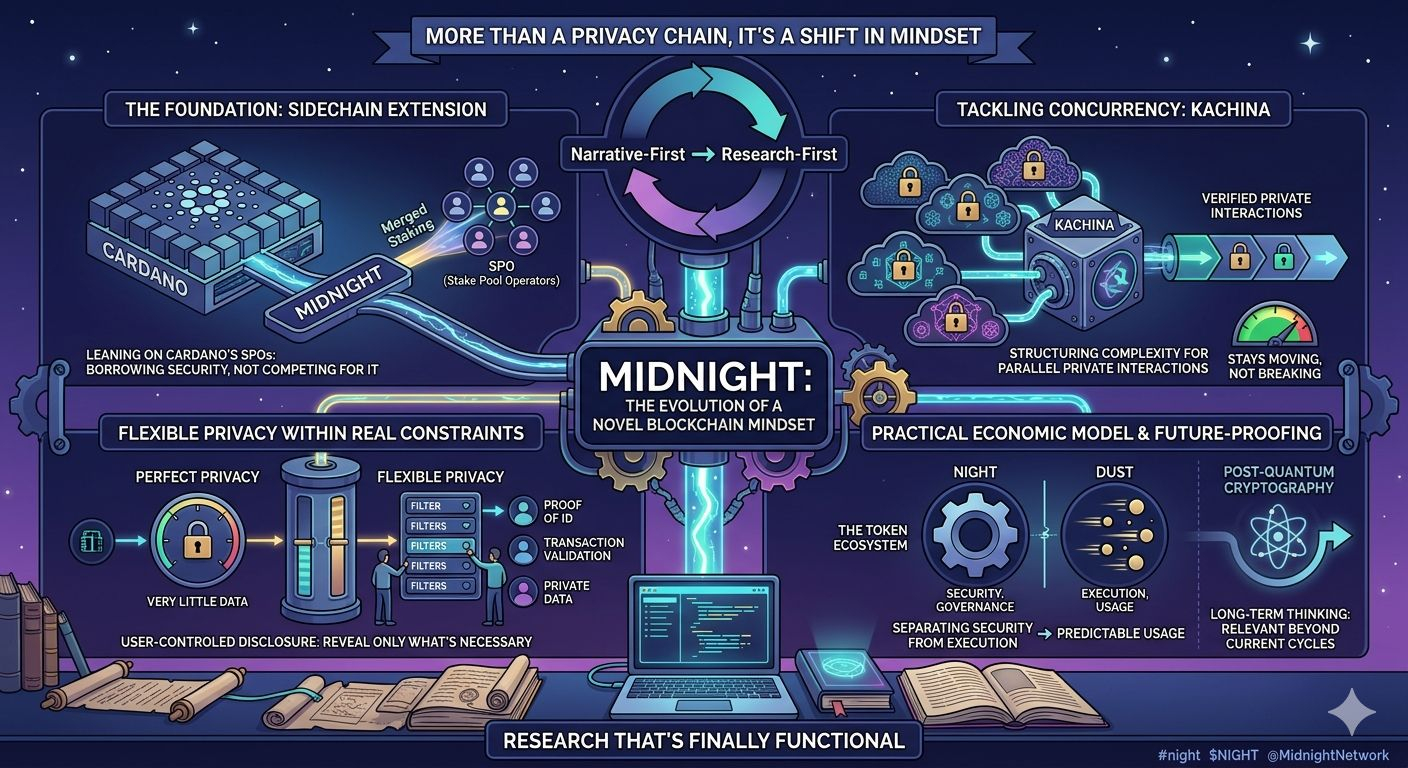
The foundation matters. Instead of forcing everything onto a single chain, the sidechain approach extends existing infrastructure. That thinking carries into Midnight’s design, especially with merged staking. Rather than creating a new validator network, it leans on Cardano’s stake pool operators—borrowing security instead of competing for it. That’s a subtle but important difference.
Then there’s Kachina, which tackles one of the less discussed issues in privacy systems: concurrency. Handling multiple private interactions at once is where many systems struggle. Midnight doesn’t eliminate that complexity, but it structures it in a way that keeps things moving instead of breaking under pressure.
What stands out is the mindset behind it. Midnight isn’t chasing perfect privacy—it’s working within real constraints. It treats privacy as something flexible, where users reveal only what’s necessary, not everything or nothing.
The economic model reflects that practicality too. Separating NIGHT and DUST creates a clearer distinction between security and execution. Instead of tying usage to volatile token prices, it introduces a system that feels more predictable and usable.
Even the mention of post-quantum cryptography hints at long-term thinking. It suggests the goal isn’t just to fit the current cycle, but to stay relevant beyond it.
Overall, Midnight doesn’t feel like a narrative-first project. It feels like research that’s finally turning into something functional—focused on fixing problems that have been overlooked for a long time.
#night $NIGHT @MidnightNetwork