I remember getting caught up in a few “infrastructure plays” that looked solid on the surface. The narrative made sense better payments, faster chains, more scalable systems. Price was moving, people were talking, and it felt like early positioning.
But once I dug deeper, most of those systems were still isolated. Payments didn’t connect to identity. Identity didn’t connect to compliance. And nothing really explained how governments would actually operate these systems at scale.
That’s when it clicked for me.
It’s not enough to build better rails.
If the systems don’t connect they don’t work in the real world.
Since then, I’ve started looking less at hype and more at how infrastructure fits together under real constraints like policy, auditability, and coordination.
That mindset is exactly why @SignOfficial caught my attention.
Not because it’s another “blockchain for governments” idea.
We’ve seen plenty of those.
But because it raises a more interesting question:
What would it take to run an entire national system money, identity, and capital on infrastructure that can actually be verified?
And more importantly:
Can one system realistically connect all three without breaking under scale, regulation, and complexity?
That’s where things get serious.
Because if the answer is yes, then S.I.G.N. isn’t just another protocol.
It starts looking more like a foundational layer governments could actually rely on.
According to the documentation, S.I.G.N. is structured around three interconnected systems: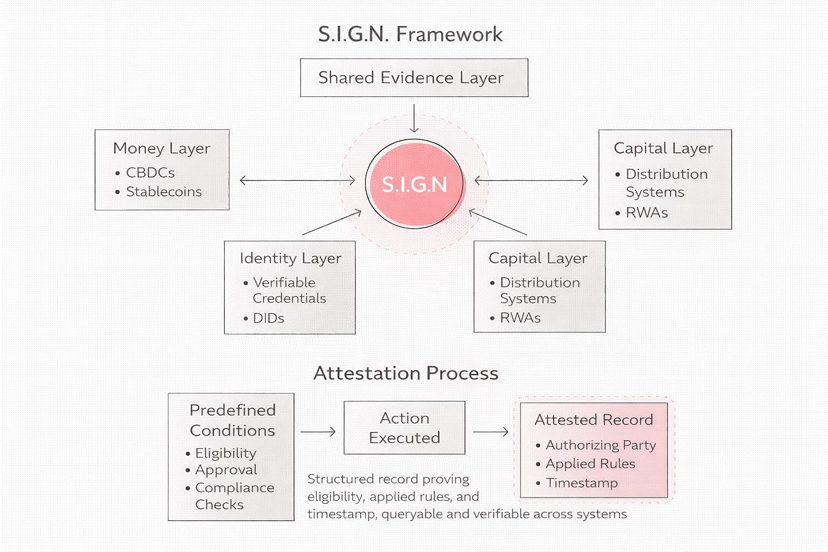
a Money layer (CBDCs and regulated stablecoins)
an Identity layer (verifiable credentials and DIDs)
a Capital layer (distribution systems, grants, RWAs)
But the interesting part isn’t the layers themselves.
It’s how they’re connected through a shared evidence layer.
This is where attestations come in.
Think of it like this:
In trading, you don’t just open a position you post margin, and everything is recorded so the system can enforce rules later.
S.I.G.N. applies a similar idea to real-world systems.
Before something happens like a payment or a benefit distribution there are conditions:
eligibility
approvals
compliance checks
When the action executes, it produces a structured record (an attestation) that proves: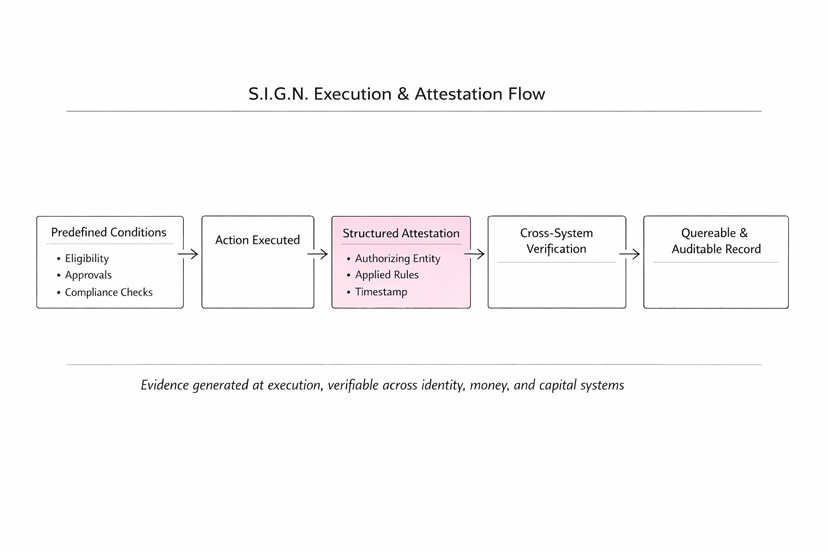
who authorized it
which rules were applied
when it happened
These records aren’t just logs. They’re queryable and verifiable across systems.
That matters because most failures in national systems don’t come from execution they come from lack of coordination and traceability.
S.I.G.N. tries to solve that by making identity, money, and capital operate on shared, verifiable infrastructure.
The market is slowly starting to notice projects in this category, but it’s still early for infrastructure at this level.
Unlike typical tokens where you can track hype through volume or retail participation, systems like S.I.G.N. operate on a different timeline.
There isn’t immediate price discovery tied to memes or narratives.
Adoption depends more on:
institutional integration
developer activity
real-world deployments
What I find interesting is that this shifts how you evaluate traction.
Instead of asking: “Is volume increasing?”
You start asking:
Are builders integrating the protocol?
Are attestations being created and queried?
Are real programs using this infrastructure?
In other words, the signal moves away from speculation and closer to usage quality.
But this is where the real test appears.
The biggest challenge isn’t whether the architecture makes sense.
It’s adoption across systems that don’t naturally coordinate.
Because S.I.G.N. only works if multiple layers move together:
identity systems
payment rails
distribution programs
If one of these lags, the whole system loses effectiveness.
For example:
You can have a strong payment rail.
But without reliable identity, you can’t enforce eligibility.
You can build a distribution system.
But without verifiable evidence, you can’t audit it properly.
So the real metric here isn’t TPS or token price.
It’s integration depth.
Are governments, builders, and institutions actually using all three layers together?
Because if they don’t, S.I.G.N. risks becoming another fragmented solution the exact problem it’s trying to solve.
But if coordination happens, the system becomes much harder to replace.
So what would make me more confident in this direction?
I’d want to see:
consistent usage of attestations across different systems
real integrations where identity, payments, and capital interact
developer tools being actively used (not just documented)
On the other hand, I’d become more cautious if:
adoption stays isolated to one use case
systems rely on S.I.G.N. only partially instead of fully
evidence layers are underutilized or ignored
Because at that point, the architecture might be sound… but the ecosystem isn’t aligning around it.
And without alignment, infrastructure doesn’t scale.
So if you’re watching S.I.G.N., don’t just watch narratives around CBDCs or digital identity.
Watch how well the system connects its layers.
In markets like this, the difference between interesting ideas and real infrastructure usually comes down to one thing:
Do systems actually work together when it matters?
Because building one strong component is easy.
Building something that holds under national scale… that’s a different game.
#SignDigitalSovereignInfra #Sign $SIGN