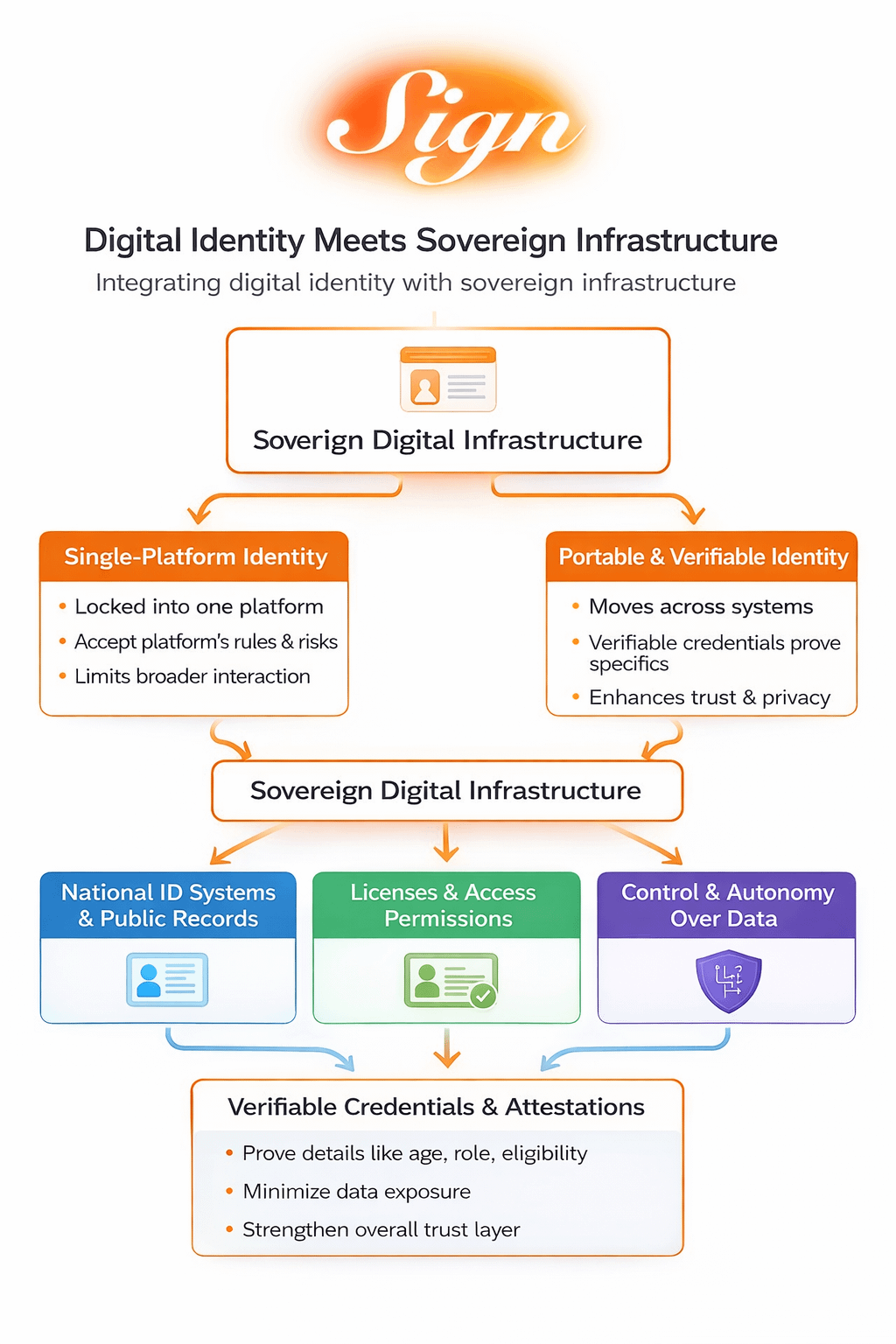
I don’t see digital identity as just a login issue anymore. It’s become something much bigger something that touches governance, security, and even sovereignty. The reality is simple: whoever controls identity ends up shaping who can participate and how. That’s why it doesn’t make sense to treat identity as a side feature. It needs to be built into the foundation of digital infrastructure itself.
When identity is locked into a single platform, you’re not just using a service you’re also accepting its rules, its limits, and even its risks. That can work on a small scale, but it doesn’t hold up when people and systems need to interact more broadly. A more practical approach is to make identity portable and verifiable, so it can move across systems without losing its meaning. That kind of continuity makes digital interactions smoother and more reliable, not just for individuals but for institutions as well.
For countries, this becomes even more critical. A strong digital infrastructure should be able to handle things like national ID systems, public records, licenses, and access permissions without relying entirely on outside providers that aren’t fully transparent. At the same time, it shouldn’t be cut off from the rest of the world. The goal isn’t to build walls it’s to create systems that can connect globally while still maintaining control locally.
This is where verifiable credentials and attestations start to make a real difference. Instead of identity being just a stored record, it becomes something you can prove when needed. A person can confirm specific details like age, role, or eligibility without revealing more than necessary. That not only protects privacy but also makes verification faster and more efficient for everyone involved.
From my perspective, Sign fits naturally into this direction. It helps turn claims into something that can be checked across different systems without friction. That doesn’t just improve identity it strengthens the entire layer of trust that sits underneath digital interactions. Once identity is built on something verifiable, everything else that depends on it becomes more stable and easier to manage.
Looking ahead, I don’t think the focus will be on collecting more and more user data. It will shift toward proving the right things at the right time, with as little exposure as possible. That’s the kind of approach that actually builds trust and it’s what sovereign digital infrastructure should aim for.
@SignOfficial #SignDigitalSovereignInfra $SIGN