

I have started looking at digital money systems a little differently lately. The question holding my attention is simple: how do you make money programmable, supervised, and auditable without making every payment overexposed?
That is where S.I.G.N. began to feel more serious to me.
The friction is plain enough. A CBDC usually wants permissioning, lawful supervisory access, deterministic settlement, and stronger privacy for ordinary users.
A regulated stablecoin may still need policy controls, but it often benefits from transparent execution, easier composability, and broader network reach.
Those are related goals, not identical ones. When one rail is forced to do both jobs in the same way, either privacy gets weakened or openness gets choked.
@SignOfficial #SignDigitalSovereignInfra $SIGN 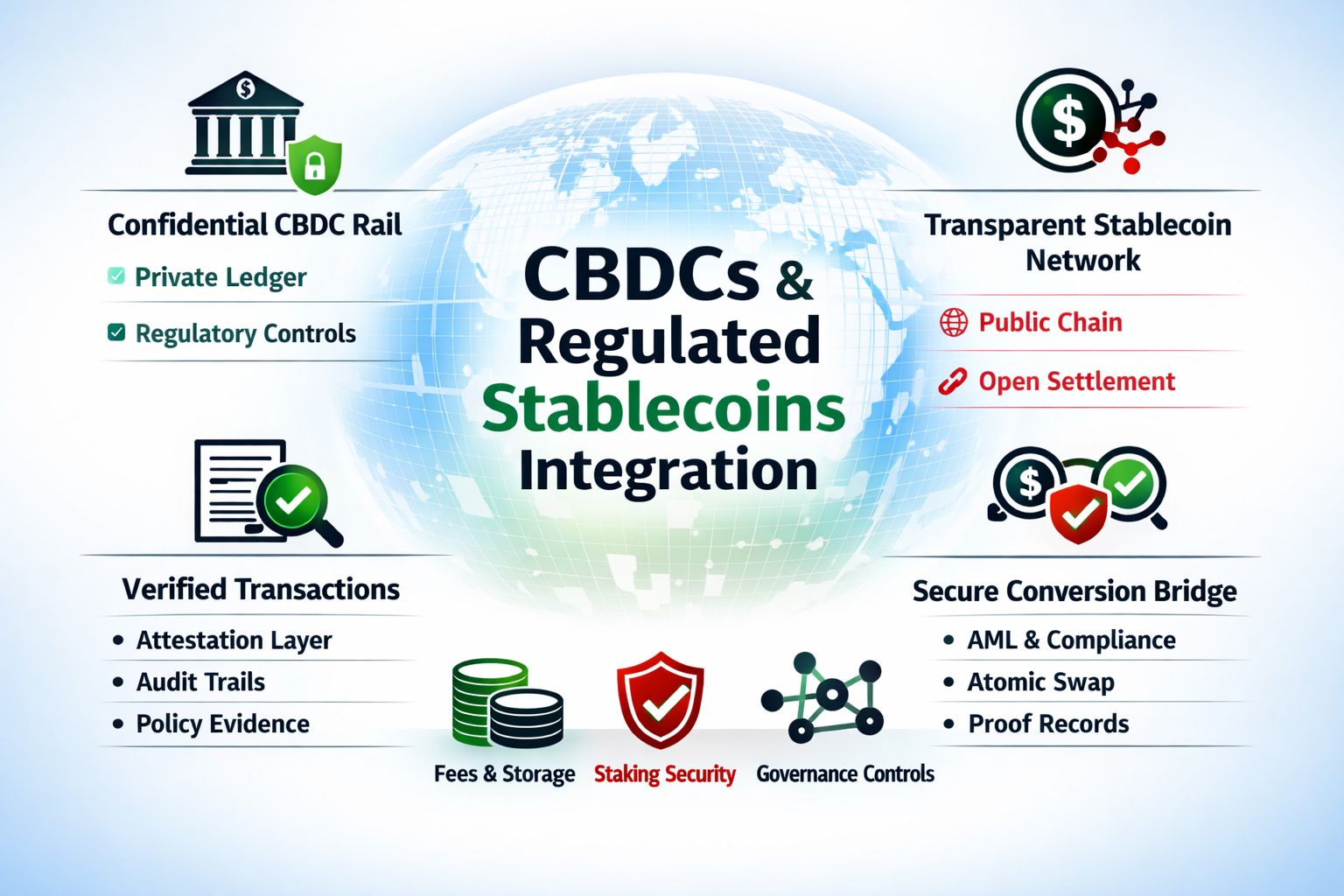
It feels a bit like running a private vault and a public receipt window from the same institution.
What I find useful here is that the network does not insist on one settlement environment. It uses a dual-path model: the public path for transparent programs and open verification, the private path for confidentiality-first CBDC operations.
That split matters because it keeps different monetary assumptions from colliding inside one ledger design.
On the public side, the reference gives two choices: a sovereign Layer 2 chain or Layer 1 smart contracts. The Layer 2 path is EVM-based, lets operators control validators or sequencers, uses PoA or PBFT-style consensus, inherits security through commitments to an underlying L1, and keeps governance at the chain level.
The Layer 1 path is simpler and leans on the base chain’s security, with policy enforced through roles, whitelists, and upgrade controls. The point is controlled transparency, not ideological purity.
On the private side, the CBDC reference is more specific: Arma BFT consensus, immediate finality, namespaces for wholesale, retail, and regulatory views, a UTXO state model through Fabric Token SDK, peer-to-peer transaction negotiation through Fabric Smart Client, X.509 identity under MSP, configurable zero-knowledge privacy, and ISO 20022 compatibility. To me, that shows the chain is trying to make compliance native to settlement flow rather than adding it later as paperwork.
The protocol seems strongest to me at the evidence layer. Regulated money is not only about whether value moved. It is also about whether the move happened under the right authority, under the right rule version, and with records that survive audit and dispute. Sign Protocol is described as the attestation layer for that job: structured schemas, signed approvals, verifiable claims, and audit references that can work across public, private, or hybrid deployments.
That allows proof to travel without forcing every sensitive fact into open view.
That logic shows up again in the CBDC-to-stablecoin bridge. The design treats it as controlled interoperability, not free movement.
The bridge is supposed to enforce atomic conversion, policy and AML checks, rate controls, emergency actions, and evidence logging.
The flow is simple in principle: request conversion, run checks, burn or lock on the source rail, mint or release on the destination rail, then record the request ID, approvals, ruleset hash, and settlement reference. That is the kind of discipline I would expect from money infrastructure that wants to remain governable.
The token utility also looks clearer when I stop treating it as a price object. Fees matter because attestations, storage, and network activity need to be paid for. Staking matters because validator-linked participation needs economic weight.
Governance matters because protocol rules and upgrades are described as evolving through validator consensus and community processes, while the disclosures separate token utility from ownership or dividend rights.
For me, that makes the token more understandable as an operating instrument than as a shortcut to valuation.
What stays with me is that the chain is trying to place privacy, openness, settlement, and evidence in different layers instead of forcing them into one compromise.
What I still cannot judge is whether institutions will handle that extra operational complexity as well in practice as it works on paper.
@SignOfficial #SignDigitalSovereignInfra $SIGN
