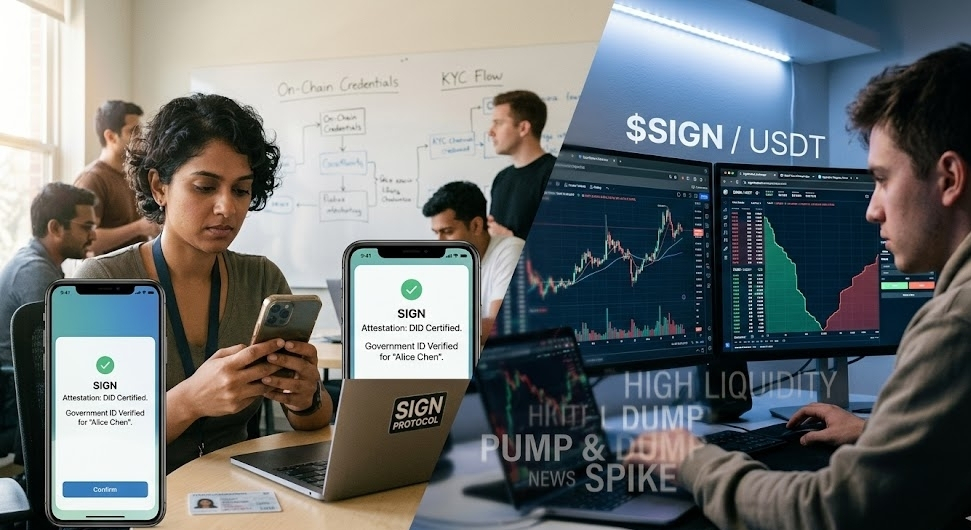
Let’s be honest—most crypto tokens sound useful on paper. But when you zoom out, a lot of them are still driven more by hype than real usage. That’s where things get interesting with $SIGN.
At its core, $SIGN isn’t just another random token. It actually powers a system built around digital identity and verification—things like on-chain credentials, KYC, and proof systems. In simple terms, it’s trying to make trust programmable on the internet. And that’s not a small idea. In fact, the protocol has already processed millions of attestations and distributed billions in tokens across millions of wallets, which shows there’s at least some real activity happening.
But here’s the catch.
Having utility doesn’t automatically protect a token from speculation. We’ve already seen $SIGN spike hard after listings and announcements, then cool off when the hype fades. That’s pretty normal in crypto—but it highlights the gap: people trade the token way more than they actually use it.
The real test is whether usage can catch up.
For $SIGN, that means more than just partnerships or big announcements. It needs real adoption—governments using it for identity, businesses relying on it for verification, apps integrating it naturally. The good news is the foundation is there: transaction fees, validator incentives, and access to services all tie back to the token.
Still, the challenge is timing.
Speculation moves fast. Utility grows slowly.
If $SIGN can keep expanding real-world use cases—like digital identity, credential verification, and large-scale token distribution—it has a shot at closing that gap. But if adoption lags, the token risks becoming just another asset people trade rather than use.
In the end, survival won’t depend on hype cycles. It’ll depend on whether people actually need $SIGN—or just want to flip it.
#signdigitalsovereigninfra $SIGN @SignOfficial