
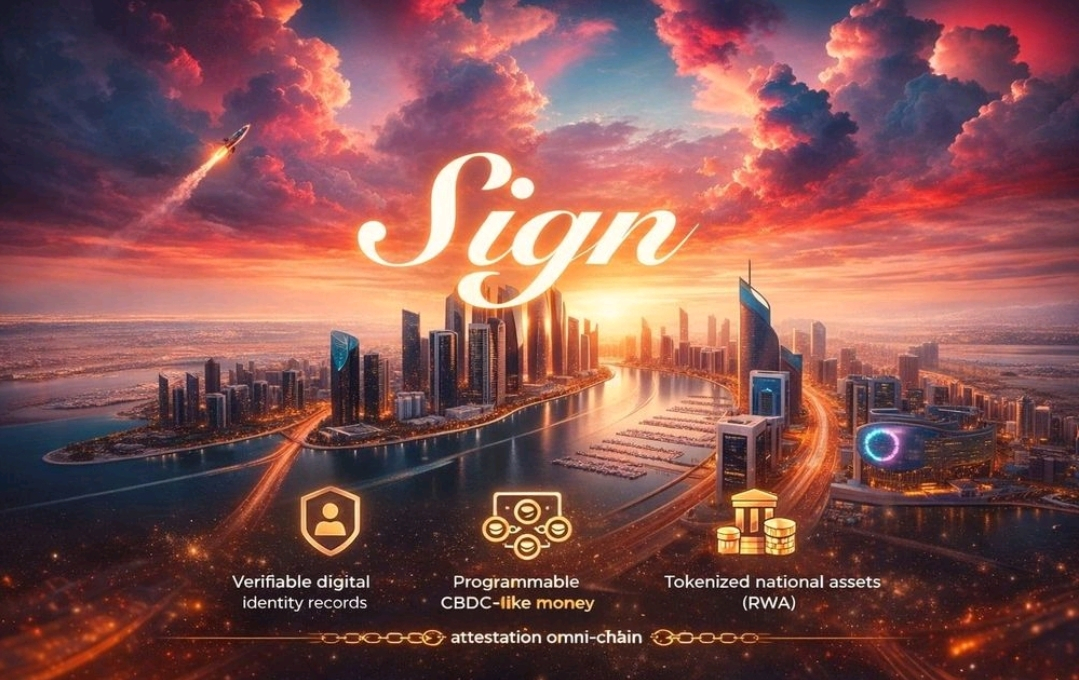
 I went down this rabbit hole tonight because the phrase “institutional pivot” keeps popping up around Sign, and… yeah, I’m suspicious of anything that sounds like it’s trying to graduate from being a crypto thing. Like, don’t get me wrong, I’ve seen plenty of projects evolve. But the timing always feels like marketing doing cardio fast steps, smooth wording, somehow never sweating.
So first thought: e-signatures. That’s actually one of those boring-sounding use cases that shouldn’t be sexy, but it’s also kind of… practical. Like, there’s always demand for stuff that can’t be casually hand-waved. If you’re doing anything with consent, approvals, document integrity, audit trails, all that stuff, you’re stepping into territory where people care about “did it happen?” not just “was it cool?” And that’s a lane where crypto can be useful, in theory. In theory, right?

Here’s the thing though. Whenever I hear “institutional pivot,” my brain immediately goes, okay… what institution is this, exactly? The kind that has legal departments, procurement cycles, and a love for footnotes? Or the kind of institution that just means “we want big money to show up in our token chart”? I can’t tell which one they’re aiming for, and that uncertainty annoys me. It’s like watching someone change their outfit mid-date and pretending it was the plan all along.
I dug around and kept catching this theme: from signatures to “sovereign infrastructure.” That wording alone is doing a lot of heavy lifting. Sovereign infrastructure sounds like governments, data borders, national-level resilience… it sounds like the kind of claim you’d put on a billboard and then defend in court. And I’m not saying it can’t be legit. But in crypto land, the distance between “we want to be sovereign” and “we’re trying to be the next big narrative” is… not that far. Sometimes it’s one press release away.
Also, let’s be real, the crypto industry has a habit of bolting grand strategy onto whatever got traction last quarter. A new term, a new angle, a new set of screenshots, same bloodstream. I don’t know if Sign is doing that, but it’s the kind of suspicion you can’t really turn off after enough years trading and reading and getting played. I’ve been burned enough times to be jaded, and then I hate myself a little for how predictable my brain is when it sees “institutional.” Like, I’m supposed to be impressed, but I’m just bracing.
What I liked—actually liked is the attempt to anchor something in real-world friction. E-signature workflows aren’t just some Web3 gimmick. People already deal with paper, PDFs, timestamps, identity checks, compliance headaches. If a blockchain-ish system can tighten that up, reduce dispute risk, or give a verifiable record, that’s at least a direction with teeth. It’s not just meme-to-main. It’s “here’s a process humans already pay for.” That’s why it’s appealing. It feels more grounded than another “we’ll revolutionize payments” story.
But… the skeptical part of me kept poking at the same question: how much of this is actually technology, and how much is packaging? There’s this pattern I’ve noticed where projects pick a tangible use case like e-signatures, then start talking like they’re building sovereign infrastructure, and suddenly the technical substance gets harder to find. It’s like when a restaurant adds a “farm-to-table” sign, but then you realize they only source one ingredient from the farm and the rest is Sysco. (Yes, I know that’s unfair. But tell me you don’t have that impulse too.)
And yeah, competition is real. Sign is not alone. There are already e-signature providers, identity platforms, compliance tooling companies, and blockchain-adjacent systems. Some of them are boring SaaS firms with enterprise relationships. Some are crypto-native networks. Some are hybrids. So when Sign talks about institutions, my brain asks: why them? Why now? Why does this have to be a crypto project? Is there some structural advantage like verification, auditability, composability, cost or is it just “we’re doing it on a chain because that’s the thing”? That difference matters. And I can’t always tell where the line is.
Still, I can’t deny the motivation behind an institutional pitch. People with money and liability don’t want “trust me bro.” They want traceability, permissions, and auditability. Crypto narratives can sound like hype, but some of the underlying primitives immutability, verifiable data, programmable checks can map onto institutional needs. It’s not crazy. It might even be overdue. I’ve watched too many teams pretend that enterprise adoption is mainly a branding problem. Sometimes it is a tech problem. Sometimes it’s a regulatory problem. Sometimes it’s both, and sometimes it’s just that nobody wants to sign a contract with a company that still feels like it could vanish in a year.
That’s the other thing. “Institutional” also means “survive scrutiny.” It means boring governance, real risk management, legal clarity, and the patience to build something that doesn’t look like a casino. Crypto is allergic to patience. That’s why most pivots feel like… frantic. Like the team is trying to outrun their own runway. I keep imagining someone in a meeting saying, “We need the institutional narrative,” and someone else replying, “Okay, but do we have the infrastructure yet?” And then everybody laughs a little too hard.
Let’s be honest crypto marketing hype is like a carnival mirror. It makes everything look bigger. It makes the same features look like breakthroughs. It makes partnerships look like inevitabilities. I’m not saying Sign is lying. I’m saying I’ve learned to treat institutional-sounding language as a test, not a promise. If the pivot is legit, there should be consistent evidence you can poke. If it’s mainly narrative, the evidence will either be missing, too vague, or constantly replaced with a new higher-level claim. That’s the thing that keeps me from getting too excited.
I also wrestle with the idea that “sovereign infrastructure” can mean a dozen different things depending on who’s talking. Sovereign as in independent network? Sovereign as in user-controlled identity? Sovereign as in data residency? Sovereign as in political rhetoric? Sometimes it’s all of the above. Sometimes it’s none. And I’m wary of terms that are big enough to swallow whatever you need them to swallow.
Also, there’s a risk in moving from a narrow-ish use case like e-signatures to something sprawling and lofty. Scope creep is real. You start with “we validate signatures,” then next thing you know you’re promising a whole ecosystem of infrastructure that touches compliance, identity, governance, and maybe even physical-world institutional processes. That’s hard even for teams with serious engineering talent and long timelines. Crypto teams often don’t have the time, because the market punishes them for slow work. So you end up with a mismatch: ambitious story, limited execution bandwidth. That mismatch is where disappointments breed.
And yet... I keep coming back to the fact that signatures are a kind of gateway. If you can credibly handle verification and authenticity for documents and approvals, you’ve got leverage. Not necessarily “sovereign infrastructure,” but at least a foothold. It’s like being a solid lock company and then claiming you’re building the entire building. The lock company might still be real. The building claim might still be premature. But you can’t dismiss the lock just because the building promise is dramatic.
I’m trying to decide whether Sign’s pivot feels like maturity or just narrative inflation. Some days it feels like maturity. Other days it feels like the team realized e-signatures alone won’t move the speculative needle hard enough, so they’re borrowing the language that institutions love hearing. Like, institutions don’t love crypto slogans, but they do love the word “sovereign” because it sounds like control and legitimacy. That’s not a crime. It’s just… convenient.
And what’s really bothering me is how familiar this feels in the market. I’ve seen projects evolve into something larger before, sure. But I’ve also watched so many teams take a decent starting point and then push it into a vague “platform” story until it’s impossible to distinguish between actual product and future hallucination. I don’t want to say Sign is doing that. I just want them to earn the upgrade, not just declare it.
Crypto in general makes it hard to be patient. Everyone’s chasing the next narrative cycle. Liquidity hunts attention. Attention hunts memes. Memes hunt capital. Then capital hunts storytelling. That loop doesn’t care if you’re building e-signatures or “sovereign infrastructure.” The incentives are weird. Sometimes the tech is good but the timeline is still wrong. Sometimes the timeline is right but the tech is shaky. Sometimes both are shaky, and the chart is the only “evidence.” I hate that, but I can’t unsee it.
So when I look at Sign right now, I feel two opposite things at once. One: the pivot makes sense if they’re trying to connect verification tools to institutional-grade infrastructure, because the demand for trustworthy records isn’t going away. Two: the rhetoric feels like it’s reaching for scale faster than the underlying story can prove. That tension… that’s where my brain stays stuck.

I keep thinking about what it means to be “sovereign” in infrastructure. Sovereignty implies independence, resilience, some form of control. But institutions—real ones—are risk-averse and process-heavy. They don’t adopt on vibes. They adopt when contracts, standards, and liability structures make sense. So the question isn’t whether the idea is cool. The question is whether Sign can actually withstand the reality of institutional adoption without turning the whole thing into a slogan.
And yeah, I’m also thinking like a trader, because I can’t stop. When a project pivots hard like this, the market usually reacts before the delivery catches up. Sometimes that’s great—you get a clean thesis and you ride it. Sometimes it’s a trap—you buy the narrative and then the tech lags while the hype moves on. I’ve watched both scenarios play out too many times. That’s probably why I sound like I’m arguing with myself in these thoughts.
I don’t know. I really don’t know if Sign is building something real or just repositioning. I’ll keep watching. I’ll keep squinting at every claim. I’ll look for receipts, not just language. But I can already feel the pull of the story—because e-signatures are a doorway into trust, and trust is the one thing institutions can’t avoid. So the promise isn’t ridiculous. The problem is the crypto part, the timing part, the incentive part... all the parts that can turn a serious idea into a narrative juggernaut before it’s ready to be one.
Anyway. It’s late. My notes are messy. I’m still curious, but I’m not letting myself get comfortable. That’s the real mood with crypto projects that talk like they’re going institutional—part excitement, part dread, and a constant question in the back of my head: is this pivot a roadmap, or is it a reroute? Because those are wildly different thing
s... and the market never waits to find out.