I’ve spent the better part of the last decade in this industry, bouncing between the hype cycles, the infrastructure wars, and the inevitable “we’re building the next internet” proclamations. If there’s one phrase that has started to feel hollow over the years, it’s “digital sovereignty.” We throw it around like confetti. You hold your private keys, therefore you are sovereign. You run a node, therefore you are free.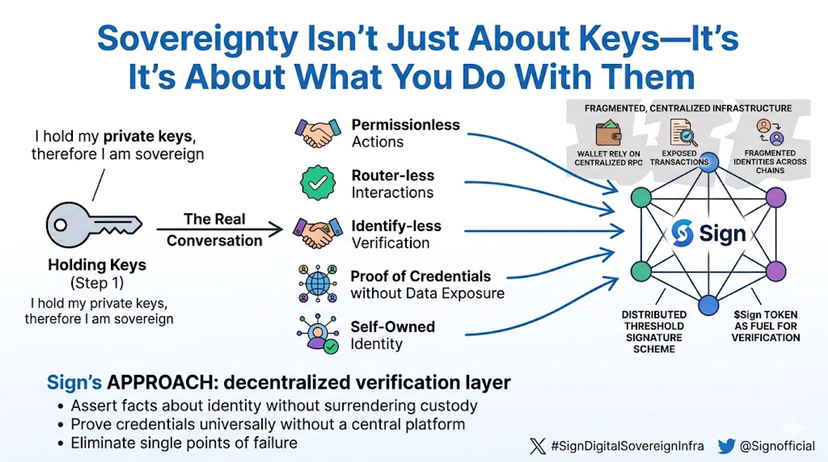
But the older I get in this space, the more I realize that holding a key is just the first step. What you can actually do with that key—without asking permission, without routing through a centralized gateway, without exposing your identity to a third-party indexer—that’s where the real conversation begins.
Lately, I’ve been digging into a project that seems to understand this distinction on a fundamental level.
When I first encountered the concept of Sign, I did what most of us do: I assumed it was just another infrastructure play. Another cross-chain messaging protocol. Another oracle alternative. But the deeper I went into the architecture, the more I realized that Sign isn’t trying to be the fastest messaging layer or the cheapest settlement layer. It’s trying to solve something that gives me a headache every time I onboard a new user to crypto: the friction of identity and verification.
We talk about decentralization, yet every day we use wallets that rely on centralized RPC endpoints. We talk about privacy, yet we sign transactions that broadcast our entire financial history to a public mempool for anyone to front-run or analyze. We talk about ownership, yet our digital identities are fragmented across thirty different chains, with no way to prove our credibility without handing over our data to a centralized platform.
Sign approaches this from a different angle. It’s built on a distributed threshold signature scheme—a mouthful, I know—but what that actually means in practice is that it removes the single point of failure that plagues our current infrastructure. It’s not just about storing a key; it’s about enabling actions across multiple networks without exposing the underlying secrets.
I’ve been using the #SignDigitalSovereignInfra tag to follow the development updates, and what stands out to me isn’t the technical jargon; it’s the philosophy. The team behind $Sign isn’t building for the sake of saying they built something. They’re focused on the infrastructure that actually allows a user to maintain control over their data while interacting with the broader ecosystem.
Think about the current state of Web3. If you want to prove you held a specific NFT at a specific time to access a community, you either connect your wallet (exposing your entire asset list) or you rely on a centralized snapshot tool. If you want to delegate voting power without transferring tokens, you’re usually stuck with complex smart contract interactions that cost gas and create friction.
Sign solves for the middle ground. By acting as a decentralized verification layer, it allows users to assert facts about their digital identity—prove you’re a human, prove you held an asset, prove you voted on a proposal—without surrendering custody or broadcasting your entire history to the world.
To me, that’s what digital sovereignty actually looks like. It’s the ability to move through the digital world with credentials that are self-owned, self-managed, and universally verifiable. It’s the difference between owning a key to your apartment and owning the deed to the land.
I’ve watched the team at @undefined roll out their testnet phases, and the focus has been relentless on stability and security rather than flashy marketing. In an era where most projects launch a token, pump a narrative, and fade into obscurity within six months, this slower, methodical approach feels almost counter-cultural. But it’s exactly the approach that infrastructure requires. You don’t want the foundation of your digital sovereignty to be built on sand.
The utility of $Sign within this ecosystem is also something I’ve been thinking about. It’s not tacked on. It’s the fuel for the verification network. Every time a user or a developer leverages this infrastructure—whether to authenticate a session, secure a cross-chain bridge, or manage complex multi-party computation—the economics flow through the token. It’s one of those rare instances where the tokenomics actually align with the utility. You’re not holding a token just to speculate; you’re holding a stake in the infrastructure that underpins sovereign interactions.
I’ve had my fair share of skepticism about “utility tokens” over the years. Too many of them are just governance tokens with a fancy name and a treasury that gets drained by mercenary voters. But with $Sign, the demand drivers are structural. As more applications realize they don’t want to build their own identity or verification solutions from scratch—solutions that are expensive to maintain and prone to centralization—they’ll plug into this existing network.
What excites me most about #SignDigitalSovereignInfra is the timing. We’re entering a phase of crypto where the low-hanging fruit is gone. The decentralized exchanges are built. The lending protocols are established. The next wave isn’t about creating new financial primitives; it’s about creating the infrastructure that allows those primitives to interact without compromising the user’s autonomy.
We’re seeing a shift away from “trust me, I’m open source” toward verifiable, cryptographically assured interactions. Sign sits at the intersection of that shift. It’s not enough to tell me your protocol is decentralized; I need to be able to verify that no single entity can censor my access to it. It’s not enough to tell me my data is safe; I need the cryptographic guarantees that it is.
This is the nuance that gets lost in the noise. Sovereignty isn’t just about owning the key. It’s about owning the context in which that key operates. If I have to rely on a centralized relayer to use my decentralized application, do I really own anything? If I have to trust a centralized indexer to see my transaction history, is that really my history?
The @SignOfficial project, through its distributed network, effectively removes those intermediaries. It turns verification from a service you request from a company into a service you perform with a network. That distinction matters. It’s the difference between being a customer and being a participant.
I’m not here to tell anyone that this is the next big thing or that the price of $SIGN is going to explode tomorrow. I’ve been in this space long enough to know that great technology doesn’t always translate to immediate market performance. But I’ve also been here long enough to recognize when a team is building something that actually addresses the headaches I deal with every day.
The sovereignty narrative has been co-opted and diluted. It’s time to reclaim it, not through slogans, but through infrastructure that actually delivers. For me, watching the development of this verification layer feels like watching the scaffolding go up for the next generation of applications—applications that don’t ask for permission, don’t expose my data, and don’t treat me like a product.
Digital sovereignty isn’t a marketing tagline. It’s a technical standard. And it’s good to see a project finally treating it like one.

Artigo
Sovereignty Isn’t Just About Keys—It’s About What You Do With Them
Aviso Legal: inclui opiniões de terceiros. Não se trata de aconselhamento financeiro. Poderá incluir conteúdos patrocinados. Consulta os Termos e Condições.
0
22
172
Fica a saber as últimas notícias sobre criptomoedas
⚡️ Participa nas mais recentes discussões sobre criptomoedas
💬 Interage com os teus criadores preferidos
👍 Desfruta de conteúdos que sejam do teu interesse
E-mail/Número de telefone