
i have a friend who works in correspondent banking and also deals IN Crypto like BITCOIN and honestly her line about cross-border transfers has lived in my head rent-free for years 😂
been doing it eleven years, and what she says is simple - the moment money leaves your rails, you are no longer managing it
you are watching it.
i thought about that this week going through the SIGN bridge architecture. because the bridge is genuinely well-designed for what it controls. and the problem is precisely that what it controls ends at the crossing
What the design actually gets right:
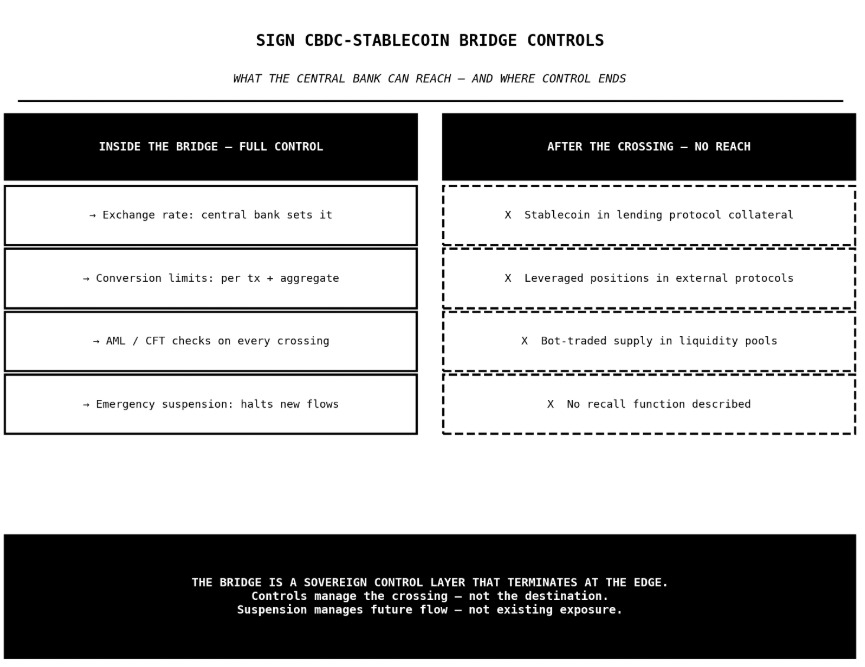
the CBDC-stablecoin bridge inside the SIGN stack is not a simple transfer pipe. it is a sovereign control layer. the central bank sets the exchange rate between CBDC and stablecoin. it configures conversion limits - both per individual transaction and in aggregate. every bridge transaction runs through AML and CFT compliance checks before it completes. and the central bank holds an emergency suspension key that can halt new crossings entirely if needed.
that is a meaningful set of controls
exchange rate management means the central bank is not just watching the peg - it is actively setting the terms of conversion. conversion limits mean large-scale capital flight through the bridge can be throttled before it becomes a systemic event. the compliance layer means the bridge is not a KYC-free exit route from a regulated CBDC system into anonymous public chain activity.
and the atomic swap mechanic is the right technical foundation. conversion operations are atomic - they either complete fully or they dont happen at all. no partial states, no funds stuck in transit, no double-counting on either side of the bridge. for infrastructure handling sovereign currency this is the correct design.
Where it gets complicated though:
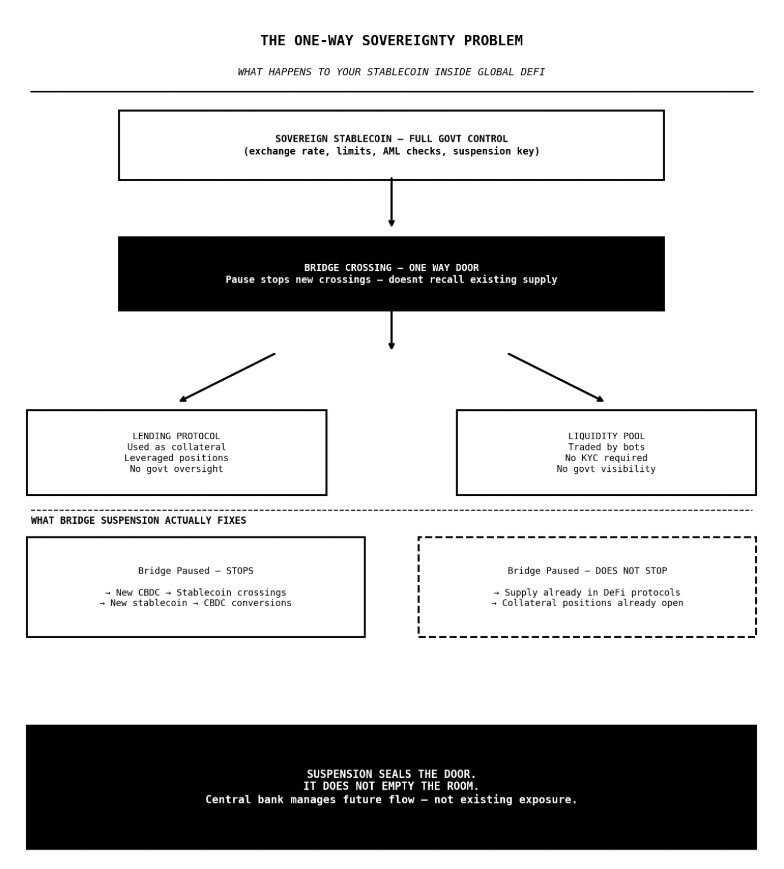
the moment the stablecoin completes the bridge crossing it is on a public chain. and a public chain means open DeFi. lending protocols, automated market makers, liquidity pools. the stablecoin can be used as collateral in a lending protocol the government has never heard of. it can be traded by bots with no KYC at any point in the process. it can sit in leveraged positions on protocols operating in jurisdictions the issuing government has no relationship with.none of that requires any malicious intent. it is just what public chains do. liquidity moves to yield. assets get used as collateral. that is the design of the system the stablecoin enters when it crosses.
My concern with this:
bridge suspension is the emergency control. but suspension stops new crossings - it does not reach supply already out.if a sovereign stablecoin has been crossing into public DeFi for six months and the central bank identifies a problem and suspends the bridge - the supply that already crossed is still out there. still in lending protocols. still in liquidity pools. still being used as collateral in leveraged positions. the suspension sealed the door. it did not empty the room.
the whitepaper describes the bridge controls clearly and accurately. what it does not describe is any mechanism for the central bank to interact with stablecoin supply that has already left the bridge and entered public DeFi
there is no recall function described
no interaction with external protocols
no post-crossing visibility tool.
that gap is not a design flaw exactly. it is the structural reality of building a sovereign control layer that terminates at the edge of a permissionless system. but it means the emergency suspension control is more limited than it might appear - it manages future flow, not existing exposure.
honestly dont know if the bridge architecture gives governments meaningful sovereignty over their digital currency in a DeFi-connected world or if the controls end precisely where the real risk begins?? 🤔
#SignDigitalSovereignInfra @SignOfficial $SIGN
