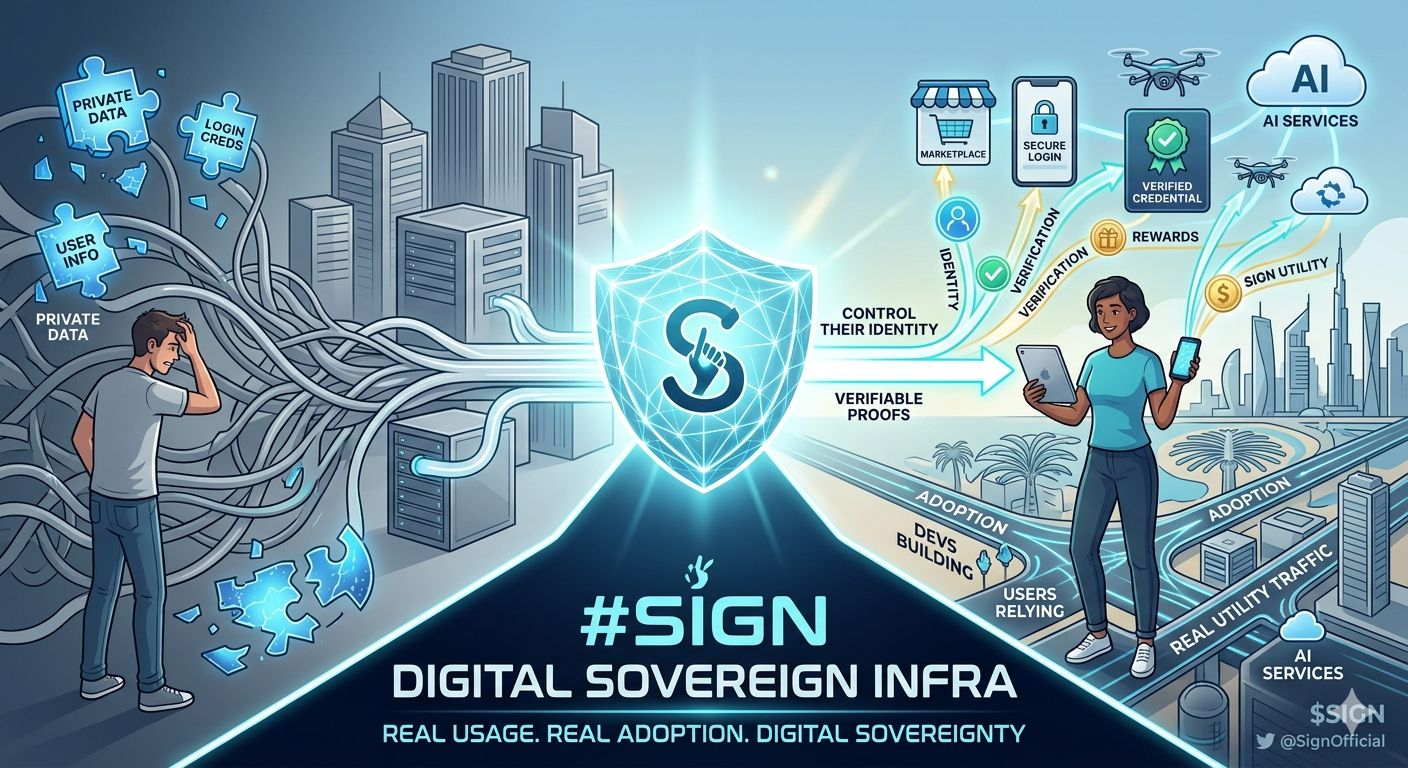
When I first looked into identity projects, I assumed adoption would come naturally. The idea sounded obvious—if users control their identity, usage should follow. But over time, it became clear that most systems either rely on hidden centralization or are too complex for everyday use. That’s why I’ve started focusing less on the narrative and more on whether a system can actually function at scale.
That shift is what made #SignDigitalSovereignInfra interesting to me. It’s not just about digital identity—it’s about whether identity can become real infrastructure. The key idea is simple: users own their identity, and instead of exposing everything, they prove only what’s needed through verifiable data. That allows identity to move across platforms without giving full control to each one.
There’s also an ecosystem angle. Integrations like $EDGE and $UAI show how identity can connect with AI systems, where data is processed off-chain but still verified and usable across applications. If this works, it creates a more flexible and secure way for systems to interact.
The token side matters too. If usage grows—through identity creation, verification, and application activity—then demand can come from real utility, not just speculation. But that’s also where the biggest challenge lies.
Because in the end, this only works if people actually use it. Developers need to build on top of it, and users need to rely on it regularly. Otherwise, it risks becoming infrastructure without traffic.
In regions like the Middle East, where digital economies are expanding fast, a system like this could play a meaningful role. But the real signal won’t be hype—it will be consistent usage and adoption over time.
That’s the part worth watching.
#SignDigitalSovereignInfra $SIGN @SignOfficial