

I usually start paying attention to token design when a paper stops emphasizing scale and starts explaining restraint. That is what caught me here.
With Midnight Network, the part that stayed with me was not the headline supply number, but the care taken around how that supply is meant to behave across more than one environment.
Cross-chain systems often sound neat until I ask a plain question: how do you stop one economic unit from being treated as available in two places at once?
That, to me, is where design either becomes credible or starts to wobble. Control is harder to explain.
@MidnightNetwork $NIGHT #night
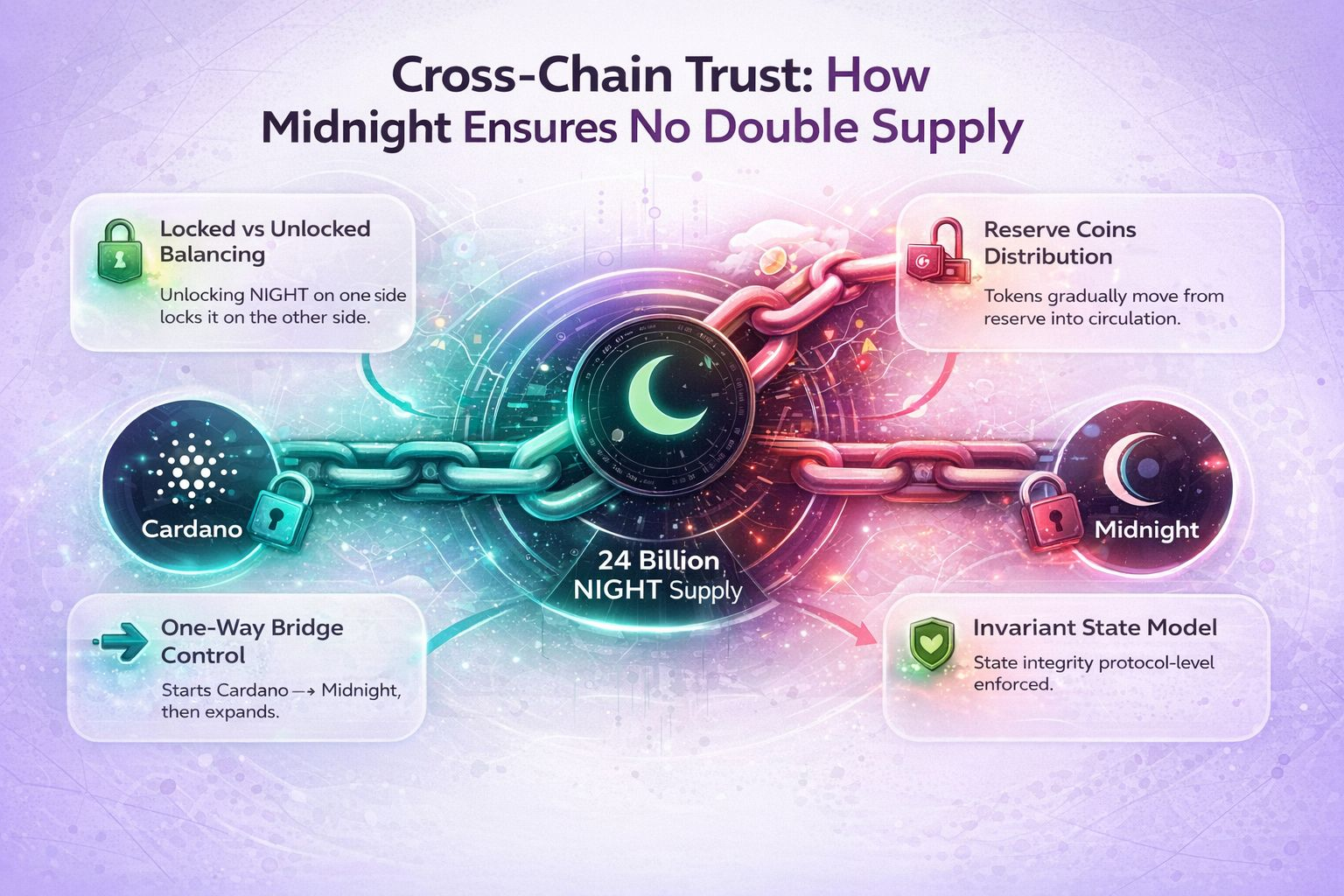
It feels a bit like a coat check where the same coat cannot honestly be worn in two different rooms at the same time.
The problem is not merely transfer. It is state confusion. If a token looks unlocked on one side while still retaining the freedom of an unlocked asset somewhere else, the system begins to describe the same value twice. A cap written on paper does not protect much if the operating model allows one unit to drift into two economic interpretations.
What I find thoughtful in this design is that the chain treats supply integrity as an invariant, not as a vague promise. The point is not only to say that effective supply stays bounded.
The point is to define a state model where reserve, locked, and unlocked balances are coordinated across environments so the same unit cannot quietly gain duplicate utility. In that sense, the token is tracked by condition, not just by location.
That distinction matters. Reserve is not the same as locked. Locked is not the same as unlocked.
The model separates uncirculated units, constrained units, and active units. That gives the system a clearer accounting language. Instead of asking only where the token is, the protocol asks what it is permitted to do.
The cross-chain trust issue is addressed by linking those conditions through a strict balancing relationship. If units become unlocked on one side, there must be a corresponding restriction somewhere else in the model.
If reserve units later enter circulation through block rewards, that movement also has to remain inside the same total economic boundary. The goal is not visual symmetry at every instant. The goal is coherent supply under one rule set.
I think that is why the initial one-way bridge matters. Beginning with Cardano-to-Midnight movement reduces early ambiguity in the state machine.
It limits the number of paths a unit can take while the invariant is being enforced under simpler conditions. A later two-way bridge may expand mobility, but the principle should remain the same: movement is acceptable only if state correspondence remains intact.
Third-party bridges may still represent the asset elsewhere, yet representation is not the same as native protocol recognition.
Underneath that logic, each layer has a concrete job. Consensus determines which chain events count as valid transitions. The state model defines whether units are reserved, locked, or unlocked instead of flattening them into one generic balance.
The cryptographic flow has to make those transitions provable without leaving room for the same unit to be claimed under conflicting conditions.
The accounting model then preserves the effective cap even when cross-chain messages are not instantaneous. A serious invariant has to survive delay rather than assume perfect timing.
The utility picture also becomes more understandable in this frame. Fees give the token an operational role in paying for activity. Staking gives it a role in security alignment and validator commitment.
Governance gives holders a role in shaping upgrades and future rule changes. I do not think those functions should automatically be turned into price arguments. What matters first is whether utility remains internally consistent as the system grows.
That is the part I respect most here. The network is not only trying to move value. It is trying to preserve one economic reality across multiple execution environments without letting convenience outrun discipline.
What I still cannot judge from design alone is how smoothly that invariant will hold under latency, governance pressure, and long-term usage.
@MidnightNetwork $NIGHT #night
