

I keep coming back to this thought: what happens when a network tries to solve privacy without becoming unusable, and tries to support compliance without falling back into surveillance? That, to me, is Midnight’s real test. Crypto has spent years treating transparency as the cleanest route to trust, but in practice that design choice often turns normal activity into an exposed stream of data, metadata, and behavioral clues. Midnight is built around the idea that this tradeoff is not inevitable, and that applications should be able to protect users, businesses, and transaction context without giving up programmability or operational clarity.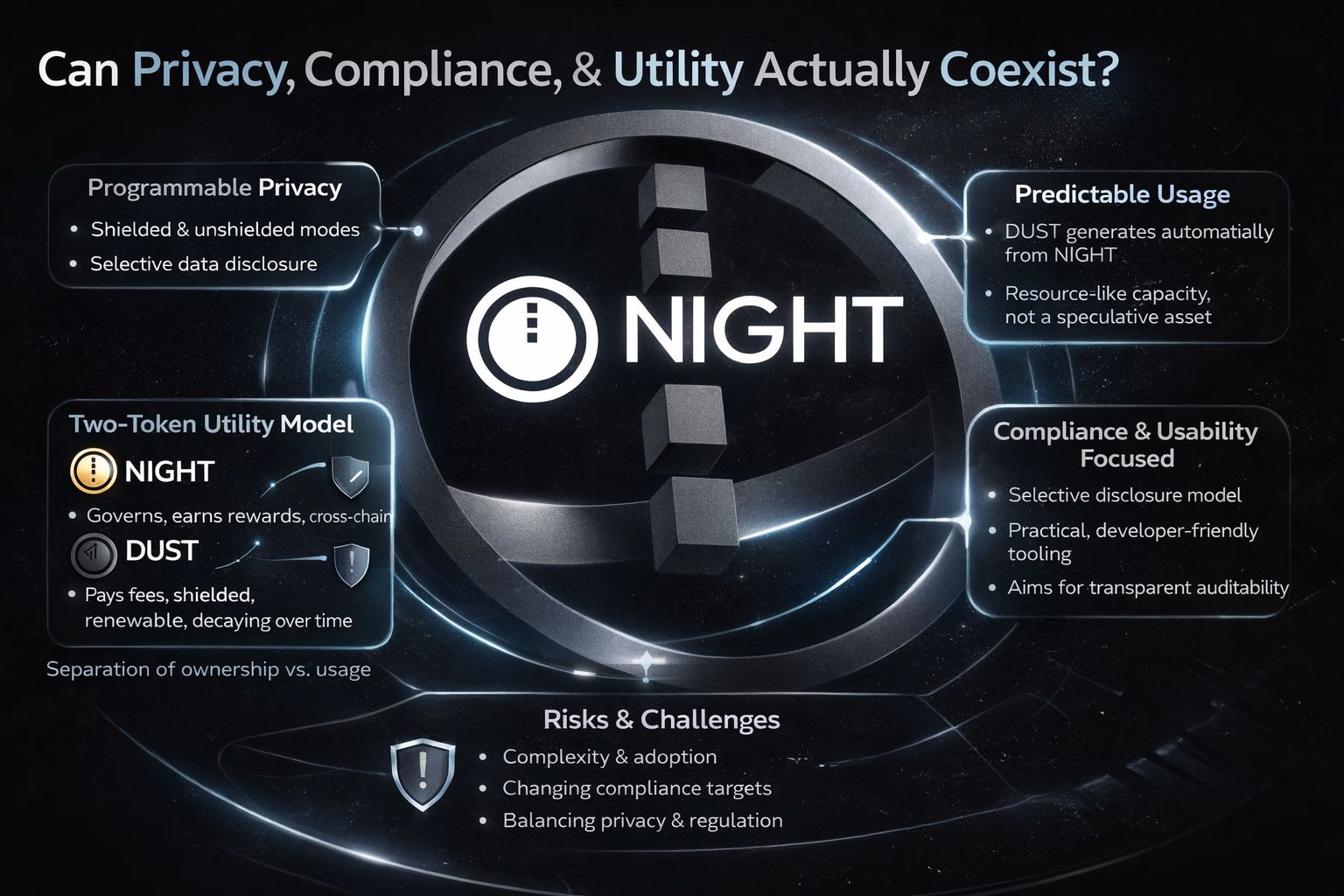
Picture a health application that needs to confirm a patient qualifies for a service. The app needs proof. The provider needs assurance. A regulator may need an audit trail. But nobody should need the patient’s full record sitting in a public environment, or copied across multiple vendors just to verify one condition.That is where the usual blockchain story starts to wobble. The theory sounds elegant: shared state, transparent execution, fewer trusted intermediaries. The practical outcome is often much messier, because public verifiability can easily become public exhaust.
I think that is the contradiction Midnight is trying to address at the product level, not just the cryptography level. Its design leans on programmable data protection, selective disclosure, and shielded as well as unshielded primitives, so the network is not forced into an all-public or all-private model. That matters. A lot of privacy discourse in crypto gets reduced to whether something is hidden, but that is too shallow. In real systems, the harder question is who needs to know what, when, and under what rules. Midnight seems to take that question more seriously than most networks do.
The second thing that stands out to me is that Midnight does not frame utility in the usual one-token way. The network separates NIGHT from DUST. NIGHT is the visible utility token tied to functions like block production rewards and intended governance, while DUST is the shielded resource used to pay transaction fees on the network. The interesting part is not just that there are two components. It is the logic behind the split. NIGHT generates DUST over time, and DUST is then consumed to operate on the network, rather than making users constantly spend the main token directly for each action. That creates a different relationship between holding the asset and using the network.
That design feels economically important.
In a lot of networks, usage and speculation get tangled together so tightly that the product becomes hard to budget for. If token price jumps, operational costs can become noisy. If the token falls, security incentives can come under pressure. Midnight’s answer is to make the transaction resource shielded, renewable, non-transferable, and decaying over time, while keeping NIGHT unshielded and usable across its broader network functions. DUST is described almost like energy rather than money: it is generated, capped by the associated NIGHT balance, used for activity, and then burned or allowed to decay. That does not eliminate economics, but it does change the user experience from constantly buying fuel in a volatile market to holding capacity that continuously regenerates network access.
Could that make privacy more usable rather than just more principled?
Maybe. If transaction access depends on a shielded resource that cannot be transferred or stored as a speculative asset, Midnight may avoid some of the regulatory and market frictions that have followed privacy coins. That seems deliberate. The design appears to protect metadata without turning the privacy layer itself into the exact component regulators are most likely to reject. I think that is one of the more practical ideas in the project, because it treats privacy not as rebellion against compliance, but as something that might coexist with it if designed carefully enough.
There is also a developer angle here that I think matters more than people admit. A privacy network does not become useful just because the cryptography is impressive. It has to be buildable. Midnight places real emphasis on approachable tooling, including developer-friendly APIs and a programming model meant to reduce the need for teams to become zero-knowledge specialists just to ship applications. That matters because privacy is not only a protocol problem. It is also a tooling problem, a learning-curve problem, and a product integration problem. A network can be theoretically powerful and still fail if building on it feels like entering a research discipline.
Still, I do not think the hard part is proving that this architecture is clever. The hard part is proving that it is legible.
Privacy systems often lose mainstream users in one of two ways: either they become too abstract to understand, or they force people to manage new mental models that feel foreign to normal software usage. Midnight introduces several of those models at once: shielded versus unshielded data, NIGHT versus DUST, decay mechanics, dynamic pricing, and broader governance and interoperability questions. None of that is irrational. In fact, much of it seems thoughtfully designed. But complexity does not disappear just because it is justified. Someone still has to make it understandable inside wallets, applications, and business workflows.
There is also execution risk. The vision is ambitious: digital identity, tokenization, enterprise applications, and systems that need attestation without broad data exposure. Those use cases are attractive, but they depend on more than architecture. They depend on app operators trusting the compliance posture, developers trusting the tooling, and users barely noticing the machinery underneath. That is a high bar. I think many crypto systems underestimate how much adoption depends on removing cognitive friction rather than just adding technical capability.
There is a subtler risk too: compliance is not a fixed target. Midnight can design for selective disclosure and rational privacy, but laws, institutional expectations, and enforcement standards keep moving. So even if the network is structurally better aligned with compliant privacy than older designs, adoption will still depend on whether businesses and regulators feel that the controls are understandable and auditable in practice. A technically elegant privacy model can still struggle if its assurances are harder to operationalize than the old, inefficient habit of over-collecting data.
That is why I see Midnight less as a pure privacy bet and more as a coordination bet. It is trying to show that blockchain utility does not have to mean public exposure, that compliance does not have to mean excessive disclosure, and that predictable usage does not have to be sacrificed to token volatility. That is a serious design claim. But serious design claims only matter when they survive contact with actual builders, actual operators, and actual users.
So the real question is not whether Midnight can make privacy sound compatible with compliance and utility on paper. The real question is whether it can make that coexistence feel normal in practice.
