

 I didn’t expect to change my perspective on $SIGN this quickly, but the latest developments forced me to look again. What started years ago as a simple on-chain signature tool has now evolved into something far more serious. SIGN is no longer just building products, it is positioning itself as digital sovereign infrastructure for real economies.
The shift becomes clear when you connect the latest pieces together. SIGN is not chasing hype cycles or isolated use cases. It is building a system where identity, trust, and capital coordination can exist natively on-chain in a structured and compliant way. That is exactly what institutions and governments have been waiting for.
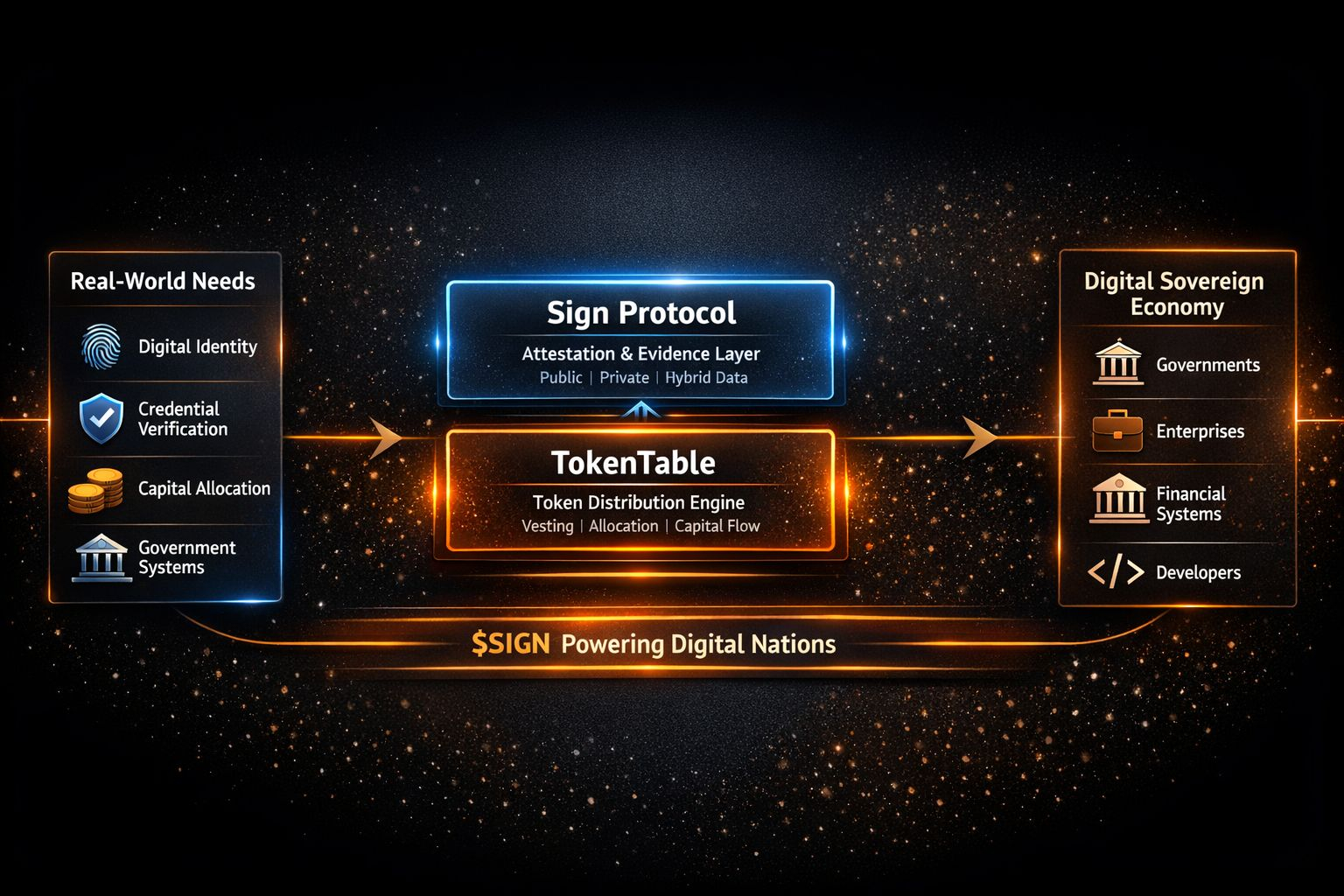
At the center of this is Sign Protocol, which acts as a universal attestation layer. Instead of fragmented verification systems, everything from identity credentials to agreements and proofs can be anchored in a flexible framework that supports public, private, and hybrid data models. This matters because real-world adoption requires both transparency and privacy at the same time.
Then you have TokenTable, which handles token distribution, vesting, and capital flows. This is where SIGN solves one of the biggest problems in crypto today. Most projects still struggle with messy, non-transparent token allocation. SIGN turns this into a programmable and structured system that institutions can actually trust. When capital becomes programmable and verifiable, it opens the door for serious adoption.
What really caught my attention in the latest updates is how SIGN is aligning this infrastructure with long-term incentives. The Orange Basic Income model is not just another rewards program. It replaces traditional staking with a more dynamic system that rewards committed holders of SIGN while maintaining sustainability. This kind of model feels closer to how real economic systems work rather than short-term yield farming.
Now connect all of this to what is happening in the Middle East. Governments across the region are actively investing in digital identity, compliance frameworks, and next-generation financial infrastructure. The demand is no longer for basic blockchain tools. The demand is for systems that can integrate into national-level operations.
This is exactly where SIGN fits.
It provides a unified layer for identity verification, credential validation, and capital coordination, all within a compliant and programmable framework. Instead of building separate systems for each need, SIGN offers a stack that can support governments, enterprises, and developers at the same time.
That positioning changes everything.
Because when infrastructure gets adopted, it does not just scale within crypto. It becomes part of how economies function. And infrastructure plays are always underestimated early because they are less visible than consumer-facing apps. But over time, they become the foundation everything else depends on.
From a market perspective, SIGN is now sitting at the intersection of multiple major narratives. Digital identity, sovereign infrastructure, tokenized capital flows, and regional Web3 adoption are all converging here. That is not accidental. It is a deliberate positioning that aligns with where the industry is heading.
The more I look at it, the more it feels like SIGN is not trying to compete with existing projects. It is trying to build the layer that those projects will eventually rely on.
And if adoption in regions like the Middle East accelerates the way it is expected to, then SIGN will represent much more than just a token. It will represent access to infrastructure that powers real economic systems.
That is the part most people are still underestimating.
SIGN is no longer just building for crypto users.
It is building for digital nations.