
I remember the exact moment because it didn’t feel like a “crypto conversation” at all.
We were sitting in a noisy coffee shop, the kind where the espresso machine hisses every 30 seconds and nobody can hear themselves think. They had a laptop open but weren’t really looking at it. Just staring past it.
At some point, they leaned forward. Elbows on the table. Eyes a bit bloodshot.
“I haven’t slept properly in two days,” they said, almost casually.
Not because of a product launch. Not because of deadlines.
Because of a potential data exposure.
That’s when the tone shifted. Not dramatic. Just… heavier.
They started walking me through it. Customer data. Internal dashboards. Stuff that never, ever leaves the building. The kind of information that, if it slips, doesn’t just cause a bad week, it rewrites the company’s reputation overnight.
“People think leaks are PR problems,” they said. “They’re not. They’re existential.”
That stuck.
Because if you’ve ever been anywhere near a production system when something goes wrong, you know exactly what they mean. It’s not abstract. It’s panic. It’s Slack blowing up. It’s leadership asking questions nobody has answers to yet.
And here’s the uncomfortable part: most blockchain systems, as they exist today, are basically designed to make that problem worse.
Everything on-chain. Public. Permanent. Traceable forever.
Great if you’re building a philosophy. Terrible if you’re running a business.
Let’s not sugarcoat it, most blockchain tooling has been a nightmare for real companies. Clunky. Overexposed. Built by people who’ve never had to explain a data incident to a boardroom.
So enterprises sit on the sidelines. Not because they’re dumb. Because they’re rational.
Now, this is where Midnight got my attention, not because it’s flashy but because it’s the first time I’ve seen something that sounds like it was designed by someone who’s actually had to carry production risk.
It doesn’t try to sell you on “everything should be transparent.”
It quietly asks: what actually needs to be?
That’s a different question.
Confidential smart contracts. Privacy-preserving computation. Fancy terms, sure. But the core idea is simple, you can prove something without dumping the underlying data into the open.
And that’s where things start to click
Take supply chains.
Everyone loves to say “blockchain can fix supply chains.” Fine. But let’s be real about it.
What if your competitor sees you’re paying 20% more for cobalt from a specific supplier?
You’re done. Margins gone. Negotiation power gone.
No company is signing up for that level of exposure. Doesn’t matter how “decentralized” it is.
But if you can verify origin, authenticity, compliance, without exposing pricing or relationships?
Now we’re having a real conversation.
Same with finance.
Yeah, regulators want proof. Proof of reserves. Proof you’re not doing anything shady.
But they don’t need and you definitely don’t want, every internal transaction visible to the entire world.
That’s not transparency. That’s self-sabotage.
Midnight’s approach, selective disclosure, feels less like innovation and more like… common sense finally showing up.
And honestly, that’s refreshing.
Now about Night Coin.
I’m not going to pretend it’s the exciting part. It’s not.
It’s the gas in the tank.
You need it to run things. To execute transactions. To keep the system moving. That’s it.
No grand narrative needed.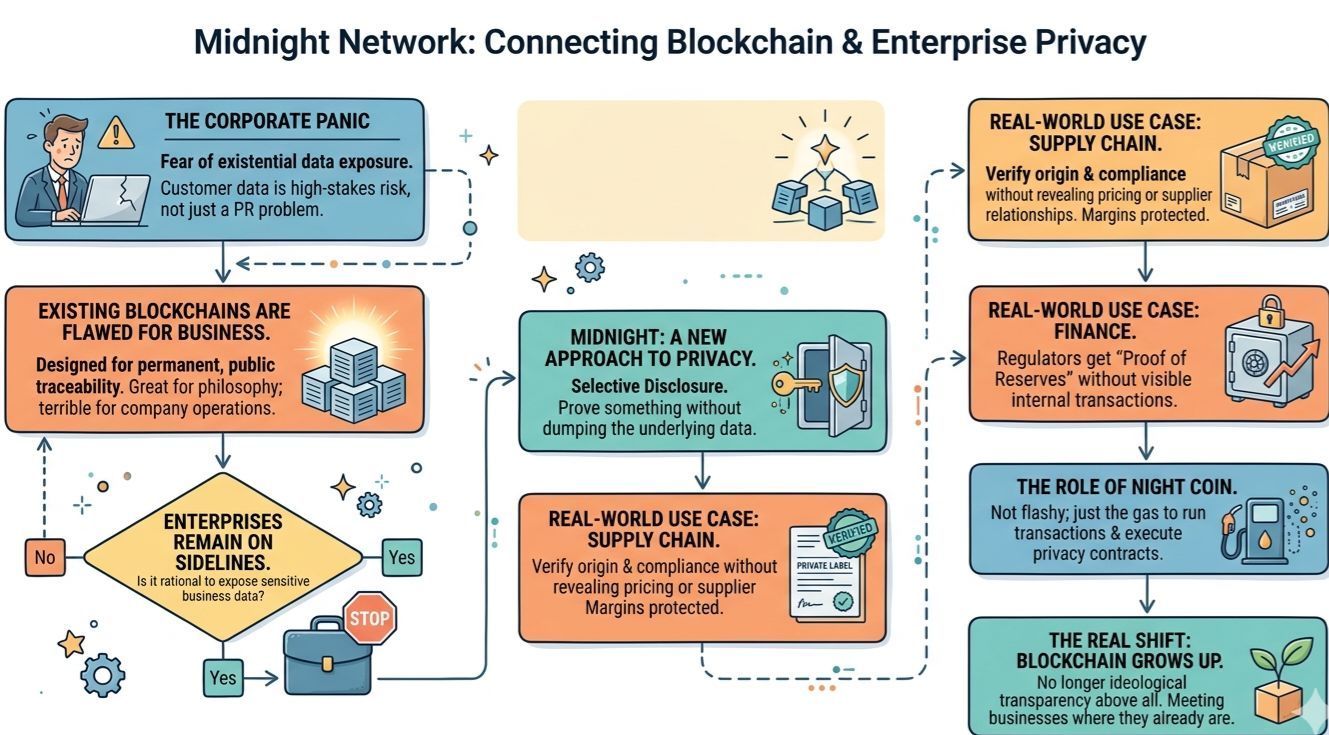
But here’s the thing, if the privacy layer actually gets used, if companies start building on top of this kind of infrastructure, then yeah, the “gas” matters. Because suddenly the engine is doing real work, not just idling in a demo environment.
Still, the token isn’t the story.
The shift is.
For years, blockchain has been stuck in this almost ideological phase. Transparency above all else. Everything on-chain. Radical openness.
Nice in theory. Messy in practice.
Because the real world doesn’t work like that.
Some data needs to be shared. Some needs to stay locked down. Most lives somewhere in between.
And until now, blockchain hasn’t handled that middle ground very well.
Midnight or at least the idea behind it, feels like someone finally acknowledging that.
Not trying to force businesses into a new worldview.
Just meeting them where they already are.
I’m still skeptical. Years of overpromising will do that to you.
But I’ll say this, this is the first time in a while where a blockchain project didn’t sound like it was trying to impress other crypto people.
It sounded like it was trying to solve a problem someone might actually lose sleep over.
And maybe that’s the real signal here.
Not that the tech is revolutionary.
But that it’s finally starting to grow up.
@MidnightNetwork #night $NIGHT


