

The first time I watched a market ignore a story that looked clean on paper, I made the mistake a lot of newer traders make. I assumed the market was being irrational and that price would eventually “catch up” just because the logic sounded strong. Over time, I learned a tougher lesson. Markets do not reward a project for sounding important. They reward proof of demand, repeat usage, and the feeling that more people will care tomorrow than they do today. That is why Sign is interesting right now. It looks real on paper. The market just does not seem ready to fully care yet.
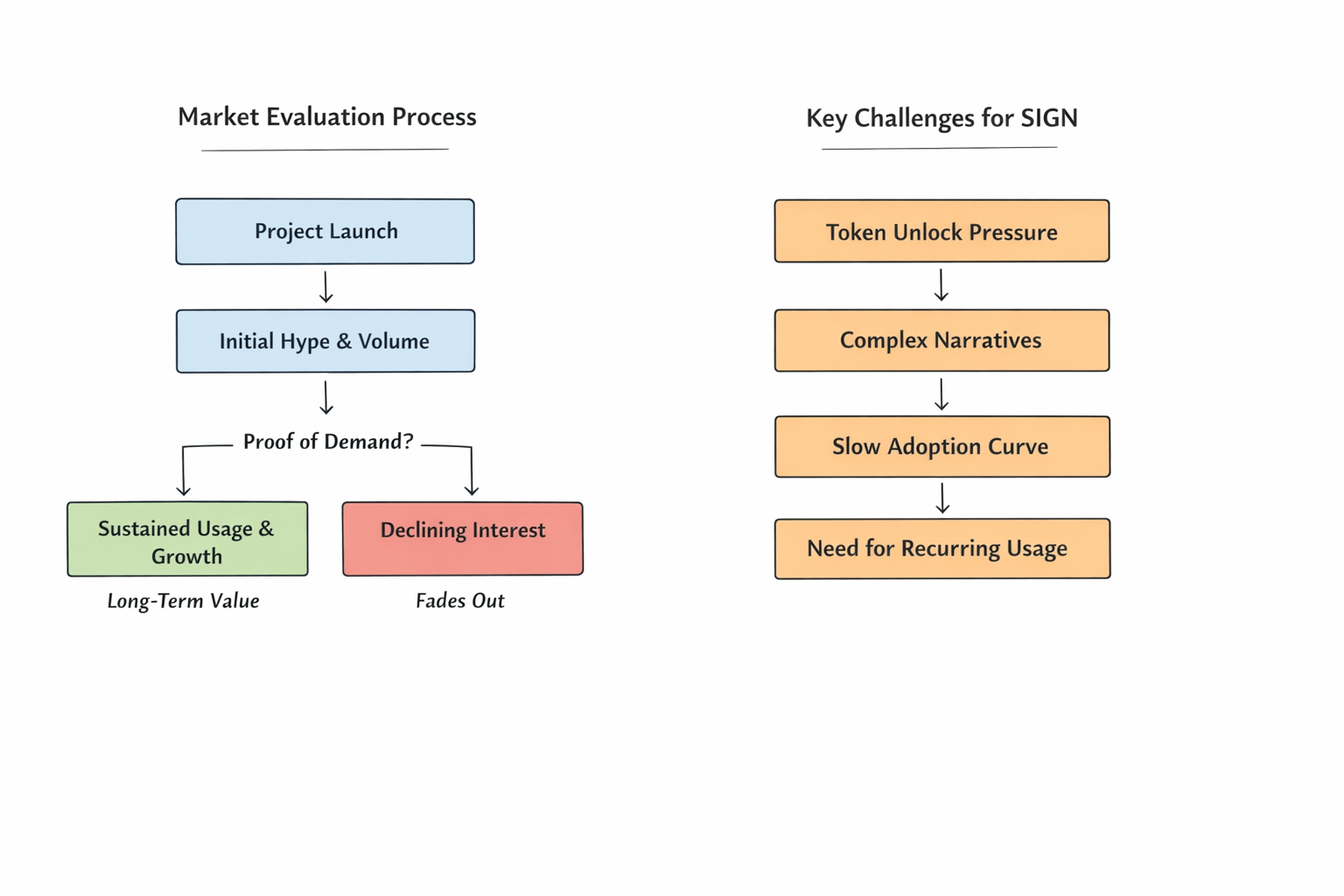
As of today, SIGN is trading around $0.048, with a market cap near $78 million, a circulating supply of about 1.64 billion tokens, and a fully diluted structure built around a 10 billion max supply. Daily trading volume has been roughly in the $33 million to $40 million range, which tells you the token is not dead, but it also tells you something else. Liquidity is present, yet conviction still looks limited relative to the full valuation story the project wants investors to buy into. The token is also still far below its prior peak, with one market tracker placing it roughly 62 percent under its September 24, 2025 all time high of $0.1282. For traders, that creates tension. A chart that far below peak can look either cheap or simply unloved. On the business side, the case for Sign is not hard to understand. The project centers on Sign Protocol, which its official documentation describes as an omni chain attestation system for recording and verifying structured claims. In simple language, it is trying to turn trust into infrastructure. Credentials, proofs, eligibility records, and similar forms of evidence can be issued, verified, and queried across chains, with support for onchain, offchain, hybrid, and privacy enhanced models. That gives the story more substance than the average token attached to vague ecosystem language. This is not just another coin searching for a purpose after launch. Sign also has products around that core. Its official materials position SIGN as the utility token powering the ecosystem, while TokenTable handles distribution logic and EthSign covers decentralized agreement signing. EthSign alone claims more than 2 million users and more than 800 thousand contracts signed. That matters because investors are usually more forgiving of a slow token when they can point to an actual product footprint. A market can ignore theory for a long time, but it pays closer attention when a project can show users, workflows, and repeatable business behavior. Still, this is where the retention problem comes in, and I think it is the real center of the title you gave me. A lot of crypto projects can generate one burst of attention. They can launch, list, airdrop, unlock, trend, and attract volume for a week. Retention is harder. Retention means users come back when there is no reward campaign pushing them. Retention means developers keep building because the protocol solves a recurring problem, not just a narrative problem. Retention means the token sits inside economic activity that repeats often enough for the market to assign lasting value to it. Sign has the ingredients of a serious infrastructure project, but the market is still waiting to see whether that infrastructure becomes habit. That skepticism is not baseless. Supply matters. Token unlock pressure remains part of the SIGN story, with unlock tracking services showing the next unlock around late April 2026 and a broader release schedule that extends into 2030. Another tracker shows recurring monthly unlock amounts around late Q1 2026. Even if the project is building responsibly, traders know that future supply can cap enthusiasm in the present. If the market believes new tokens will keep arriving before new demand arrives, it hesitates. That hesitation is often rational, not emotional. There is also a broader narrative problem. Sign sits in a category that sounds important but can be difficult for the market to price quickly. Attestation infrastructure, identity rails, and trust layers are useful ideas, but they do not create instant excitement in the way meme coins, gaming narratives, or high speed DeFi cycles do. This is the kind of sector where adoption can matter more than marketing, and adoption usually takes longer than traders want. Even recent funding support, including reported strategic backing led by YZi Labs in late 2025, helps credibility more than it guarantees price appreciation. Capital support can buy time. It cannot force the market to re rate a token before usage proves itself. A real life comparison is easy to make here. Think about a small but well run shop in a good location. The furniture is nice. The product is real. The owner is serious. But foot traffic is still inconsistent, and regular customers have not formed a habit yet. On paper, you can see the business working. In the market, though, potential is not the same as proof. That is how SIGN feels to me today. Serious enough to watch closely, not proven enough to command broad market passion. For traders, that means SIGN is less a blind momentum bet and more a monitoring exercise. Watch whether usage metrics keep translating into recurring relevance. Watch whether token unlocks are absorbed without heavy damage. Watch whether the market starts treating Sign as infrastructure with staying power rather than another respectable project with a nice deck. For investors, the question is even simpler. Can this protocol become something people repeatedly need, or is it something they only briefly admire? That is the whole game here. Sign looks real on paper because it probably is real on paper. The market’s refusal to fully care is not necessarily a mistake. It may just be asking for harder evidence. If you are serious about this name, do not chase the story. Track the retention, track the supply, track the return of users, and let the market show you when belief becomes demand. That is when interesting projects stop being ideas and start becoming investments.