
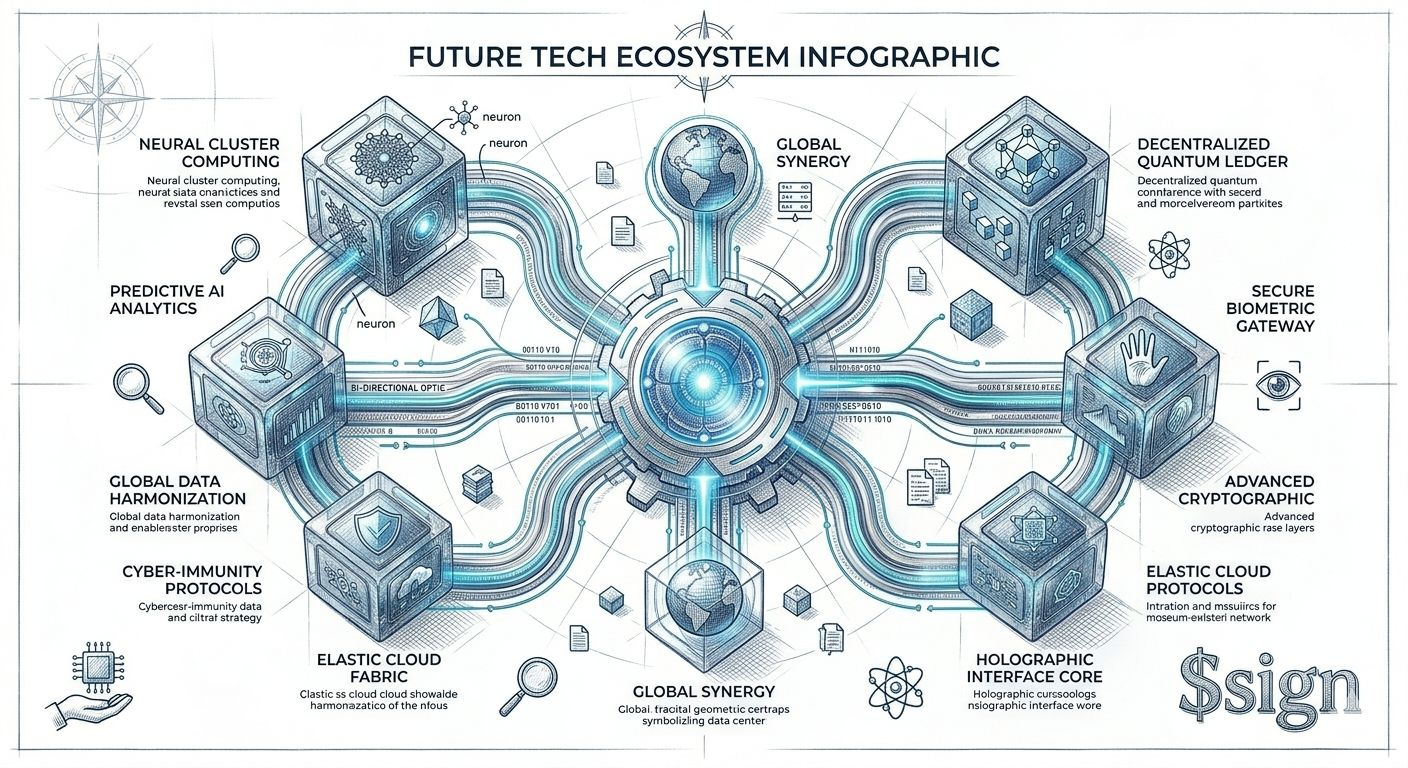
There was a time when I genuinely believed that identity alone was enough. If a project talked about ownership verification, or sovereignty I didn’t question much. It felt like the future was obvious—whoever controlled identity would control everything that followed. But that belief didn’t last long, because when I looked deeper, most systems were quietly failing at one critical point: they could create identity, but they couldn’t actually use it. Profiles existed, credentials were issued, but nothing moved beyond that. No transactions depended on them, no agreements required them. It was like building passports in a world with no borders to cross. That realization changed how I evaluate everything today, because now I don’t ask what a system claims to verify—I ask whether that identity actually does anything once it exists.
That’s where Sign started to feel different, not because it repeats the usual language of trust or sovereignty, but because it focuses on what comes after identity is created. It asks a more grounded question: how does identity move through an economy? Because identity isn’t valuable when it sits still. It only matters when it becomes part of action—when it flows into agreements, decisions, and real interactions. In regions like the Middle East where coordination across institutions borders and regulations is essential, that flow becomes more than a technical feature; it becomes economic infrastructure. A system that only verifies identity is incomplete, but a system that enables identity to be used continuously starts to change how entire markets operate.

From what I’ve seen in the design, Sign Protocol approaches this by turning identity into something active instead of static. It doesn’t treat identity as a profile stored somewhere—it treats it as a series of verifiable statements called attestations. These attestations can represent ownership, credentials, or agreements, and each one is cryptographically signed and structured so that other applications can read and rely on it. A business can issue a certificate to a supplier and instead of that record staying isolated it becomes a verifiable object that can be referenced across systems. That simple shift creates something powerful: a shared layer of trust that developers can build on. The more these attestations exist and are reused the stronger the network becomes because each interaction reinforces the next.
This is where the system starts to resemble infrastructure instead of just another protocol. The token plays a role in aligning incentives and coordinating participation, which is important because verification layers don’t survive on design alone—they need consistent engagement. In fragmented markets where trust is difficult to establish, a system like this attempts to standardize how verification is created and consumed, but its real strength depends on whether people actually use it repeatedly. If attestations are only created but never referenced again, then the system risks becoming a static registry. But if they are continuously used across applications, they start forming the backbone of real economic activity.
The market, however, is still in an early and uncertain phase. Signals like price behavior trading volume and holder distribution suggest interest but not full validation. Activity appears in bursts rather than as steady organic demand. This often means the market is still positioning around potential rather than reacting to proven usage. That distinction matters, because infrastructure is not defined by speculation—it is defined by repetition. Systems become valuable when they are relied upon consistently, not when they are talked about occasionally.
This is where the real test begins. The question is no longer whether the protocol can issue attestations, but whether those attestations are actually used in real workflows. If developers build applications that depend on them the system strengthens over time. Each use case adds weight to the network making it more difficult to ignore. But if usage remains limited or sporadic then the system never transitions into true infrastructure. It stays in a conceptual stage where value depends more on expectation than on actual utility. For a region like the Middle East, this challenge is even more important, because adoption depends heavily on integration with real institutions—governments, enterprises, and financial systems. Without that integration, even a well-designed protocol remains underutilized.
So the evaluation comes down to something very simple: does identity become part of daily operations or does it remain an isolated feature? Systems like RDNT demonstrate how capital can move efficiently across markets, but without verifiable identity attached to those flows, trust remains incomplete. Sign attempts to address that gap by ensuring that every interaction can be backed by something verifiable, something that persists beyond a single transaction. The real question then becomes: who is issuing attestations consistently who is consuming them and what keeps both sides engaged over time?
If I had to measure confidence in this system, I wouldn’t look at hype or short-term activity. I would look for consistent growth in attestation usage across multiple applications. I would look for real integrations with financial institutions or regulatory bodies and I would pay close attention to developer activity—because builders are usually the first to signal whether something is becoming part of a real workflow. If applications start depending on these attestations as a core component, that’s when the system begins to embed itself into the economy. On the other hand, if usage only appears during incentives or campaigns, and then fades afterward, that signals weak organic demand.
At the end of the day the difference between a system that survives and one that fades is not how much it promises but how often it is actually used. The systems that matter are not the ones that create identity. They are the ones where identity continues to move—quietly consistently and without needing attention.@SignOfficial
#signDigitalSovereignlnfra #SignDigitalSovereignInfra
$SIGN

#Megadrop #meme板块关注热点 #MegadropLista