There’s this tiny moment everyone ignores when they “sign” something online.
Click. Tap. Scribble with a mouse like you’re drawing with your elbow.
Done.
And we all just… accept it. Like yeah, that’s legally binding now. Cool.
I’ve spent enough time in legal tech to tell you: it’s not that clean. Not even close. Under the hood, it’s duct tape, assumptions, and a surprising amount of “well, we hope this holds up in court.”
Let’s be honest, global e-signature law is a patchwork.
On one side, you’ve got places like the US basically saying: “Did you mean to sign it? Is it tied to the document? Good enough.” That’s the whole vibe. No ceremony. No heavy cryptography required. Just intent + association.
And then there’s Europe.
eIDAS. The gold standard, apparently.
Also… kind of an over-engineered bureaucratic maze.
Three levels of signatures. Acronyms everywhere. “Qualified” signatures that need certified providers, identity checks and enough friction to make you question your life choices. It works, sure. But scalable? Usable? That’s another conversation.
But here’s the part people miss and I’ve seen this go wrong more times than I’d like to admit:
Courts don’t actually care about your fancy label.
They care about proof.
Who signed it? Was the document changed? Can you show intent without hand-waving?
I once had to help track down a “signed” agreement where the PDF had been quietly swapped after signing. Same filename. Different content. Total mess. Everyone pointing fingers. No clean audit trail.
That’s the kind of thing that keeps lawyers employed.
And this is where stuff like Sign Coin and EthSign stops sounding like crypto noise and starts looking like… actual plumbing. The kind that quietly keeps things from breaking.
Because instead of pretending a signature is that little scribble or checkbox, they treat it for what it really is: a cryptographic event.
Not vibes. Math.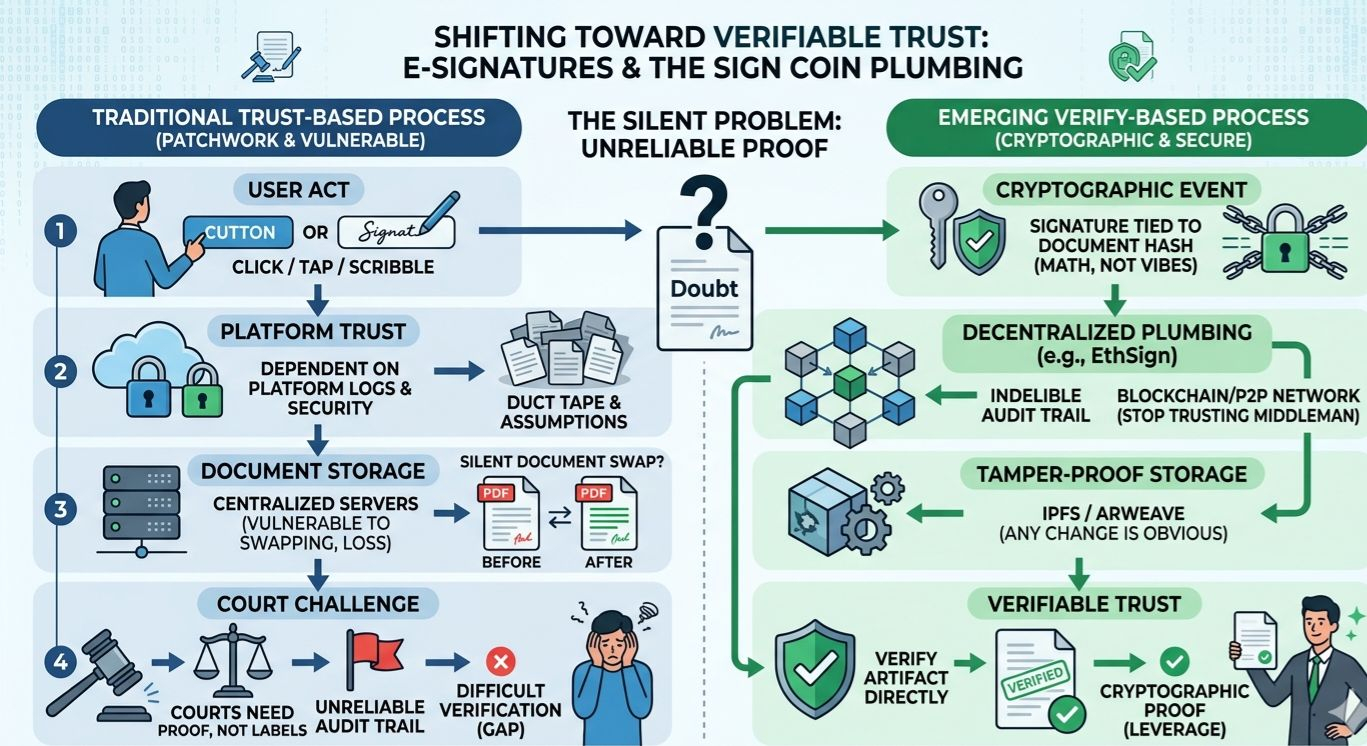
With EthSign, the signature is tied to a hash of the document. Change one character, and the whole thing breaks. Instantly. No debates. No “but this looks the same.” It doesn’t matter how it looks.
And the storage? Not sitting on some company’s server that can be “updated” or “migrated” or conveniently lost. It’s pushed to decentralized storage IPFS, Arweave. Basically, places where tampering isn’t just discouraged, it’s obvious.
And yeah, I know “blockchain fixes this” has been abused to death.
But in this case? It actually fixes something real.
Because the current model is built on trust layers:
You trust the platform
You trust their logs
You trust their security
You trust they didn’t mess anything up
That’s a lot of trust for something that’s supposed to prove an agreement.
Sign Coin flips that a bit. Or tries to, at least.
The idea is simple: stop trusting the middleman, start verifying the artifact itself.
And here’s the “so what” that most explanations skip:
If your landlord edits your lease after you sign it, you can prove it.
If your employer tries to “update” a contract quietly, you can catch it.
If someone claims you signed something you didn’t, you’ve got cryptographic proof, not just a log file controlled by a third party.
That’s not convenience. That’s leverage.
Now, compliance-wise… it’s funny.
In places like the US, EthSign already ticks the boxes that actually matter. Intent? Covered. Association? Stronger than most platforms. Record retention? Arguably better than centralized systems.
In the EU? It won’t magically become a “Qualified Electronic Signature.” No certified authority, no government stamp.
But here’s the loophole nobody likes to say out loud:
The law doesn’t require magic. It requires proof.
And if you can reliably prove identity, intent, and integrity… courts tend to listen, regardless of whether your signature came from a government-approved vendor or a private key.
The more interesting shift, though, is identity.
Traditional systems want everything.
Your ID. Your face. Your data sitting in some database you don’t control.
EthSign leans the other way: prove you control a key, and that’s enough for a lot of use cases. Minimal exposure. Maximum verifiability.
That’s a pretty big deal in a world where data leaks are basically a weekly occurrence.
Now, don’t get me wrong, this doesn’t magically fix everything.
You’re still not using this for wills or certain legal instruments in a lot of jurisdictions. The law is slow. Painfully slow.
But the direction is obvious.
We’re moving from: “Trust me, this is signed”
to: “Here’s proof. Verify it yourself.”
And yeah, Sign Coin sits somewhere in the middle of that shift. Not as a buzzword. As part of the rails.
Because once you remove the need to trust the platform, the signature stops being a gesture and starts being evidence.
And honestly? It’s about time.
I’ve seen too many “signed” documents fall apart the moment someone asks a simple question:
“Can you prove this hasn’t been changed?”
Silence.
That’s the gap this stuff is trying to close.
@SignOfficial #SignDigitalSovereignInfra $SIGN