I spent some time looking through Midnight’s architecture and developer materials, and my first reaction was not excitement. It was hesitation.
Privacy in crypto usually sounds better in theory than it feels in practice. Many systems either hide too much and become difficult to verify, or reveal too much and call that transparency a feature. Midnight interested me because it seems to be trying to sit in the uncomfortable middle.
That middle is where most real financial and institutional systems actually live.
In public blockchains, verification is easy, but privacy is weak. Anyone can inspect wallet flows, trading patterns, counterparties, and transaction timing. That level of openness is useful for audits and settlement, but it is also a poor fit for businesses, identity systems, private payments, or regulated applications where exposure carries real cost.
On the other side, fully shielded systems solve one problem by creating another.
If a network hides everything, then outsiders are asked to trust a black box. That may work for a narrow privacy use case, but it becomes harder to justify in markets where participants still need to prove solvency, compliance, eligibility, or lawful behavior. That tension has been around for years, and most projects have not really resolved it. They just choose one side.
What interested me most about Midnight is that it does not seem to choose either side completely.
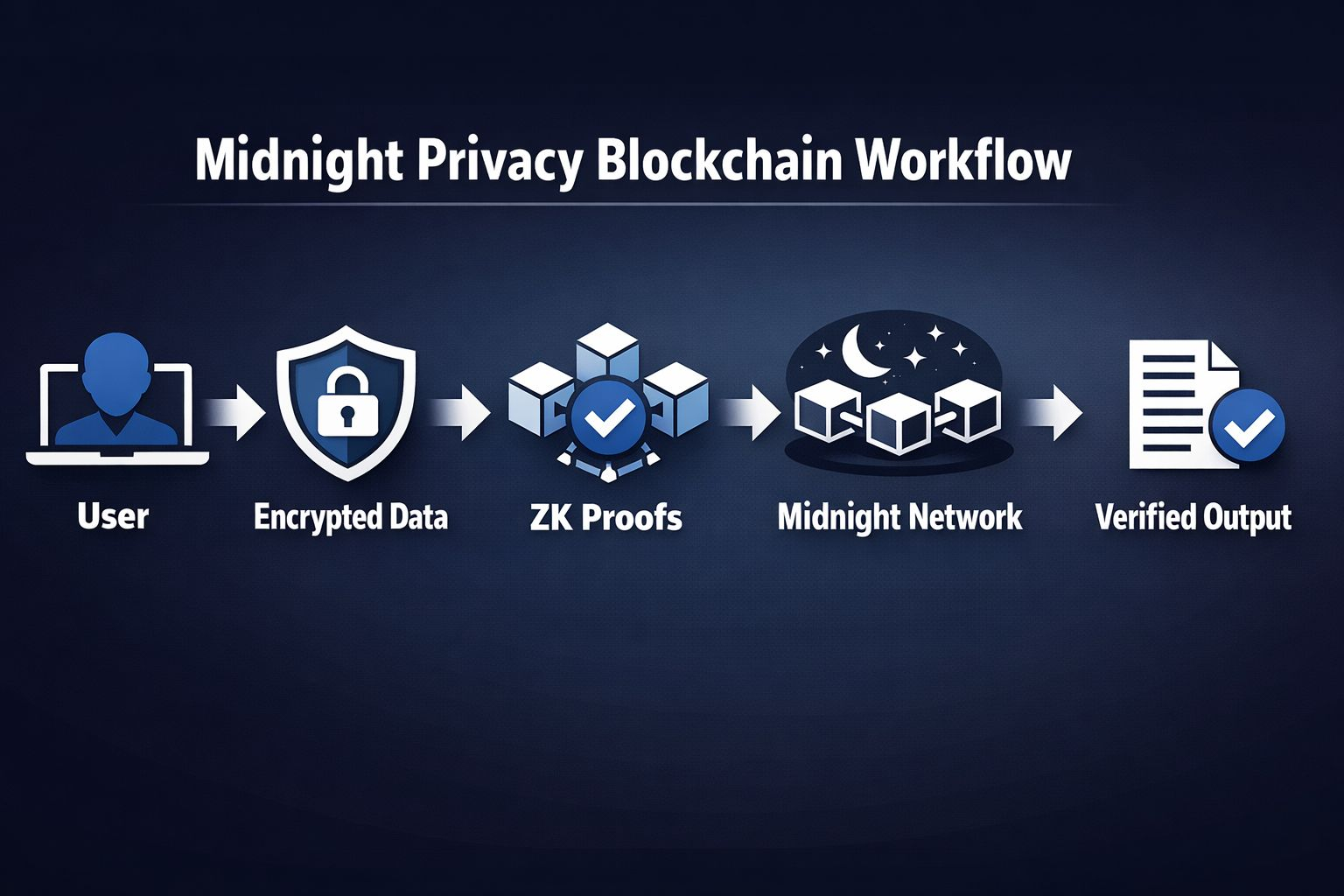
After going through the system, the core idea looks fairly clear: prove what matters, reveal only what is necessary. The project is built around zero-knowledge proofs and selective disclosure, which means a user or application can validate a claim without exposing all of the raw data behind it. In crypto terms, that is not a new concept. What is different is how central that principle seems to be to the whole architecture.
I noticed that Midnight is not really selling privacy as invisibility.
It is closer to controlled visibility. A user should be able to show that they meet a requirement, that a transaction is valid, or that a compliance condition has been satisfied, without handing over the full dataset behind it. That framing feels more mature than the usual privacy narrative, because most real systems do not need total secrecy. They need narrower disclosure.
The architecture reflects that.
Midnight combines a UTXO-style asset layer with account-based smart contract functionality. That hybrid structure is important. Pure UTXO systems can be good for asset privacy and spend logic, but they become awkward when applications need persistent contract state. Pure account systems are easier for complex apps, but privacy often becomes harder to preserve because activity is more directly tied to addresses and visible state changes.
Midnight appears to be trying to keep one foot in each model.
From what I saw, NIGHT exists in a UTXO-style form, while contracts and contract state are handled in a more account-like structure. That may sound like a technical compromise, but I think it is a deliberate one. The system seems designed to preserve shielded asset mechanics while still supporting programmable applications that behave more like modern smart contract platforms.
That leads to the smart contract layer, which is where Midnight becomes more interesting.
The network uses a language called Compact. After reading through the design, my impression is that Compact is not meant to feel like a general-purpose developer playground in the way Solidity sometimes does. It is more constrained, more explicit, and more tied to proof-oriented execution. That makes sense. Once privacy and zero-knowledge proofs are central to the system, loose contract design becomes a liability.
The execution model also seems intentionally bounded.
Instead of pushing toward open-ended, highly dynamic computation, Midnight uses a more controlled environment where contract behavior can be reasoned about more precisely. I think this design is smart, even if it may feel restrictive to some developers. In privacy systems, constraints are often a feature. The more predictable the execution path, the easier it is to verify outcomes and contain leakage.
One thing I appreciated is that the docs do not pretend privacy is automatic.
That is an important point. Midnight gives developers tools for confidentiality, but the burden of design still matters. State updates, arguments, and data flows can still become public if the contract is written carelessly. In other words, the system offers privacy primitives, not privacy guarantees by default. That may disappoint people looking for simple narratives, but it is a more honest way to describe how these networks actually work.
The asset model is another unusual part of the system.
Midnight separates NIGHT from DUST. NIGHT is the native token. DUST is a shielded, non-transferable resource used for fees and computation. Holding NIGHT generates DUST over time, and DUST is what gets consumed when users transact or interact with contracts.
At first, I was skeptical of this structure.
Crypto projects often create extra resource layers that feel unnecessary. But in this case, the separation seems purposeful. It distinguishes ownership and governance from operational usage. It also appears designed to avoid some of the problems that come with private transferable fee assets. DUST is framed less like money and more like fuel. That will not remove all regulatory questions, but it does show that the designers are trying to be careful about how privacy and value transfer intersect.
Then there is Zswap, Midnight’s shielded asset mechanism.
Conceptually, it follows the familiar privacy architecture of commitments, nullifiers, and proof-based validity checks. What matters is not that this exists, since many privacy systems have similar ingredients. What matters is that Midnight is trying to integrate those mechanics into a broader programmable environment rather than leaving them isolated at the payment layer.
That integration is where the project either succeeds or fails.
A lot of crypto systems work well in a narrow laboratory setting. They can demonstrate private transfers, private balances, or private credentials in isolation. The harder challenge is making those pieces usable inside a live application ecosystem, where contracts, fees, wallets, compliance logic, and user experience all interact. Midnight seems to understand that challenge, although I think it is still fair to question how smooth that experience will be in practice.
What interested me most is the type of use cases this architecture points toward.
Not speculative use cases. Not generic claims about Web3 identity. I mean cases where public transparency is genuinely a problem: payroll systems, private business transactions, compliance-heavy financial products, on-chain proof of reserves, credential checks, eligibility gating, and forms of digital identity that require verification without oversharing.
In those areas, Midnight’s design starts to make more sense.
A normal public chain can verify activity, but often at the cost of exposing too much context. A fully private system can hide that context, but may make oversight and trust harder. Midnight is clearly trying to make selective disclosure the bridge between those two models. I think this is the most serious part of the project. It is not trying to romanticize privacy. It is trying to make privacy usable.
Still, I would be careful about overstating how novel that is.
The crypto industry has been talking about zero-knowledge proofs, selective disclosure, and privacy-preserving compliance for a long time. Midnight’s value will depend less on whether the ideas sound correct and more on whether the system is operationally coherent. Can developers actually build with it without excessive complexity? Can users interact with it without confusing abstractions? Can institutions trust the confidentiality model without losing the ability to audit what matters?
Those are not small questions.
After examining the system, my view is that Midnight is one of the more thoughtful attempts to answer them. Not because it promises perfect privacy, and not because it claims to solve regulation through branding, but because it seems to accept the real tradeoff: privacy is useful only when verification still works.
That is probably the broader significance here.
Crypto has spent years treating transparency as a default virtue. Midnight suggests that the next stage may require something more selective and more disciplined. Not everything should be visible. Not everything should be hidden either. The interesting part is deciding what must be proven, what can remain confidential, and whether a blockchain can enforce that boundary reliably.
I think Midnight is worth watching for that reason.
Not as a finished answer, and not as a guaranteed breakthrough, but as a serious test of whether privacy in blockchain can move beyond ideology and become infrastructure.
@MidnightNetwork #NIGHT #night $NIGHT