

That’s the first thing that stood out to me when I went through S.I.G.N.
Most days in crypto, we’re dealing with assumptions.
Wallet = identity.
Transaction = truth.
Signature = intent.
but none of these actually answer the deeper question:
who verified this… and under what authority?
S.I.G.N. is basically trying to solve that — not at app level, but at sovereign scale.
What S.I.G.N. actually is (my take)
I don’t see S.I.G.N. as a “crypto project.”
It feels more like a national infrastructure blueprint disguised in Web3 rails.
Three layers:
• Money → CBDCs + regulated stablecoins with policy controls
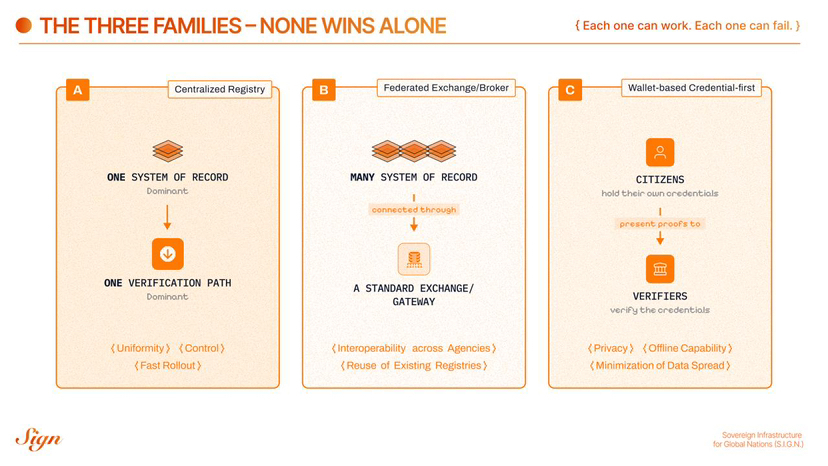
• Identity → verifiable credentials without exposing raw data
• Capital → programmable distribution (grants, benefits, incentives)
Individually, we’ve seen all of this before.
But stitching them together under one system…
with auditability baked in from day one — that’s different.
The real unlock: attestations
This is where it gets interesting.

S.I.G.N. leans heavily on Sign Protocol, which uses:
• schemas → define what “truth” looks like
• attestations → verifiable records of that truth
Not hype. Not narrative.
Actual cryptographic evidence of events.
Think about it:
• eligibility isn’t claimed → it’s attested
• compliance isn’t assumed → it’s provable
• payments aren’t trusted → they’re traceable with context
This shifts systems from “trust me” → “verify me anytime.”
Insider observation (the part most people will miss)
A lot of projects push decentralization as freedom from control.
S.I.G.N. does the opposite.
It embraces control — but makes it inspectable.
That’s a subtle but important shift.
Because in real-world systems (governments, institutions),
control isn’t optional… opacity is.
S.I.G.N. is basically saying:
you can have strict policy, compliance, and governance —
as long as every action leaves a verifiable trail.
That’s why this fits institutions way more than retail crypto.

Utility (where this actually matters)
If this gets adopted, we’re looking at:
• national ID systems without centralized data leaks
• cross-border compliant payments with real-time verification
• government aid distribution with zero duplication or fraud
• onchain audit trails for public spending
and more importantly…
systems that can prove what happened, not just record it
My opinion
I think S.I.G.N. sits in a category most CT will ignore… until it’s too late.
It’s not chasing memecoin velocity.
It’s building infrastructure for systems that can’t afford to fail.
That also means:
• slower adoption
• heavy regulatory alignment
• less hype cycles
but if it clicks, it doesn’t just onboard users…
it onboards entire nations and institutions.
Final thought
crypto started with “don’t trust, verify”
S.I.G.N. is one of the few projects actually trying to operationalize that
at a level where verification becomes infrastructure, not a feature
and honestly… that’s where the real game changes
quietly, not loudly.