
I have spent enough time in crypto to know the pattern by heart. A new project shows up with a big idea. The narrative sounds great. The community hypes it for a while. Then it slowly fades once people realize the idea never actually turned into something real. So when I came across $SIGN and the #SignDigitalSovereignInfra conversation, I did not get excited about the concept right away. I got curious about something more basic. Is there anything real here or is this just another story?
After spending proper time looking into it, I think there is something genuinely worth paying attention to. Not because of the price or the hype. Because of what the project is actually trying to fix. The map above shows everything Sign is building as a whole. It is not one product. It is a full stack, with each piece solving a different piece of the same big problem.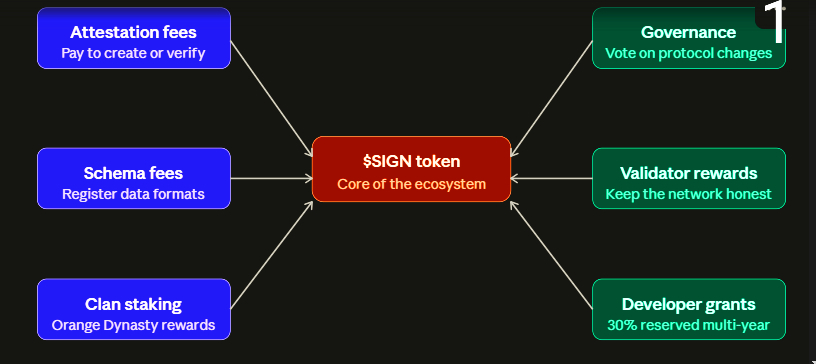
The core problem Sign is solving is simple when you say it out loud. On the internet today, you cannot prove anything about yourself without giving your data to some company and trusting them to keep it safe. That company then owns your identity. They can lose it, sell it, or shut it down whenever they want. Sign builds a system where instead of trusting a company, you trust math. You create a proof of who you are, what you have done, or what you own. That proof lives on a blockchain. Anyone can check it. Nobody controls it. And you do not have to share your private information to use it.
They call these proofs attestations. Think of it as a verified stamp that cannot be faked, cannot be deleted, and does not require anyone in the middle to confirm it is real. Here is how that process actually moves from start to finish.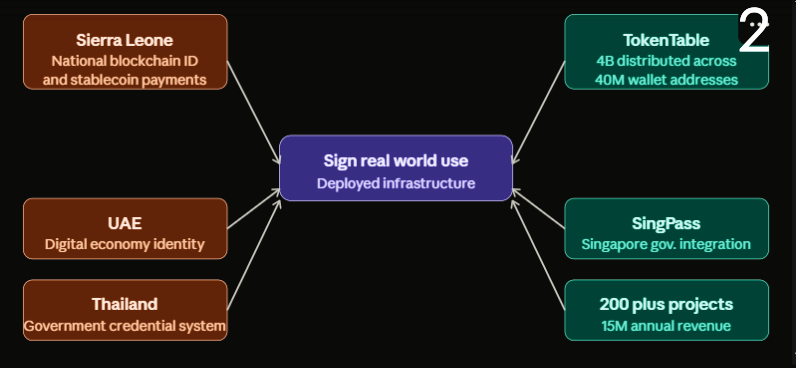
The key thing to notice in that flow is what is missing. There is no central authority deciding whether the attestation is valid. Once something is on chain and signed, anyone can check it without asking permission from anyone. The attester could disappear tomorrow and the proof would still be there, still working, still trustworthy.
This is fundamentally different from how verification works in Web2, where trust is always handed upward. You trust Google because you trust that Google is trustworthy. Remove the platform and the trust disappears with it. Sign flips this. The math does the work, not the institution.
The part that makes the most sense to me as a long term idea is the zero knowledge angle. A user can prove they passed verification somewhere without ever showing the actual documents behind it. You confirm the fact without exposing the information that established it. This is exactly what compliance in a digital world should look like. Prove what needs to be proven. Keep everything else private.
Now here is where Sign separates from the dozens of identity projects that have come before it and gone nowhere. Real deployment with real governments.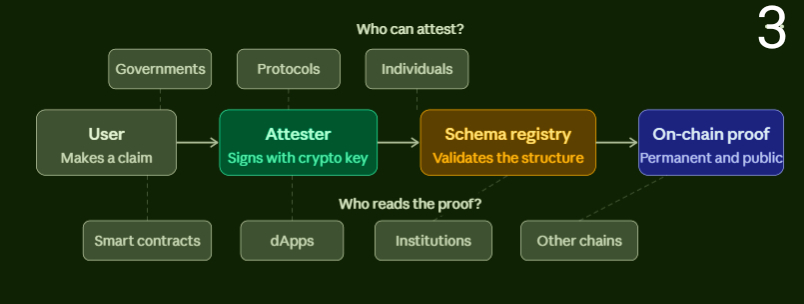
These are not announcements about future plans. In November 2025, Sign CEO Xin Yan signed a formal agreement with Sierra Leone's Ministry of Communication, Technology, and Innovation to build the country's blockchain based digital ID and stablecoin payment system from the ground up. That includes identity frameworks, digital wallet systems, and asset tokenization all in one national rollout.
The numbers behind the existing products tell a similar story. Over four billion dollars distributed. Over 40 million wallet addresses. Over 200 projects using the platform. Annual revenue at fifteen million dollars. For a protocol that most people still categorize as an early stage identity project, that is a level of throughput that most crypto infrastructure projects never reach at all.
What makes this especially interesting is where these deployments are happening. The regions moving fastest on digital governance right now, parts of Southeast Asia, the Gulf, West Africa, are also the regions where the gap between formal identity systems and the actual population is biggest. Billions of people globally cannot fully prove who they are in ways that legacy bureaucracies recognize. A system that works across chains, requires no physical document, and can anchor to government records without storing that data in one central place is not a niche use case. That is the kind of infrastructure that entire economies are waiting for.
Now the question I always come back to with projects like this is where the token actually fits into all of it.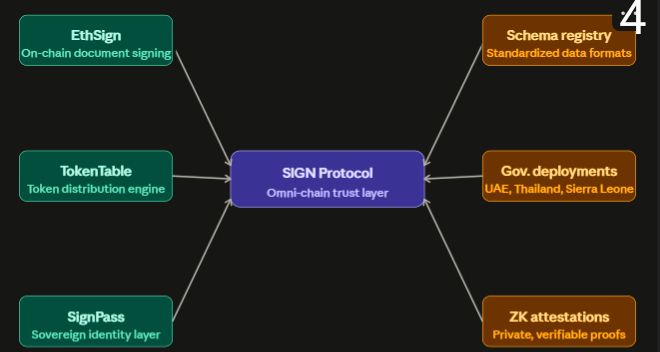
The $SIGN token launched in April 2025. It is used to pay for creating attestations, registering schemas, participating in governance votes, and staking inside the community structure Sign calls the Orange Dynasty. Groups of community members form clans, stake $SIGN together, and earn a larger share of daily rewards as the collective stake grows.
The community reached 400,000 members within two weeks of the Orange Dynasty launch. Over 100,000 of those were verified active participants. The funding backstory helps give it more weight. Sign raised over 55 million dollars from investors including YZi Labs and IDG Capital. These are not small or casual investors. When firms like that put money into multiple rounds, it usually means they are seeing something real inside the operation, not just backing the narrative.
But here is where I try to stay honest with myself. Community size and actual protocol usage are two completely different things. A lot of people join for staking rewards and leave when the excitement cools down. What I watch instead is whether developers are building products where attestations are load bearing, meaning the product cannot function without them. That tells you far more about the long term health of a protocol than any community growth number.
The thing that keeps pulling me back to SIGN is what it represents as a missing piece. Web3 built incredible financial tools. It built ways to move money, trade assets, and create ownership records that nobody can erase. But it never built a solid way to know who is actually using any of it. Every sybil attack, every manipulated airdrop, every fake governance vote exists because there is no reliable trust layer underneath the financial layer. Sign is working directly on that gap.
The market right now is still pricing this mostly on narrative. That is normal for a protocol at this stage. The real test comes later, when the narrative fades and the only thing left is the question of how often real people are using it to prove real things in their actual lives. That is the moment that separates protocols that lasted from ones that did not.
I am not saying the path is simple. Getting developers to build on a new trust layer takes time. Getting users to think about their identity as something they carry with them rather than something a platform holds for them requires a real shift in habits. None of that happens quickly.
But I completely understand why I keep coming back to it. Because the problem is not going anywhere. Trust has been the missing piece of the digital economy since before crypto ever existed. And Sign is one of the few projects that is actually building toward a solution rather than just describing one.