
$SIGN is one of the few projects that doesn’t try to sit at the surface of economic activity, but goes straight into the coordination layer underneath it. With SIGN, the focus is not on moving capital faster, but on making the conditions around participation easier to carry across different systems. That difference sounds abstract at first, but it becomes very concrete once you actually interact across multiple environments.
Whatever you prove inside one platform stays there. The moment you move, even slightly, you are expected to rebuild that context again. SIGN approaches this differently by allowing specific proofs to travel in a controlled way, without forcing the user to reopen everything each time. It’s not about removing checks, it’s about avoiding unnecessary repetition.
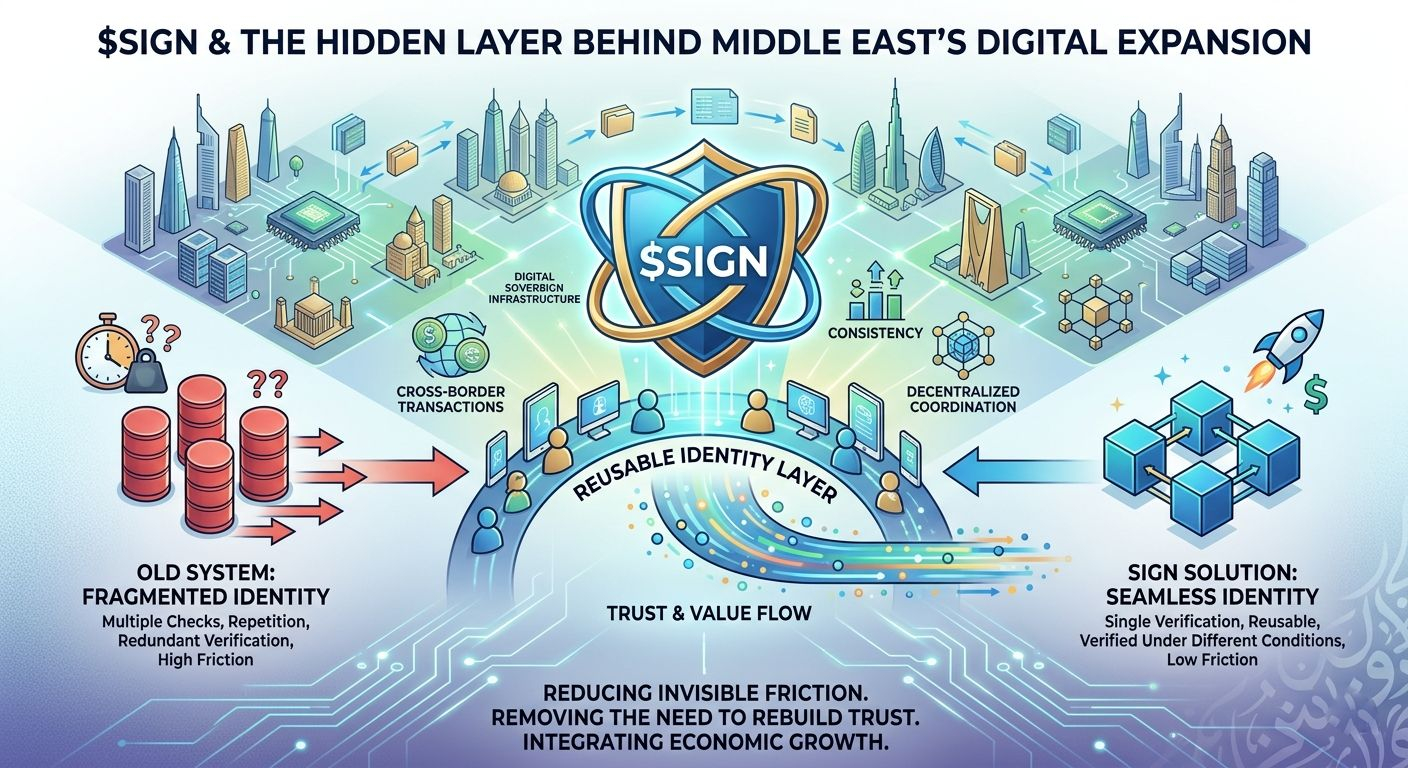
I ran into this pattern a few times in smaller situations that didn’t seem important on their own. Moving assets between different environments, interacting with new counterparties, or even just trying to access certain features. Nothing failed completely, but there was always a pause where the system needed to “re-understand” who I was. That pause is easy to ignore once, but repeated enough, it starts to shape how smooth or slow everything feels.
This is why the Middle East context makes sense for something like SIGN. The region is not building one unified system, but multiple systems expanding at the same time. Each one has its own structure, its own requirements. Growth here depends less on forcing everything into a single standard, and more on allowing those systems to recognize valid states without constant resets.
The way I look at $SIGN is through that lens. Not as something loud, but as something that reduces how often processes have to start over. When coordination becomes smoother, activity naturally follows. It doesn’t create growth on its own, but it removes the small frictions that quietly limit how fast that growth can compound.