
There’s something about Web3 that still doesn’t sit right.
Not in an obvious way. On the surface, everything sounds ideal—ownership, control, freedom from centralized systems. But when you actually spend time in it, you start to notice a strange feeling: you’re visible all the time.
Every transaction, every move, every interaction—it all leaves a trail. And not just a small one. A permanent one.
That’s where the discomfort comes from.
Because in real life, control doesn’t mean being fully exposed. It means having a say in what people can see.
And that’s exactly the gap Midnight Network is trying to address—not loudly, not with hype, but in a way that feels more grounded.
It’s Not Really About “Hiding”
A lot of crypto projects talk about privacy, but if you listen closely, most of them are really talking about hiding everything.
And honestly, that never felt like the right answer.
Because people don’t actually want to disappear. They just don’t want to overshare by default.
There’s a difference.
In real life, you don’t walk around showing every detail of your identity to everyone you meet. You share what’s necessary, depending on the situation. Sometimes more, sometimes less.
Web3 hasn’t really figured that out yet.
Midnight seems to start from that exact point. Not “how do we hide everything?” but “how do we let people stay in control?”
That shift might sound small, but it changes everything.
The Quiet Power of Proving Without Showing
This is where zero-knowledge proofs come in—but honestly, you don’t even need to think of it in technical terms.
Just think of it like this:
What if you could prove something is true…
without giving away everything behind it?
You could prove who you are—without exposing your entire identity.
You could complete a transaction—without making your full history visible.
You could interact with an app—without feeling like you’re being watched the whole time.
That idea feels… right.
Not futuristic. Not complicated. Just right.
And that’s what makes Midnight interesting. It doesn’t feel like it’s forcing a new behavior. It feels like it’s correcting something that was off.
Finally, Something Between the Extremes
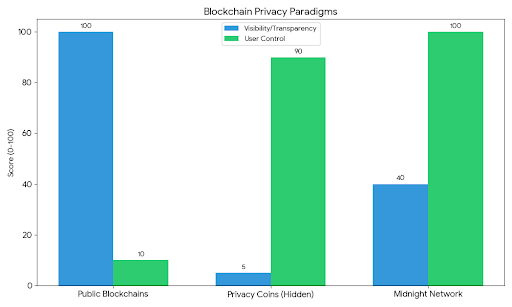
Right now, most blockchain systems feel like they’re stuck in two modes:
Either everything is open and public forever…
or everything is hidden in a way that makes it harder to use.
And neither of those feels realistic.
People don’t live like that.
We exist somewhere in between. We share, but selectively. We prove things when needed, but we don’t expose everything just to exist.
Midnight feels like it understands that middle space.
It’s not trying to make everything invisible. It’s not trying to keep everything exposed. It’s trying to let both things exist at the same time.
That balance is what makes it feel less like a concept… and more like something you could actually live with.
Built With Privacy, Not Patched With It
One thing that quietly matters here is when privacy is introduced.
In a lot of projects, it comes later. As an add-on. Something developers have to work around.
And you can feel that. It’s never smooth.
Midnight feels different because privacy isn’t added—it’s assumed from the start.
That changes how everything is built on top of it.
Developers don’t have to fight the system to protect users.
Users don’t have to think about protecting themselves all the time.
It just becomes part of how things work.
And honestly, that’s how it should have been from the beginning.
Where This Actually Starts to Matter
This isn’t just theory. It shows up in real situations.
Think about identity for a second.
You shouldn’t need to reveal everything about yourself just to prove one small thing. Whether it’s your age, your credentials, or access rights—it should be enough to prove what’s needed, nothing more.
Or take payments.
Not every financial action needs to be publicly traceable forever. But at the same time, it still needs to be valid, trusted, and accountable.
Then there’s business use.
No serious company is going to run operations on a system that exposes internal logic or sensitive data. But many would still want the benefits of blockchain—if that risk wasn’t there.
Even smart contracts feel different in this context. Instead of everything being visible, they can work with protected information while still producing outcomes that others can trust.
And maybe most simply—people just want to use systems without feeling like everything they do is being recorded and analyzed.
That’s not a luxury. That’s normal.
Trust, But Done More Thoughtfully
There’s this idea in crypto that transparency equals trust.
But that’s not always true.
Sometimes too much visibility just creates noise. Or worse, discomfort.
Midnight doesn’t remove trust—it just builds it differently.
Instead of saying “look at everything,” it says “prove what matters.”
And that feels more natural.
In real life, you don’t expose everything to earn trust. You show enough to make your point. You prove what’s needed.
Midnight brings that same logic on-chain.
A Small but Meaningful Design Choice
Even the way Midnight handles its network economy feels more… intentional.
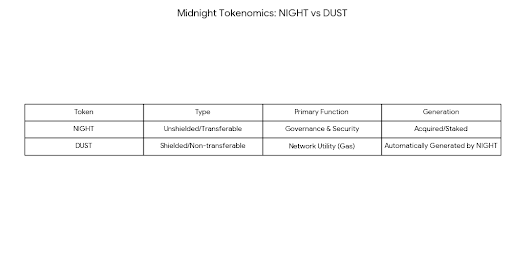
Instead of forcing one token to do everything, it separates roles. The token exists, but the resource that actually powers private activity on the network is handled differently.
That might not sound exciting, but it’s actually important.
It means the system isn’t built purely around speculation. It’s built around usage.
And in crypto, that’s rarer than it should be.
It Feels Like It Was Built for Real Use
Some projects feel like they’re built to attract attention.
Midnight feels like it’s built for people who actually need it to work.
Developers who care about protecting users.
Businesses that can’t afford to expose sensitive data.
People who want control, but don’t want to disappear to get it.
It doesn’t feel loud. It feels considered.
Why This Hits on a Human Level
If you strip everything down, this isn’t really about blockchain.
It’s about something simpler.
People want control over their own information.
They want privacy, but not at the cost of access.
They want to use technology without feeling like they’re constantly being watched.
And builders want to create things that respect that.
That’s it.
Midnight just happens to be one of the few projects that seems to take that seriously from the start.
A Quiet Thought to End On
None of this guarantees success.
Good ideas still need execution.
Strong design still needs adoption.
And real value only shows up over time.
Midnight still has to prove itself in all of those ways.
But what makes it stand out is simple.
It’s not trying to repeat what Web3 has already said a hundred times.
It’s trying to fix something that never really felt right in the first place.
And maybe that’s why it feels different.
Not because it’s louder.
But because it’s paying attention to something everyone else quietly learned to ignore.