
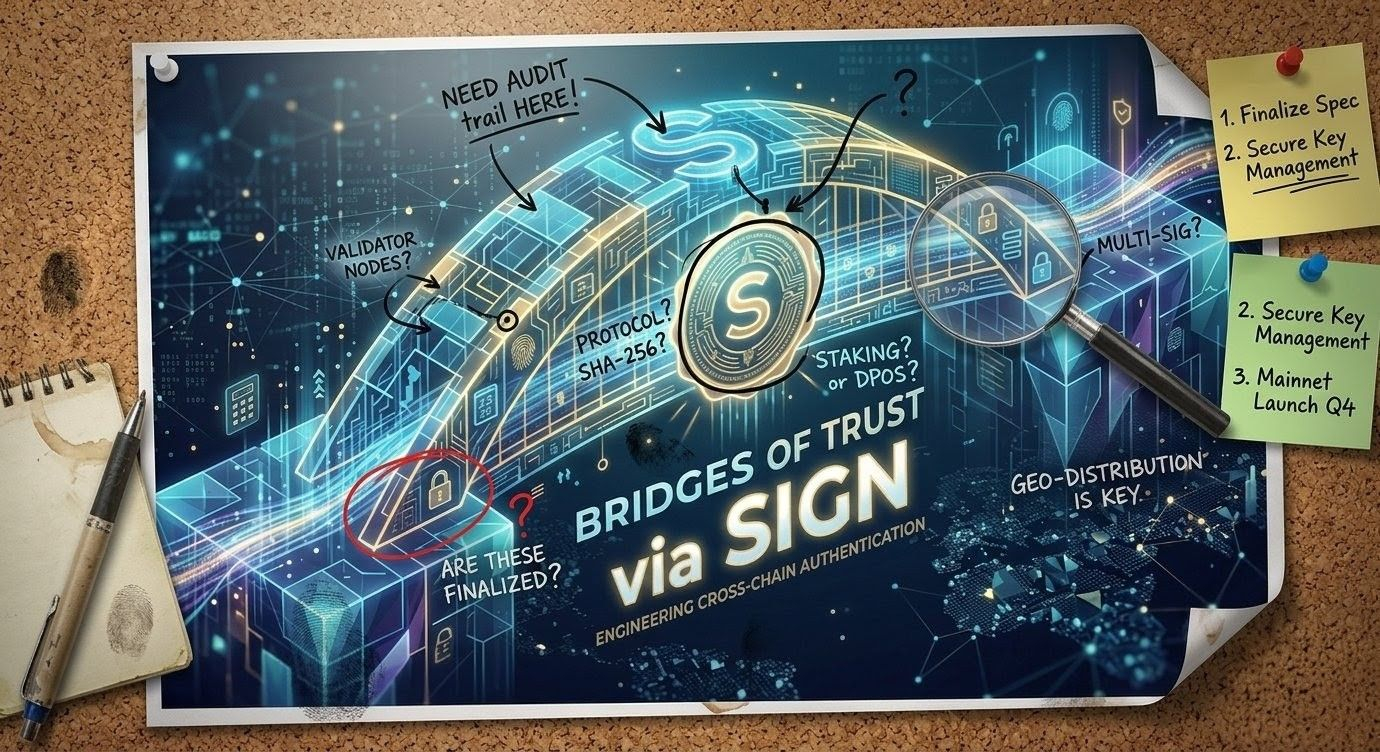
I was quietly watching the API Status interface as it tracked attestations moving in milliseconds between networks. As the data coursed through these digital channels, I returned to the Sign Protocol’s reference architecture and wondered: how can a cryptographic proof verify a user’s eligibility across completely separate Web3 systems, without a human intermediary or exposing the original data?
The biggest challenge in Web3 is “information dispersion.” Blockchains naturally silo themselves, leaving credentials trapped within their originating networks. This is where SIGN shines: it transforms documentation from static records into a global exchange protocol through omni-chain technology. It’s not just about moving data—it’s about creating a form of “digital diplomacy,” where composable attestations become universally interpretable building blocks, enabling smart contracts to interact across chains.
Exploring universal compatibility, the protocol treats proof like a “technical transit permit.” Instead of rebuilding trust each time, SIGN provides cross-chain validity proofs, showing that regulatory or financial conditions were already satisfied. This is the essence of structural interconnection: local data becomes a protected global value. Schema-driven attestations then ensure that even when protocols follow different standards, information disruption is eliminated.
SIGN’s success relies not just on code efficiency but on economic alignment via $SIGN. Operators safeguarding these data pathways use the protocol to calibrate incentives and protect the integrity of transmission. If a party attempts a breach, SignScan immediately rejects the transaction before it settles, making deviation technically and economically unviable. This converts trust from fragile, centralized bridges into robust, mathematically enforceable cross-border reasoning.
The true value of Sign lies not in branding, but in its role as a global translator in an interconnected world. The real milestone will come when a single SIGN attestation enables a software agreement across three different networks, demonstrating that technical reliability can be engineered as a stable bridge—immutable, just like the laws of physics.