

@SignOfficial #SignDigitalSovereignInfra $SIGN
I used to think systems proved their value the moment they were created. If something was technically elegant, well-designed, and backed by credible people, I assumed the rest would follow. Oh, it felt obvious build something useful, and the world would naturally start using it. I saw infrastructure as a finished product, not a living process. That was the naive part.
Over time, that belief started to feel incomplete. I began noticing how many well-designed systems simply… stopped. Not because they were broken, but because nothing meaningful happened after creation. They existed, but they didn’t move. And that’s when the question shifted for me: what happens after something is created?
That’s where something like SIGN the idea of a global infrastructure for credential verification and token distribution becomes more than just a concept. At first glance, it sounds like many other systems: verify credentials, distribute tokens, enable trust. Okay, fine. But I’ve learned to ignore what systems claim to do. I care about what happens when they’re actually used, in messy, real environments where incentives, habits, and friction decide everything.

So I started looking at it differently. Not as a tool, but as a process. Imagine a stamp in a passport. On its own, it means nothing. Its value comes from being recognized, reused, and trusted across borders. If no one checks it, if no one builds on it, it’s just ink. That’s how I now see credentials in SIGN. They only matter if they keep moving being referenced, verified again, triggering actions somewhere else.
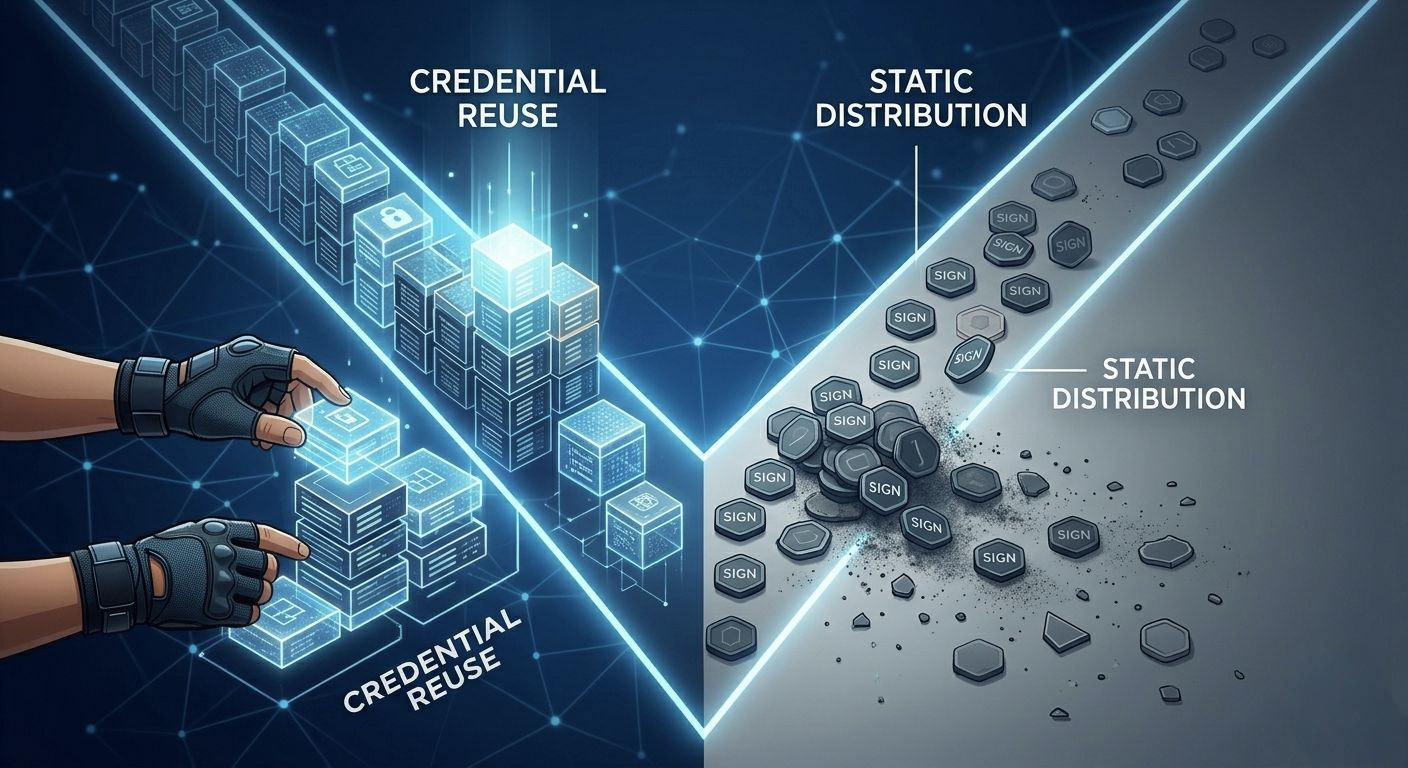
The same goes for token distribution. It’s easy to send something out once. That’s creation. But does that token circulate? Does it get used again, exchanged, or tied into another process? Or does it just sit in a wallet, static, like a flyer handed out on a street that nobody reads? That gap between distribution and continued activity is where most systems quietly fail.
When I break it down structurally, I’m really asking three things, even if I don’t say them out loud anymore. First, how does this system actually let people interact? Not in theory, but in practice. Can a developer issue a credential that another platform immediately recognizes without friction? Can an institution rely on it without building custom layers around it? If interaction requires too much coordination, it slows everything down.
Second, can what’s produced be reused? A credential that gets verified once and then forgotten isn’t infrastructure. It’s a one-time event. But if that same credential becomes a reference point something other systems pull from, build on, or depend on then it starts to behave more like a shared language. Oh, and that’s where things get interesting, because reuse is what turns isolated actions into connected activity.
Third, does the system compound over time? Network effects aren’t just about more users showing up. They’re about increasing relevance with each new interaction. If every new credential or token makes the system more useful for the next participant, then you have something that grows in strength. If not, it just scales in size without deepening in value.
From a market perspective, this is where I’ve become more cautious. Positioning is often ahead of reality. A system can sit at the center of a powerful narrative identity, verification, distribution and still be early in actual maturity. I’ve learned to watch whether activity is consistent or just spikes around announcements, partnerships, or incentives. Event-driven usage looks impressive from a distance, but it fades quickly if there’s no underlying reason to return.
Participation matters too, but not just in numbers. If the same small group of users or developers keeps interacting while everyone else remains passive, the system isn’t expanding it’s circulating within a closed loop. Real infrastructure pulls in new participants naturally because it solves something they repeatedly encounter.
That’s where the distinction between potential and proven adoption becomes unavoidable. Potential is easy to describe. Proven adoption shows up as routine. It’s when people use something without thinking about it, because it’s already embedded in what they do.
And honestly, the core risk here is simple, even if it’s uncomfortable. Is the usage continuous, or is it driven by incentives that eventually disappear? A lot of systems can simulate activity by rewarding participation. But once those rewards fade, so does the movement. Real strength shows up when the system sustains itself when people keep using it because it fits into their workflow, not because they’re being pushed.
So I keep coming back to the same grounding question: do real entities have a reason to stay? Do institutions integrate this into their operations because it reduces friction? Do developers build on it because it saves time or opens new possibilities? Do users engage with it because it simplifies something they already do?
My confidence doesn’t come from announcements or design anymore. It builds slowly, from signals that are harder to fake. When I see repeated interactions between different participants without coordination, yeah, that matters. When outputs from one part of the system show up naturally in another, that matters more. When usage continues even in the absence of incentives, that’s when I start paying real attention.

At the same time, I’ve become more sensitive to warning signs. If activity clusters around specific events and then drops off, I notice. If integration requires constant effort instead of becoming seamless, I question it. If most outputs don’t lead to further interactions, I take that seriously.
Because in the end, the systems that matter aren’t the ones that simply create something and stop there. They’re the ones where that thing keeps moving being used, referenced, and integrated into everyday activity without needing constant attention. That’s when a system stops being an idea and starts becoming infrastructure.
@SignOfficial #SignDigitalSovereignInfra $SIGN
