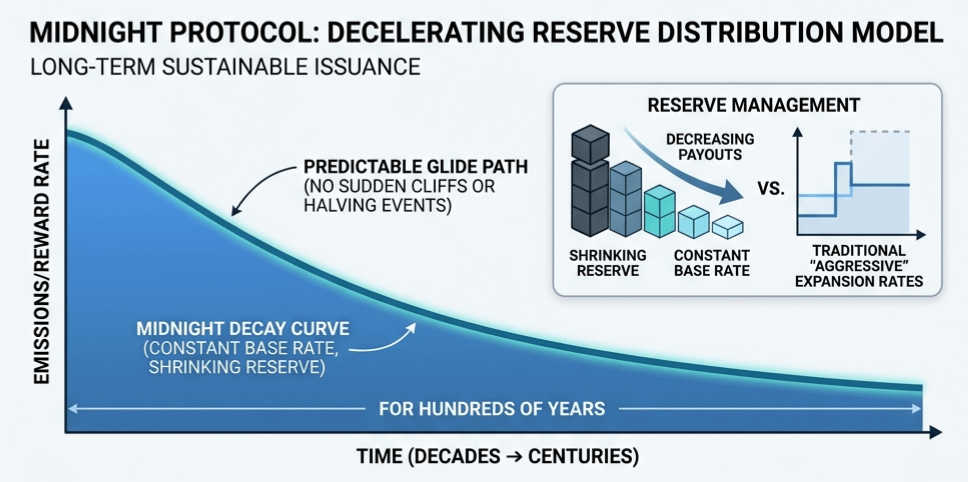
I was sitting in a dimly lit terminal room last week thinking about how most tokenomics models are basically just high-stakes games of musical chairs. We have seen this movie before where a protocol launches with massive fanfare only to have its incentives crater because the founders forgot that math is a cruel mistress. Most chains treat their reserves like a checking account during a midlife crisis but Midnight is attempting something that feels more like a sovereign wealth fund. They have built this dedicated protocol-managed Reserve that dispenses rewards based on a constant base distribution rate. It is a bit of a mathematical trick because while the rate itself stays the same the actual number of tokens hitting the market drops with every single block. As the Reserve shrinks the payouts shrink too creating this incredibly smooth decelerating curve that could theoretically keep the lights on for hundreds of years.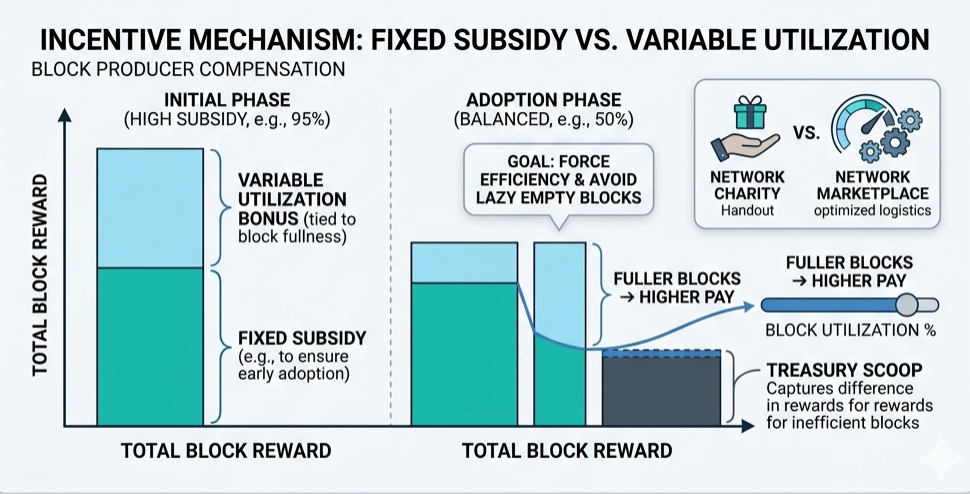
The old guard like Ethereum and Cardano started with expansion rates that were arguably a bit aggressive for the long haul. Midnight is aiming for an initial inflation rate that is much tighter and closer to what a traditional economist would actually call healthy. I find it refreshing that they are being honest about the fact that inflation here just means moving tokens from a vault into the hands of the people actually securing the network. It is a predictable system where any block producer can look at their stake and the remaining Reserve to calculate exactly what is coming their way. There are no sudden cliffs or halving events that send the market into a panic. Instead it is a slow and steady glide path that prioritizes sustainability over the short-term dopamine hits of high-emission farming.
Of course the grand vision of a stable economy always hits the bone-deep reality of human laziness. If you pay people the same amount for an empty block as a full one they will take the path of least resistance every time which is why the base reward is split into a fixed subsidy and a variable component. Right now the protocol is leaning heavily on the subsidy side with a ninety-five percent rate to make sure the early adopters actually show up and stay. But the real genius or perhaps the real gamble is the variable part tied to block utilization. The fuller the block the more the producer gets paid. If you are lazy and ship an empty block the Treasury simply scoops up the difference. It is a clever way to force efficiency in a world where most protocols are content to let their block space go to waste.
We have to be realistic about the friction though because reaching peak adoption takes time and a high subsidy is basically a training wheels phase. Eventually they plan to crank that subsidy down to fifty percent which is where things get spicy. At that point the network stops being a charity for node operators and starts being a marketplace where you actually have to work for your keep. It reminds me of the shift from the early days of the internet where everything was a free-for-all to the modern era of hyper-optimized logistics. You can think of the Midnight Reserve as a massive reservoir of potential energy where the protocol acts as a sophisticated turbine. It is the difference between a waterfall that dries up after a season and a massive dam that provides steady power to a city for generations.