

There was a phase where I paid too much attention to identity narratives.
Anything tied to ownership, verification, self-sovereign identity — it all felt inevitable. If a project could “prove who you are,” it sounded like long-term value by default.
That assumption didn’t hold for long.
Most systems could issue identities. Very few could make them usable. Identity existed, but it didn’t move. It didn’t flow into transactions, agreements, or decisions. It just sat there, disconnected from actual economic activity.
That changed how I evaluate things now.
I don’t look at whether identity can be created. I look at whether it gets used after that point.
That’s where Sign Protocol started to stand out.
Not because it talks about sovereignty. That language is everywhere. But because it focuses on what happens after identity exists. How it travels. How it gets referenced. How it becomes part of something operational.
That question becomes more relevant in places like the Middle East.
Not because of hype, but because of structure. Cross-border coordination. Regulatory layers. Institutional trust. Systems that don’t just need identity, but need to rely on it repeatedly.
That’s a different requirement.
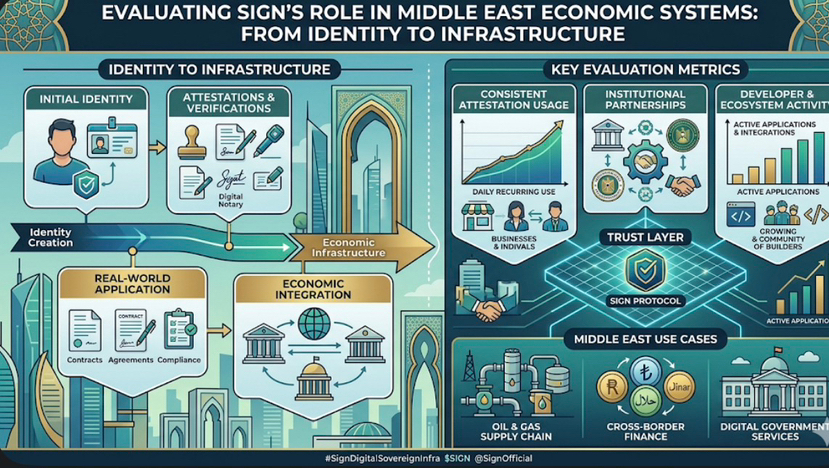
According to its design, Sign Protocol doesn’t treat identity as a static object.
It treats it as something that produces evidence.
Attestations sit at the center of that model. A claim, signed by an issuer, structured through a schema, and made verifiable later. Not just visible, but usable.
A credential becomes more than a label.
An agreement becomes more than a document.
A transaction becomes more than a transfer.
Each one carries context.
A simple way to frame it is this. Instead of storing records in isolated systems, those records become verifiable objects that other applications can read. Not just display, but act on.
That’s where the shift starts.
Not identity as ownership.
Identity as input.
In theory, this creates compounding utility.
The more attestations exist, the more applications can rely on them. The more they are reused, the stronger the system becomes. Not because of volume, but because of dependency.
But that’s also where the risk sits.
Because the system only works if attestations are used repeatedly.
Not issued once.
Not stored passively.
Used.
If developers build around them, if institutions integrate them, if applications depend on them, then the system starts to behave like infrastructure.
If not, it becomes a registry.
Technically correct. Economically quiet.
The market signals reflect that ambiguity.
Positioning is forming, but not resolved. Activity appears in bursts, often around integrations or announcements. Participation is growing, but not yet evenly distributed. It looks like a system being evaluated, not one that has already been absorbed.
That distinction matters.
Because early attention is not the same as embedded usage.
For the Middle East, this becomes more than technical.
Adoption depends on institutions. Financial systems. Regulatory bodies. Enterprises that need verification not occasionally, but continuously.
If those layers don’t integrate, the system remains external.
If they do, it becomes part of the workflow.
That’s the line.
So the question shifts.
Not whether identity can be verified.
But whether that verification becomes part of daily operations.
Who is issuing attestations consistently.
Who is consuming them.
What keeps them engaged when incentives are no longer the driver.
Those are slower signals. Harder to measure. But they define whether something becomes infrastructure or remains optional.
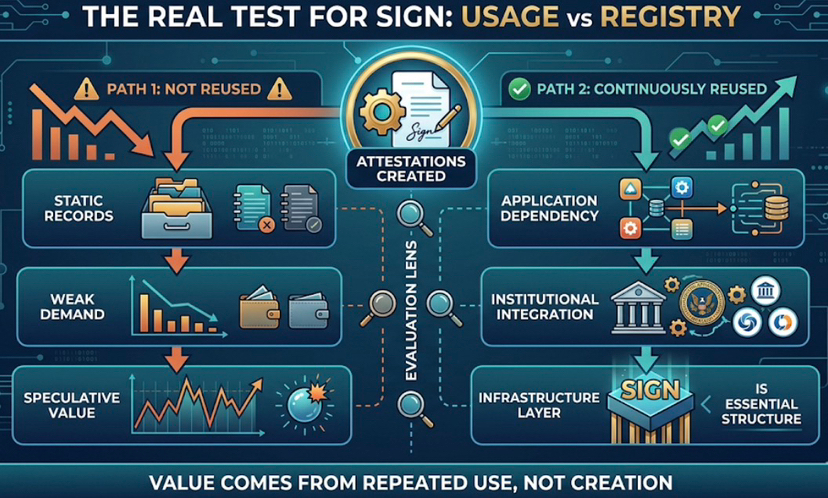
What would increase confidence is not price movement or short-term activity.
It’s continuity.
Attestations being reused across applications.
Developers building systems that depend on them.
Institutions integrating them into actual processes.
That’s when the system starts to matter.
On the other side, event-driven usage, short bursts of activity, or reliance on incentives would suggest something less stable. Something still searching for its place rather than occupying it.
So if you’re watching this space, the signal isn’t in how identity is created.
It’s in whether identity keeps moving.
Because the systems that last are not the ones that define identity.
They are the ones where identity becomes unavoidable.
#SignDigitalSovereignInfra $SIGN @SignOfficial