I’ve had this argument more times than I can count. Someone tells me they’re fully decentralized because they hold their private keys. I nod. Then I ask: how do you prove you held those keys on a specific date? Usually I get a blank stare. Or they point to a block explorer. But that’s not proof—that’s just a record that exists on someone else’s interface. If that explorer goes down or decides to filter data, what then?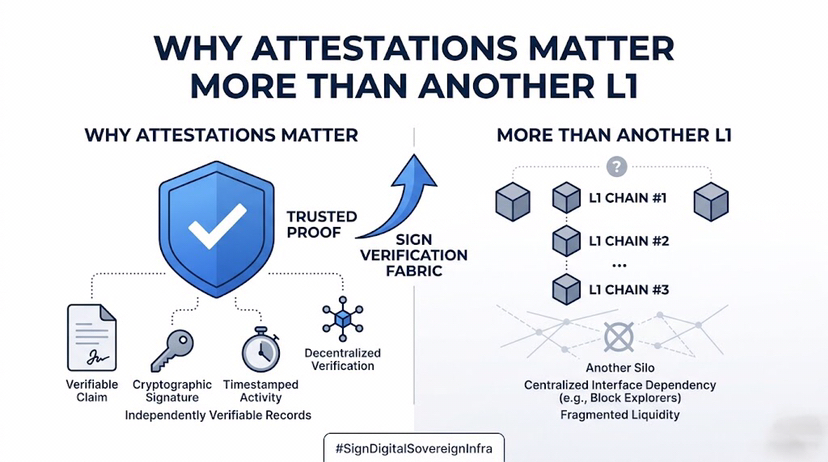
That’s where I started paying attention to Sign. Not because of the token price—I honestly didn’t check that for the first few weeks. I was more interested in the question they’re trying to answer: how do you assert truth about digital activity without handing that power to a third party?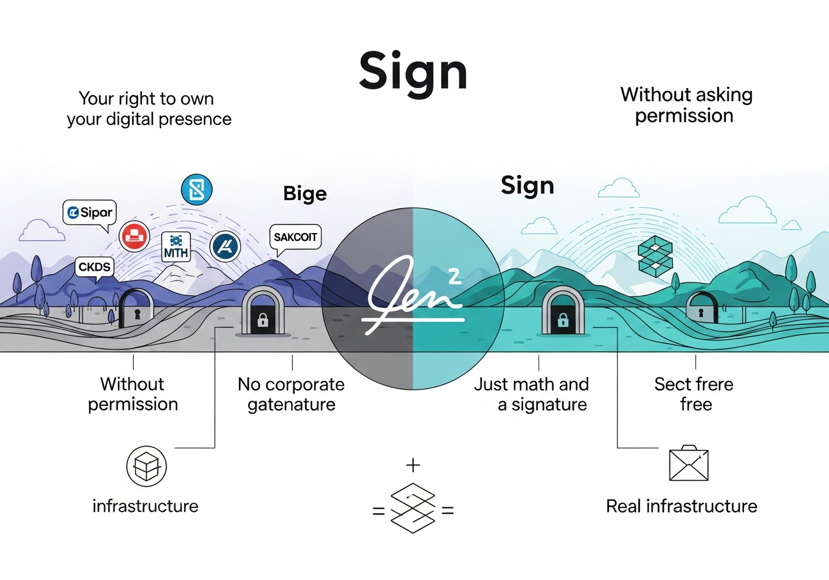
The project account @undefined doesn’t post like a typical crypto marketing machine. There’s no countdown to a “game-changing announcement.” They post about attestations, about signature schemes, about the difference between claiming something and proving something. That dry stuff is exactly what caught me. When people stop trying to hype and start talking about mechanisms, I listen.
The Data We Don’t Own
We keep saying “be your own bank.” Fine. But a bank doesn’t just hold money—it provides statements. It provides records that institutions accept. In crypto, we have the first part (custody) but the second part (provable records) is a mess. If you need to show a lender, an auditor, or a court that you owned a certain asset on a certain date, your options are either a centralized API or a messy screenshot that anyone could fake.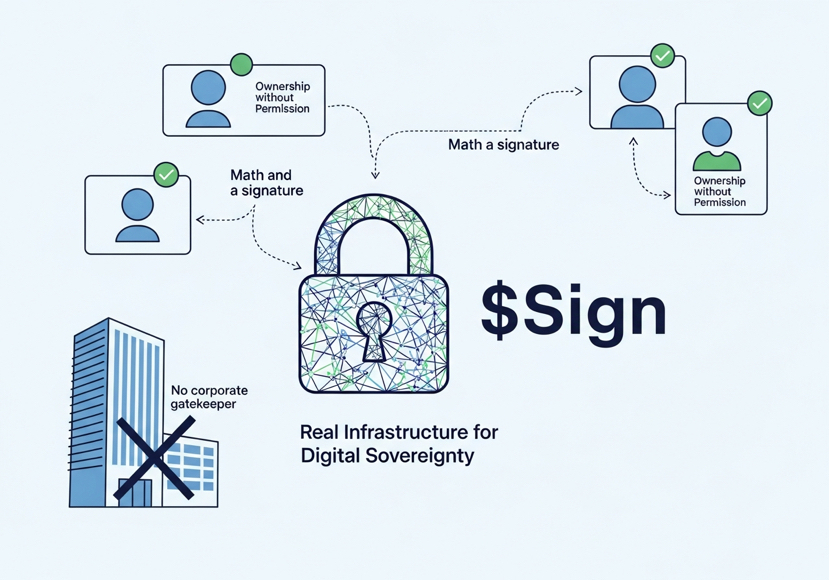
$Sign is trying to become the layer that fixes that. It’s not a blockchain itself—it’s more like a verification fabric that sits on top of existing chains. You make a claim, you sign it, the network attests to it, and that attestation lives forever in a way that’s independently verifiable. No central gatekeeper. No dashboard that can be altered after the fact.
I started using their testnet a while back. Not because I was looking for a profit play, but because I wanted to see if the UX matched the theory. It’s still rough around the edges—I’ll be honest. You have to think in terms of schemas and attestation flows. But that roughness tells me something: they’re building for builders first, not for speculators.
The Shift That’s Already Happening
We’re seeing a quiet migration in crypto. The retail hype cycles are getting shorter. The people who survive are the ones who figure out utility. Not “utility” as in staking to earn more tokens, but utility as in “I can’t operate my business without this.”
I’ve talked to a few founders building compliance tooling for institutional DeFi. Every single one of them mentioned the same headache: proving transaction histories without relying on a centralized indexer. That’s a massive attack surface. If your compliance system trusts a single API, that API becomes a point of failure—or worse, a point of control.
Sign removes that. You submit an attestation using $Sign, and suddenly the proof isn’t tied to any one company’s database. It’s on the network, signed by a decentralized set of validators. That changes the dynamic entirely. Instead of asking “do you trust this explorer?” you ask “do you trust the cryptographic signature?” The second question is easier to answer.
Why I’m Not Using the Usual Language
I refuse to call this a “gem.” I’m not here to tell you about a “moonshot.” I’ve been around long enough to know that those words are usually a prelude to a bag dump. If I’m writing about something, it’s because I think the problem they’re solving is under-discussed, not because I want to move price.
The hashtag #SignDigitalSovereignInfra gets thrown around in their updates. At first I rolled my eyes—everything is “sovereign” now. But after digging in, I get why they use it. Digital sovereignty isn’t just about not being censored. It’s about being able to prove your claims in any context, regardless of what platforms or governments do. That’s infrastructure. Boring, essential infrastructure.
Most of crypto is still playing with the top layer—applications, games, meme tokens. That’s fine; that’s where the attention is. But the bottom layers, the ones that make those applications trustworthy, have been neglected. We have dozens of L1s fighting for liquidity, but we have maybe two or three projects genuinely working on attestation infrastructure at scale. Sign is one of them.
The Token Aspect
I hold $Sign. I bought it after using the testnet for a couple weeks, because I wanted to have skin in the game while watching development. It’s not a large bag—I’m not a whale. But I treat it the same way I treat my positions in other infrastructure projects: if they solve a real bottleneck, the token economics will work themselves out over time.
What I like about the token model is it’s not forced. You don’t need $Sign to look at attestations, but you do need it to create them, to validate them, to participate in the network’s security. That creates a natural market. If the network actually gets used, the token gets used. Simple.
What I’m Watching?
I’m watching integrations. @SignOfficial recently started talking about partnerships with cross-chain messaging protocols and some data availability layers. That’s the right move. Attestations don’t make sense in isolation—they need to plug into the existing stack. If you can verify a message from one chain to another and have that verification be trustless, suddenly a lot of cross-chain applications become safer.
I’m also watching how they handle schema governance. One of the unsolved problems in attestation is: who defines what a valid claim looks like? If it’s too rigid, nobody uses it. If it’s too loose, the attestations lose meaning. Sign has a governance model that tries to balance that. I don’t know if they’ve nailed it yet, but I respect that they’re trying.
No Story, Just Thoughts
I didn’t want to tell a story in this piece—no personal narrative about how I discovered the project at 3am while doomscrolling. I think that style is overdone and usually fabricated. Instead I’ll just say this: if you’re tired of the endless cycle of hype and you actually care about the infrastructure that makes crypto work in the real world, spend some time with Sign.
Read their docs. Try the testnet if you have patience for things that aren’t polished yet. Follow the discussions in their community. You’ll notice quickly that the conversation is different. People aren’t asking “wen moon.” They’re asking “how do we model this attestation schema?” and “what’s the best way to revoke a compromised key?”
That’s the sign of a healthy project. Not hype, but builders asking builder questions.
I’ll keep using $SIGN for what I do—mostly for timestamping my own development work and for experimenting with verifiable claims. It’s not glamorous work. But it’s the kind of work that, five years from now, we’ll look back and realize was the actual foundation.
#SignDigitalSovereignInfra

Artigo
Why Attestations Matter More Than Another L1 Sign
Aviso Legal: inclui opiniões de terceiros. Não se trata de aconselhamento financeiro. Poderá incluir conteúdos patrocinados. Consulta os Termos e Condições.
0
15
195
Fica a saber as últimas notícias sobre criptomoedas
⚡️ Participa nas mais recentes discussões sobre criptomoedas
💬 Interage com os teus criadores preferidos
👍 Desfruta de conteúdos que sejam do teu interesse
E-mail/Número de telefone